Category: News

General News items

  • Wildlife Warden June Newsletter

    Wildlife Warden June Newsletter

    This month’s Newsletter covers a lot of ground, literally, with wardens and opthers venturing out as summer begins. Topics covered include:

    The Local Plan.

    Training sessions.

    Project visits.

    Ogwild’s Rectory Field open afternoon.

    Wild about Devon.

    Devon Rewilding Network.

    Here’s the full newsletter

  • XR Protests at the G7

    XR Protests at the G7

    When you think about an Extinction Rebellion (XR) activist, you probably don’t think of someone like me, writes Amanda Cole. A 68 year old grandmother, with a 44 year history of NHS work in a responsible and respected position. But I attended the protests at the recent G7 meeting in St Ives and joined hundreds of other people rebelling against the failure of governments to act on the dual climate and ecological emergencies.

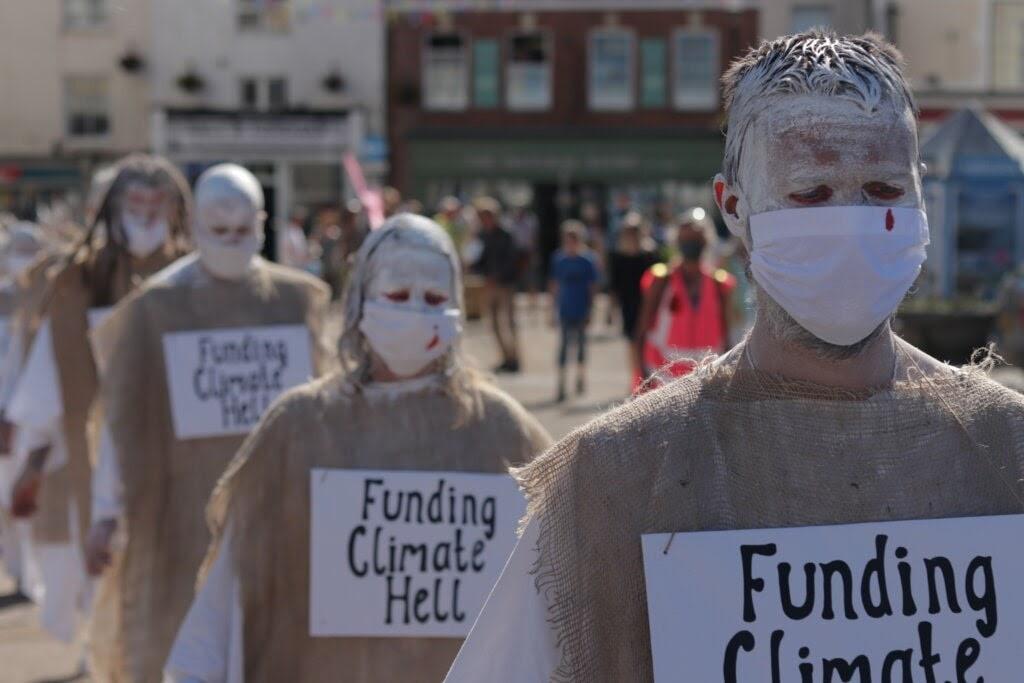
    100 Penitents carry the sins of the G7 through Cornwall. Photo: Tristian Herbert

    A sixth mass extinction of wildlife is already underway. Studies show a 60% decline in wildlife populations since 1980, while the world’s natural ecosystems have lost about half their area, all largely due to human action. Climate change is already affecting our weather, bringing more frequent floods and heatwaves. If we don’t allow ecosystems to recover and expand, as well as massively reduce our carbon emissions, it will all get worse. Other parts of the world with more vulnerable communities are suffering these effects more acutely than Britain is right now. 

    Attending the XR events at the G7, a meeting of the Group of Seven richest nations, was a great experience in many ways. The protests were creative, inspiring, sometimes sombre, and sometimes fun. There was lots of media coverage; it was great to engage with the public and the police. The reception in my experience was pretty much 100% friendly. There was one woman muttering at a bus stop, but I didn’t catch what she said. There were no Rebel arrests. But of course we were securely separated from the official goings-on in Carbis Bay, so I’m not sure how much we were listened to. The government resolution to pledge a £500m Blue Planet Fund for marine conservation had already been announced last year. About US$2bn is to be provided to help countries worldwide to phase out coal-fired power generation. This may not even be new money. The summit failed to set us up for a successful COP26, the UN climate talks to be held in Glasgow in November, as trust is sorely lacking between rich and developing countries. Overall, these outcomes were more than disappointing. 

    So yes, you are right; I am not a typical Rebel. Extinction Rebellion members do come from a particular demographic in the main. But with the richest nations in the world failing to provide leadership and finance to tackle the climate crisis, it falls to each and every one of us to make the changes we feel able to make.

    People sometimes think individuals cannot make a difference, but that is wrong. Look at how the British public responded to the challenges the pandemic brought. We were far more responsive and able to change than the government, and even the scientists predicted. And there is some evidence that if you feel good about making a little change, you will go on to make another. What is vital is to choose something you want to do, and are able to do. I would never ask my beef farmer friend to give up meat or suggest my friends on benefits buy expensive eco-products. But we can all start reusing plastic, sorting our recycled waste, and picking up litter, for example. We can all do something. 

    I was heartened at the end of the visit to St Ives to hear the speaker at the closing ceremony for the XR events say: “Some people say we’re preaching to the converted in XR. Well let’s make it our pledge before COP26 to talk to people outside this group. Ask what they think. Find out what makes them sceptical or hesitant. See if you can help.” 

    So that’s what I’m doing. Let’s all take some climate action today and build towards a happier and healthier future.

  • Update on the CEE Bill

    Update on the CEE Bill

    Following our piece in the May Newsletter on the Climate and Ecological Emergency Bill, the CEE Bill Alliance has drafted a second (‘summary’) version of the bill, The Climate and Ecology Bill No. 2

    This strengthened and condensed version of the CEE Bill is designed to present a clearer proposal, be easier to understand, function as a more effective campaign tool and amend certain sections of the first Bill in response to feedback.

    Under the new bill the government will be required to:

    Calculate and plan to reduce the UK’s entire carbon footprint: At the moment the UK only accounts for its “territorial” emissions, ie those we emit locally, ignoring those included in the goods and services we buy in from abroad and our fair share of international aviation and shipping. Including these emissions provides a fairer “consumption” basis for our emissions but, being one of the world’s highest net importers of emissions, nearly doubles the emissions for which we are responsible.

    In accordance with the stricter targets of the Paris Agreement, issued in 2018, increase the chance of the UK meeting its emissions targets using equitable policies: The UK’s current net zero target is based on a greater than 50% chance of limiting global heating to a 1.5°C rise in temperature. To be fair to future generations, this needs to increase to 66%. In consideration of the UK’s historic emissions and its capabilities as a developed nation it needs to account for a proportionately smaller share of the global carbon budget, reduce emissions at a faster rate than developing countries and provide support for them to do so.

    Adhere to national carbon budgets set each year, not every five years.

    Reduce the UK’s greenhouse gas emissions primarily by stopping emissions caused by human activity, whilst also ending the extraction, export and import of fossil fuels: Little discussed even 10 years ago, the UK and most developed countries are assuming that, in the decades ahead, technologies will be available to remove vast quantities of carbon dioxide from high emitting sources, such as power stations, or even to remove it directly from the air, and then safely store it underground. Reliance on such speculative and unproven at scale technologies not only fosters delay in dealing with emissions but also passes the problem to future generations. Consequently the bill requires the emphasis to be on actually reducing emissions, rather than removing them once they are made.

    Follow a strict nature target to ensure that it reverses the decline in the state of nature no later than 2030: The state of nature is defined as the abundance and distribution of plant and animal species; risk of extinction; extent and condition of priority habitats; and health and enrichment of ecosystems.

    Actively conserve and restore nature: Focussing both on biodiversity and soils’ protection, restoring natural carbon sinks, such as in the conservation of woodlands, and restoring peat bogs all of which act as a natural reservoir for carbon and to keep it out of the atmosphere;

    Take responsibility for its entire ecological footprint: This means preventing adverse impacts on ecosystems and human health caused by consumption, trade and production, in the UK and internationally, including the extraction of raw materials, deforestation, land degradation, pollution and waste.

    Create “Citizens Assemblies”: Being representative of the UK population, to work directly with the Climate Change Committee and the Joint Nature Conservation Committee, before the strategies are laid before Parliament.

    Full details of the Bill, its supporters and ways in which you can lobby your MP, are on The CEE Bill Alliance’s website.

  • Six Months to COP26

    Six Months to COP26

    In the lead up to COP26 debates are intensifying over some key issues, some of which have rumbled on for over a decade, passing through and beyond COP21 in Paris more than five years ago.

    Explored in part in our website post Know your Net Zero from your NETs and BECCS, there is growing tension between two groups. In one are those who promote the importance of doing all we can today to reduce emissions and decarbonise the economy, thus keeping us from exceeding carbon budgets. In the other are those who believe we can rely on current and future technologies to provide both cleaner and more efficient energy and remove, use or store carbon in the decades ahead.

    At the heart of the latter approach is a belief that we can, and should, live our lives relatively unchanged, taking up new technology like electric cars and relying on the markets and technological innovation to provide sufficient clean energy and cope with other mitigation paths.

    Those who follow the former approach, however, worry that with carbon budgets and related emission reduction pathways only giving us perhaps a 50:50 chance of keeping the temperature increase to 1.5℃, we should concentrate on reducing demand and consumption today and using technologies available today, which will not only accelerate emission reductions but will also give cleaner energy (such as wind and solar) a better chance of catching up with current demand and that from newly electrified areas such as transport. The changes in lifestyle necessary for this route are seen by some as unnecessary sacrifices and by others as common sense.

    What clouds the issue is that many fossil fuel companies are promoting the technological route, raising the suspicion that they do so because it delays the inevitable demise of their industries and, in say the case of gas, prolongs its use for the production of hydrogen.

    There are other related and intertwined considerations within these debates:

    Equity – All official emission reduction pathways, from the Paris Agreement to the recent International Energy Agency report, call for fairness in tackling climate change. To recognise historic emissions this calls for developed countries – the “Global North” – to take a proportionately smaller cut of the remaining carbon budget than the poorer countries – the “Global South” – and also requires the Global North to reduce emissions faster than, and to provide support to, the Global South. It also extends to reducing the burden we place on future generations in mitigating climate change.

    The few – Following the above, it’s been the case for many years that the richest 10% of the global population are responsible for perhaps 50% of global emissions and that if they reduced their emissions to say the level of the average European, global emissions would immediately drop by 30%, with everyone else doing nothing. This brings the national and global debate above to a personal level.

    Triaging solutions – As technologies develop there will be several areas in which they can be used. For example, as Hydrogen production is developed there is a choice between its use in heating, transport, steel or even as energy storage, in place of batteries. Decisions will have to be made as to where the most benefit (environmental rather than economic) can be gained from its use. Similarly with biofuels,

    Economic Growth – The same pathways also assume continued economic growth of typically 2-3% pa, perhaps doubling economies in the next thirty years. Whilst some countries, like the UK, have managed to achieve growth, whilst reducing emissions, this is partly as a result of a shift away from manufacturing to service industries thus, effectively, exporting their emissions to other countries. Globally therefore the graph of increasing emissions follows very closely the graph of economic growth and there remains little evidence that the two can be “decoupled” any time soon. Consequently many are now promoting ways to reduce or even reverse growth or to disregard it altogether in favour of more human and nature-based measures of Wellbeing.

    Carbon financials – there are a plethora of money led incentives and penalties designed to decarbonise our economies, from carbon trading to taxation. One that is gaining favour is known as “Carbon Fee & Dividend” which imposes a tax at the point of production or import of fossil fuels which is then distributed to the population of the country consuming the fuel as a dividend on a per capita basis. The tax will add to the cost of the fuel in the consumer’s hand and so consumers who use the least will gain the most when they receive their share of the dividend and the highest users will suffer the most in a net cost.

    Further reading and watching to get you in the mood:

    Dr. Hugh Hunt & Professor Kevin Anderson discussing Climate Change realities at COP21 Paris (30 minute video)
    An entertaining and easy to follow chat in December 2015, by a couple of scientists following the COP picking out on the key points above.

    John Kerry: US climate envoy criticised for optimism on clean tech
    Reaction to the interview with Andrew Marr and the quote “I’m told by scientists that 50% of the reductions we have to make (to get to near zero emissions) by 2050 or 2045 are going to come from technologies we don’t yet have.”

    Climate scientists: concept of net zero is a dangerous trap
    Three scientists speaking out against the increasing reliance on Net Zero.

    In defence of net zero
    The editor of Business Green responding to the doubts over Net Zero

    Sir David Attenborough Presents: Breaking Boundaries (10 min video)
    Discussing the potential for humanity to destabilise planetary systems.

    No new oil, gas or coal development if world is to reach net zero by 2050, says world energy body
    A Guardian article on the recent International Energy Agency Report on the 2050 Net Zero roadmap for the energy sector.

  • Wildlife Warden March newsletter

    Spring is here! The emergence of life after the long dreary winter months is what makes this my favourite time of the year. It is always uplifting to see the first celandine flowers emerge, followed closely by pollinators, such as the early bumblebee. Soon, the swallows, swifts and house martins will be returning. 

    The picture at the top is a patch of wood anemone growing beside the River Lemon. A group of up to 100 flowering stems could come from a single plant! Wood anemones, along with a number of other species, including bluebells, wild garlic and primroses, are indicators of ancient woodland. You can find useful information about ancient woodland on the Woodland Trust website.

    Funding
    We are very fortunate to have been awarded £7,500 in funding from the Devon Environment Foundation (who awarded us £5,000 a few months ago). This means that ACT is able to contract the coordinator (Flavio) for 20 hours per week instead of 9.5 hours.

    Thank you to all of our funders: Devon Environment Foundation, the Nineveh Trust, Cllr Jackie Hook’s Locality Fund, Dartmoor National Park Authority and Teign Energy Communities Community Fund.

    Training sessions
    Now that the covid situation is improving, we are starting to offer training, in person, to small groups of Wildlife Wardens. The first two Wildflower Identification Sessions were held in Woodland at Deer Park Farm. I (Flavio) was fortunate to attend one of these and learnt about various fascinating plants, including toothwort (Lathraea squamaria), which is a parasite of hazel and is nationally scarce.

    We plan to offer training in other areas, including aquatic invertebrate ID, planning and development, species and habitat surveys and leading volunteer groups. 

    Audrey has been busy writing lots of training documents, which can be found on our website Projects and training – ACT Wildlife Wardens (actionclimateteignbridge.org)

    Read the full newsletter

  • Wildlife Warden February Newsletter

    Thanks to all wardens for the hard work you have put into the scheme during these difficult times. The scheme is constantly growing and moving in the right direction. We have created a subdomain on the ACT website for the Wildlife Warden Scheme. It is still in development, but it already contains lots of useful information: 

    The picture at the top is my most recent wildlife sighting – a barnacle-looking gall found on bramble. It may not be the most beautiful sighting, but I found it fascinating. I believe they were created by Diastrophus rubi, which is a small parasitoid wasp. A gall can contain up to 200 larvae, each in an individual cell.

    We have been finding out a lot about seagrass (eelgrass) habitats. There are two species of seagrass (Zostera noltei and Z.marina), which provide an important habitat for a wide range of species, and help to stabilise the seabed, clean surrounding seawater and absorb vast quantities of CO2.

    Unfortunately, seagrass is critically endangered. It is threatened by high nutrient levels (mainly from fertilisers and animal waste), damage from anchors and propellers, disease, and destructive fishing practices. There is anecdotal evidence that seagrass probably existed in the Teign Estuary prior to the 1990s, but it is no longer present. Seagrass in the Exe Estuary has expanded in recent years and can be found near Dawlish Warren, Exmouth and Lympstone.

    Read more here

  • Teignbridge progress with the climate and ecological emergency

    Cllr. Jackie Hook, executive member for Climate Change, Flooding and Coastal Defence reported to Teignbridge District Council’s (TDC) Overview and Scrutiny Committee on 9th February 2021.

    Here is a video clip of her report

    She reported on TDC’s work on Climate change and the Ecological Emergency:

    • TDC appointed William Elliot in February 2020 as Climate Change Officer
    • TDC has met regularly with ACT to discuss direction and progress on the climate and ecological agenda.
    • In October 2019 policy S7 of the current local plan was amended to uplift the carbon reduction by 2030 from 42% to 48%. The carbon calculator has been updated to only consider building emissions.
    • A new draft local plan for 2020 – 2040 has been published including a whole chapter on climate change and went to consultation March to July 2020.
    • University of Exeter is developing a low carbon strategy to determine where and how renewable energy generation and low carbon development should feature in the district, and will feature in Part 2 of the local plan.
    • South West Exeter District Heating Network will supply low-carbon heat to 2,500 new homes, using waste energy from Matford.
    • Electric Vehicle charging infrastructure and Ultra Low Emission Vehicles policy
    • Rapid EV Chargers in Chudleigh and Buckfastleigh as part of Highways England Scheme.
    • Authority participating in DELETTI and will install double rapid EV chargers in four of Teignbridge’s AQMAs.
    • Shortlist of 12 sites selected in collaboration with parish councils for On-street Residential Charging Scheme (ORSCS) in car parks.
    • Draft local plan requires installation of EV chargers in new development.
    • Joint bid submitted under the Cosy Devon partnership to delivery energy efficiency improvements for low-income households. A further bid for £1.14M has been submitted to deliver authority led improvements.
    • The Authority has participated in the Solar Together scheme. 917 solar PV and 153 battery storage systems are proposed as part of the scheme across Devon.
    • Low-carbon social housing projects include Drake Road, East Street and Sherbourne House. These will achieve high carbon and energy standard and feature Air Source Heat Pumps and EV charging points.
    • William Elliot has been measuring the authority’s own carbon footprint, annually Scope 1 & 2 emissions are 2Mt CO2 and Scope 3 emissions 6.7Mt
    • The Authority is currently working on a Carbon Action Plan to identify a cost and carbon efficient pathway to becoming carbon neutral, which will cover about 40 projects across 15 buildings owned by the authority. A budget of £E3.6M over 2021-2024 has been allocated, and a grant application for £3.1M has been submitted covering seven sites, which could deliver a combined reduction of 400 tonnes of CO2/yr. A full report will be submitted to Executive Council in April 2021.
    • TDC is a signatory of the Devon Climate Emergency and is supporting the Devon Carbon Plan, the consultation on the interim plan has just ended, following a Citizen’s Assembly the final Devon Carbon Plan is due for adoption by Local Authorities in summer 2021.
    • Following the declaration of an Ecological emergency in September 2020, plans are in hand to plant 1,500 trees in Q1 2021 in partnership with the Woodland Trust and Idverde. A tree strategy is progressing and a draft will be available for consultation in Q1 2021. The Authority has committted £5,000 to Devon Wildlife Trust to support a habitat mapping exercise.
    • It was reported that ACT’s Wildlife Warden Scheme has received 75 applications and has trained 50 wardens to date.