Category: News

General News items

  • ACT: three years and counting!

    ACT: three years and counting!

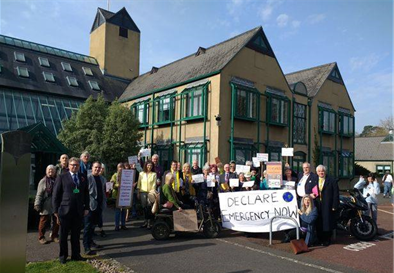
    On April 18th 2019, Audrey Compton was standing outside Forde House, the home of Teignbridge District Council (TDC), with a group of people holding banners. They were there to lobby the council to pass the climate emergency declaration proposal put forward by Councillor Jackie Hook. 

    “We really didn’t think it would pass, but it did, unanimously, and with an amended carbon neutral target date of 2025, which was quite a surprise,” says Audrey, a Teign Valley farmer and environmental campaigner.

    That target date was the most ambitious in the country, says Fuad Al-Tawil who was also at Forde House that day. “We thought it would be tough for the council to meet that target so suggested setting up a support group.”

    The suggestion was welcomed, and Action on Climate in Teignbridge (ACT) was formed in the summer of 2019 following a public meeting in July at Coombeshead Academy in Newton Abbot attended by about 200 people. 

    Fuad says: “The idea was to support TDC to deliver on its climate emergency declaration and to work with community organisations in Teignbridge, including parish and town councils, as a bridge between them and TDC.”

    New ways of working

    A voluntary organisation working with a district council was a novel idea – unique even. Fast forward three years and how has that worked out? Well, the monthly meetings still happen and ACT has given freely of its expertise and opinions, which appear to be valued. It has at times offered a critical voice, and remains completely independent of the council. “We have built a good and pretty unusual relationship with the council,” says Fuad.

    Kate Benham, ACT chairperson, says it has been a learning curve for both parties. “The council moves slowly, which can be frustrating, but it’s a case of understanding what it can and can’t do.”
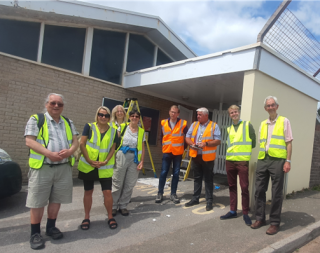
    ACT members join Councillor Jackie Hook and council officer Will Easton to view work on renewable energy projects at the Teignmouth Lido in July 2022
     

    Andrew Shadrake, a founding member of ACT, believes ACT has kept the pressure on the council: “Things have happened that wouldn’t have happened without us. We offer a resource, particularly on technical knowledge, that TDC relies on.”

    However, the reality remains that carbon emissions have barely budged. Says Fuad: “ACT has  succeeded in doing what we set out to do, in terms of supporting the district council and engaging the community. But in delivering on what matters, carbon reduction, we haven’t succeeded.”

    Action on nature and carbon

    ACT has had success on the ecological front, in particular with its Wildlife Wardens scheme, launched in the autumn of 2020. There are now 100 volunteer wardens spread across Teignbridge who have received training and do what they can to help wildlife in their parish.
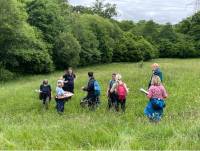
    Wildlife Wardens being trained to complete surveys by the Devon Biodiversity Records Centre
     

    “It’s been twice as successful as I ever hoped,” says Audrey, who set up the scheme and runs it with Flavio Winkler-Ford, a part-time paid coordinator.

    “The great thing is wardens follow their own interests rather than ACT telling them what to do,” she adds. 

    Spurred by the success of wildlife wardens, in early 2022 ACT launched the Carbon Cutters initiative in a renewed effort to move the dial on carbon emissions. Trying to achieve this through engaging with local councils has proved tough. ACT will continue to work with councils, but will concentrate on engaging with community groups for the Carbon Cutters scheme.

    “We are working with around 13 groups so far,” says Kate. “They are hugely enthusiastic and really want to help.” The scheme is run by part-time paid coordinator Peta Howell, with the help of a group of ACT members.

    Still going strong
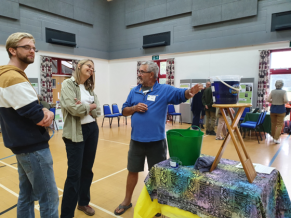
    Demonstrating the global carbon budget at the Energy Roadshow in September 2022
     

    Three years since launch, ACT still has a core group of enthusiastic, ambitious and committed people, and a wider membership of close to 450. That’s an achievement in itself, says Andrew.

    Moreover, with Wildlife Wardens, and now Carbon Cutters, “we have tested and succeeded in developing a model for people to take action. We have also demonstrated a way of moving a district along, and raised the profile of climate change in the community.”

    Flexibility is a key strength. “We are an evolving organisation that is learning all the time,” says Kate. “It’s good that we’re not afraid to change direction if we need to and try new things.” Mandy Cole, a psychologist who volunteers with ACT says it’s also important that “we don’t tell people what to do. We listen and learn more about what would help them to do more about climate change.”

    There is also the personal reward for ACT members that comes with taking positive action, working with like-minded people and just having fun. For Audrey, “the last three years with ACT have been the most productive of 20 years of campaigning on climate change”.  
  • The day the well ran dry

    The day the well ran dry

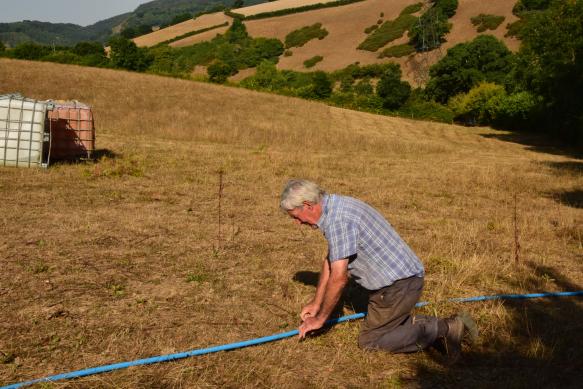
    On Wednesday 20th July our water stopped running: after providing our farm with running water for 36 years our well was dry. For us this was serious and scary. We were already being careful with our water use as it has been dry since the New Year. But then, suddenly, the only source of water for our home, our garden, our livestock buildings and half of our fields has run out.

    John Whetman, Audrey’s husband, setting up an emergency water supply.

    We farm on the drier, eastern edge of Dartmoor, not far from the beautiful River Teign. We keep around 30 cattle and 20 sheep who graze our flower-rich pastures, making sure they are full of insects, spiders and birds. We have a garden full of vegetables and fruit that feed us right through the year. We farm with nature, not against it; we don’t use fossil-fuel based fertilisers or sprays and we heat our house using wood cut from our hedges when we ‘lay’ them. We are trying hard to minimise our effect on the planet – but our well is dry.

    For many years we have known that our climate is changing and becoming more erratic, so six years ago we spent £2,000 on reserve water tanks, which we fill up with winter and springtime water. But we only have 10,000 litres, so we had to act fast!

    The first thing we had to do was to move our cattle to the far side of the farm, where they can drink from the brook, or to our furthest fields, where there are mains water troughs. The cattle have now eaten the remaining dried-up grass in our far fields and we are feeding them our winter hay. It is going to be a long hot start to the winter! Thank goodness we have small fields and big bushy hedges that give our animals some shade throughout the day!

    In the garden, anything that isn’t essential has been left to its own devices. In the house we minimise water use, but every evening we soak our tired bodies in a few inches of (shared) hot water. When we have finished, I add some eco-detergent and the dirty washing for a bit of a scrub and a good soak. In the morning we drain the laundry on a clothes horse propped across the bath before putting it out on the washing line to drip-dry. The rest of the bath water is used to flush the loo or water plants. Across the world millions of people live with very limited water, but many people in the UK turn on the tap and don’t even think about how it got there.

    Why has our well dried up? We’ve only had 22cms of rain this year (less than 1 inches). In July we had less than 0.5cm. We’ve also had higher temperatures than we have ever experienced before. So climate change is definitely a big factor, but it is more complex than that. People use more water each day than they used to, and there are more people too! To satisfy the demand, water companies are extracting extra water from rivers and reservoirs. As a result, our natural underground water levels are falling, and in the summer the water is below well-level.

    So, what next? It will probably be months before our well runs again, and we are fortunate that our neighbours have invited us to plumb into their supply until the situation improves. We have bought 250 metres of pipe to bring the water down to the farm and now we can start to be just a little less miserly with our water. So, we will get through, but this scorching summer has given us a lot of gruelling, extra work!

  • Economic growth measure fails on green front

    Economic growth measure fails on green front

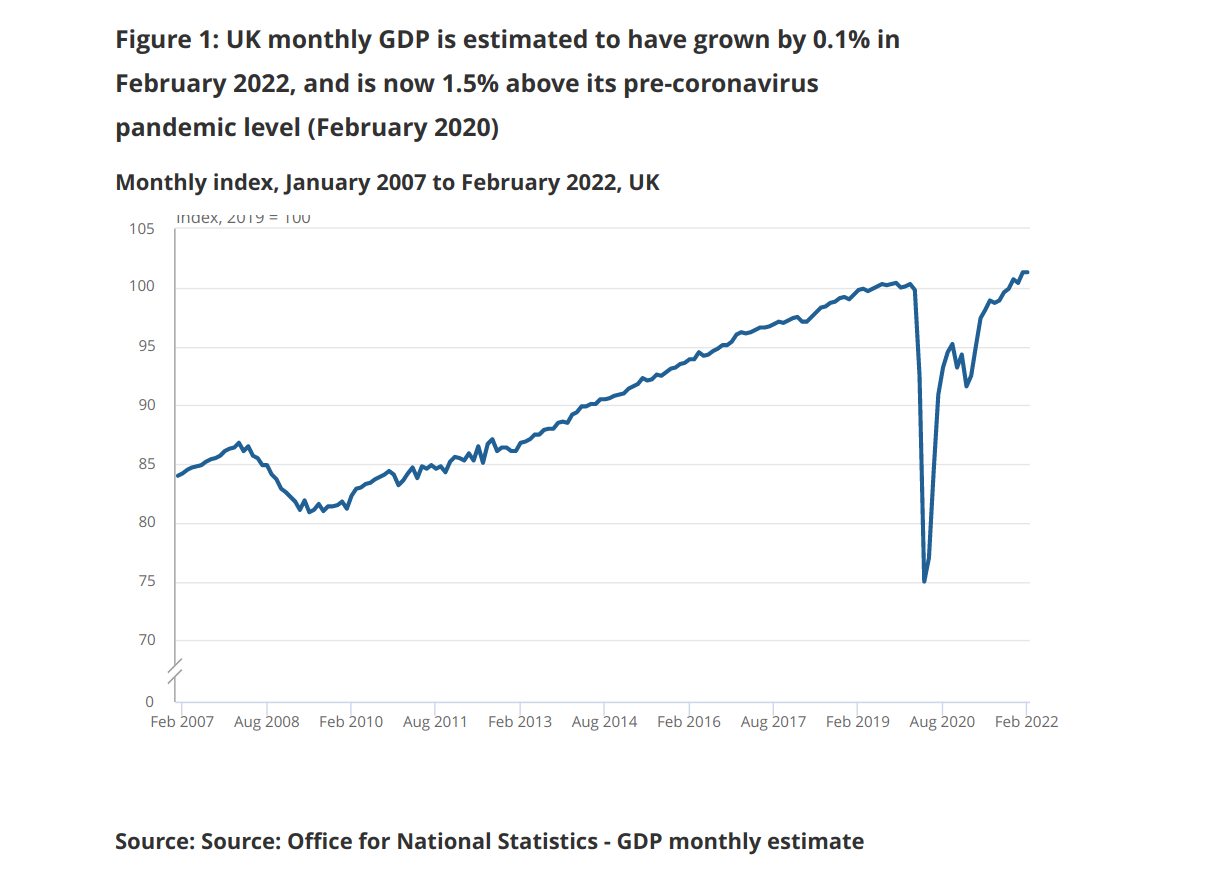
    The UK economy shrank by 9% in 2020 but bounced back in 2021, growing by 7.5%. This year, it is expected to grow by 3.6%. These numbers matter a lot to the government, but there is increasing debate about how relevant they are to setting economic policies to tackle the climate and ecological emergencies.

    That’s because our national prosperity is measured purely by the rise or fall in the market value of all the goods and services we produce (known as gross domestic product, or GDP). There is no consideration of anything that can’t be measured in price terms, including environmental and social matters. And that is a problem, according to climate focused economists called on to give evidence to the government’s Environmental Audit Committee earlier this year.

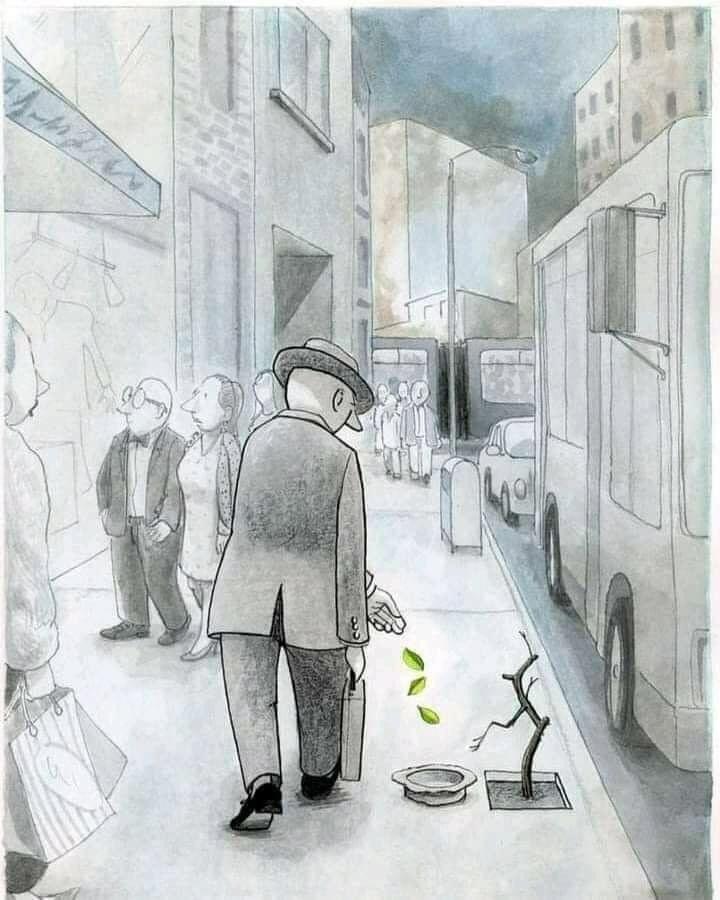
    For example, the value of planting trees will only be measured if and when those trees are cut down and sold as timber. They are not valued for the shade they provide, the carbon they sequester, or the habitats they offer to wildlife. Even more perversely, the likelihood of more severe storms, floods, heatwaves and wildfires due to climate change will be good for economic growth because cleaning up after such events will add to GDP. There is no accounting for the loss of life, livelihoods, housing or infrastructure.  

    Similarly, GDP, which was developed as a measuring tool in the 1930s, ignores both the environmental damage caused by extracting fossil fuels and the pollution and greenhouse gas emissions caused by burning them. And what doesn’t get measured doesn’t get managed, as the well-known saying goes.

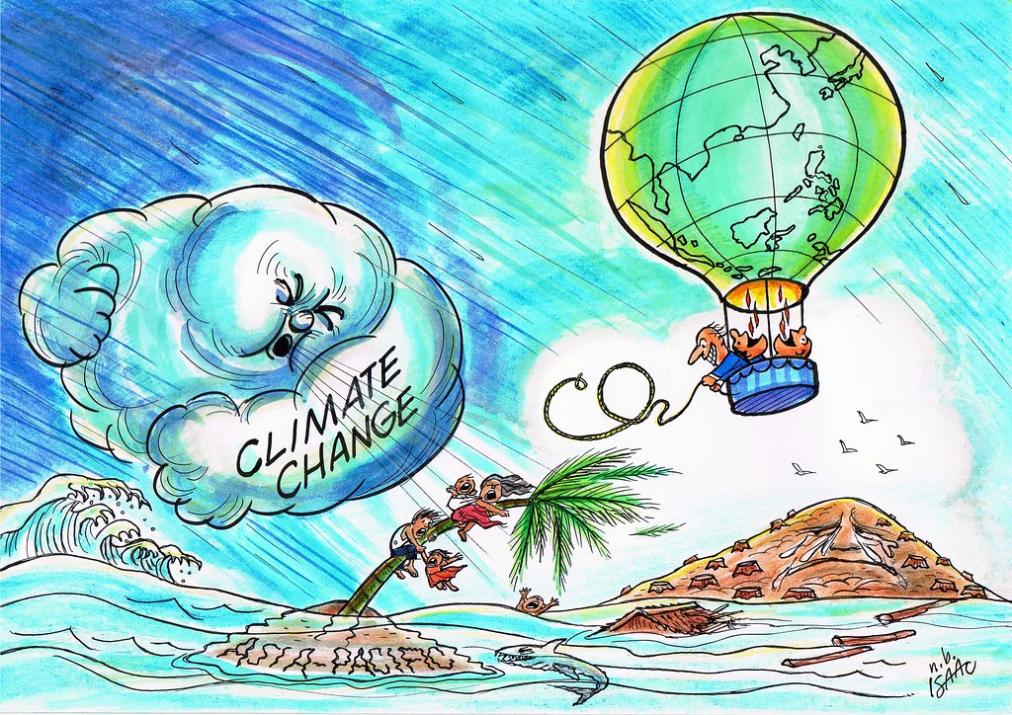
    Another critical aspect in tackling climate change is that of equity. Richer nations have caused the problem while poorer nations not only suffer most from the effects but are also less able to adapt. This is recognised in environmental treaties, with richer nations committing to help poorer ones develop and cope with adaptation. 

    GDP also ignores distributional issues. This is most obvious when the government celebrates a rise in GDP whilst a majority of the population see a stagnation in their income and a drop in living standards. But it is also present when importing natural resources and value from poorer nations without properly compensating them.

    Given these defects, the Environmental Audit Committee asked its five witnesses whether GDP is still up to the job of guiding economic targets. Only one declared support for GDP remaining a key metric, with perhaps some enhancement for environmental effects. The other four said it was no longer fit for purpose and we need to employ a range of measures, perhaps in the form of a dashboard, to record financial, social and environmental elements of prosperity or damage. 

    Many such measures are readily available, including sustainable development goals, environmental and planetary boundaries and measures of social wellbeing, but few countries build them into their economic plans or give them any prominence.

    Some witnesses also threw doubt on the goal of ever increasing economic growth in rich countries like the UK, with research quoted showing that the richer a nation becomes, the less beneficial is additional wealth. 

    The ability to grow our economy whilst reducing carbon emissions, a process known as “decoupling”, was another topic of discussion. Witnesses criticised the government’s claim to have achieved significant decoupling, pointing out that the emissions embedded in our imports are not counted. We should also take account of our historic emissions and our material (non-carbon) footprint on the environment and planet, they said.

    It will be hard to move away from the metric of economic growth as it is built into many of our social structures, and much work is needed to imagine how a post-growth society and economy would operate. But the consensus among the witnesses to the committee was that it needs to be done.

  • Cutting carbon emissions: a new district-wide climate project

    Cutting carbon emissions: a new district-wide climate project

    Teignbridge is a beautiful district to live in – but, like the rest of the world, it is part of the climate problem, but also, part of the solution! There are so many people worrying about the crisis – so many communities that would like to help reduce climate change – what if we could work on it together?

    Action on Climate in Teignbridge is planning to launch a project that will support community-based volunteers or existing groups who are looking for ways to enthuse and inspire their community to reduce their carbon footprint. 

    Can you spare a few hours to help us do this? You don’t need special qualifications, just enthusiasm for spreading the message that everyone can do something to reduce carbon emissions. We’re looking for people who love communicating (maybe even public speaking), organising fun events, creating colourful posters and graphics, and achieving miracles on a tight budget! If you can do any of these things (we don’t expect you to do all of them!), please get in touch with Kate about joining our team    

    We are looking for an overall project coordinator.  If we can’t find a volunteer, we are confident that we can get funding to pay someone to be a self-employed, part-time coordinator. You wouldn’t need specific academic qualifications, but you would need to have a friendly and optimistic outlook, and be able to talk, write, listen and express ideas clearly.  

    The first task for the coordinator would be to find and support community-based climate volunteers, who would usually be town/parish-based. We would be particularly interested in working with anyone who is a member of a Teignbridge climate group. 

    The coordinator and volunteers would be given introductory training and ongoing coaching to help them deliver small-scale projects – but it would be up to them to find projects and challenges that will enthuse people in their communities. Here are possible carbon cutting projects that your community might like:

    • Energy – cutting home energy use and costs
    • Reducing the impact of our clothes/fashion industry 
    • Listening to teenagers – and helping them to take action
    • Running a repair café
    • Running a community larder

    If you are interested in any aspect of this idea and want to find out more, please contact Kate