Category: Transport

  • Energy group meeting notes (18.01.24)

    Energy group meeting notes (18.01.24)

    The next regular meeting will be a zoom on Thursday 15th February 2024 at 19:30

    Happy Newy Year to you all.

    Here are some notes from our January meeting, some interesting discussions on lots of topics raised by group members.

    Strategic planning of gas and electricity networks.  Is TDC engaged?

    This guide was launched by the Energy Networks Association, aimed at councils. A few years ago, ACT arranged a meeting for this to happen on a regular basis, not sure if this is still happening. We’ll try to find out.

    Is timed low-carbon electricity matching system any closer?

    This topic often raises the question of how to allocate ghg emissions to the electricity we consume from the grid. Unfortunately there are many misunderstandings often exploited by suppliers.  The TECs Greenwash guide has been tweaked to clarify some of the points raised at the meeting.

    There are efforts to create software systems to enable half hourly ghg calculations.  This in leu of a monitoring/tagging standard with greater granularity than the current annual grid electricity Carbon Intensity.  The following is a recent example aimed at business consumers and generators.

    Heat Pump basics (again!) and their deployment at schools, opportunities in Teignbridge.

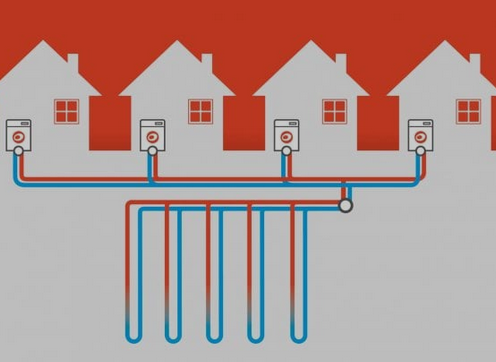
    Regen has a useful guide on shared ground source heat pumps, for use when supplying multiple buildings such as in the case of schools. Also see this example of HP deployment at schools.  Unusually, the Trust has measured things before designing the system, something ACT encourages we all do.

    ‘Insider’ report from COP28

    Here are some takeaways from a webinar organised by the UK’s UN Global Compact Network with three speakers who had attended.

    • Not just technological, we need social/behavioural change;
    • action needs to be local & personal;
    • need responsible business/organisations to develop a plan so as to leave the right legacy.
    • Global stocktake to set targets in article 14 will need to be completed.
    • GHG pricing in article 6 needs work to correctly set markets.
    • Greenwashing is recognised as a serious issue.
    • Easy part is over!
    • Push government to have appropriate policies.

    Behavioural surveys, are they useful?

    This is an international survey with insights from different countries about climate change.  The relationship between level of concern, causes and actions is worth looking at more closely.

    Transport Strategy consultation

    Devon and Cornwall (Peninsula) questionnaire on transport strategy for the region, deadline 5th Feb. Worth responding to as it is an opportunity to support some of the better ideas.

    Observations from media outlets

    BBC Radio 4 Start The Week had some good insights into the positive things that are happening as well as the economics and some science about the consequences.  The positives focused on technology, at no point throughout the 45 mins was reduction of energy consumption through behavioural change mentioned. The most unfortunate statement came from the presenter who suggested that 40% of UK energy came from renewables, this in connection to the UK being ahead of everyone else.  This of course is a mistake often repeated by politicians and media presenters.

    What they should say is that ~40% of electrical energy is now generated by renewables. This represents ~17% of our total territorial energy consumption which is ~1,600 TWh/a compared to electricity which had dropped since the pandemic from 324 TWh/a in 2013 to 275 TWh/a in 2022. These figures do not include the energy we consume for the net import of goods and services.  It also varies year on year with recent reporting showing significant reductions, but mainly because of Covid.  It’s therefore worth looking at the source data (a toe = 11.630 MWh of energy).

    Offsetting, what are valid actions? Tree planting, exported electricity

    We discussed whether tree planting and exporting PV generated electricity to the grid can be used as a legitimate ghg emissions mechanism. This came up at the August meeting, in essence you want to make sure that the scheme:

    • Needs to remove emissions which would not otherwise have been removed.
    • Needs to correctly assign emissions avoided in the year that happens, not historic or future.
    • Needs direct, verifiable evidence reported annually.

    Sizing battery Power to maximise PV generation

    Can one add batteries when on-site PV generation is much greater than on-site consumption, e.g. in the summer.  The direct answer is: technical yes but it would extremely unlikely to pay back financially within it’s expected life, it may even increase ghg emissions.

    Anther topic which we’ve discussed on a number of occasions.  It really pays to do the calculations to size/design the PV and battery systems before opting for an installer’s suggestion, or even one’s own gut feeling.  To help with this please refer to the TECs guides for PV and residential battery systems.

    Impact of new refrigerant (R290 vs R32) on HP efficiencies

    Big claims are being made on the breakthrough R290 refrigerant will make on HP deployment.  R290, or propane, has been used as an effective refrigerant for many years.  It has several pros but also cons, e.g. it is highly flammable. HP manufacturers need to use refrigerant gases which meet the low Global Warming Potential regulations. R290 is ~3 times that of CO2 which compares very favourably to other refrigerants.

    While the heat transfer coefficient of refrigerants used in HPs is important, it is not the only contributor to the overall system’s Seasonal Performance Factor (SPF).  There are several academic studies that analyse different refrigerants, e.g. this one comparing R290 to R32.

    It is important to first establish that a HP is suitable for your home, something you can do relatively easily, start with the TECs guide on HPs.  When choosing a HP, it’s more important to establish the SPF based on the product data as applied to your home and how you heat it, rather than what refrigerant it uses.  It’s also useful to get real world experience of systems in operation if this is available.

    Written by Fuad

    Energy group coordinator
    fuad@actionclimateteignbridge.org

  • Energy group meeting notes (23rd November 2023)

    Energy group meeting notes (23rd November 2023)

    The next regular meeting will be on Thursday 18th January 2024

    Thus. 18.01.24 at 16:30 and every 8 weeks:

    Thus. 15.02.24 at 19:30 and every 8 weeks: 

    Note that the December meeting is not happening. I wish everyone a great Christmas period, whatever you are doing.  Bring or sent me your topics/questions for our next drop-in meeting.  Here are some notes from our November meeting which again had new and returning faces.

    Addendum to Local Plan submission, ACT’s draft response.

    The council has made several changes to the Local Plan, the amended text (in red) can be commented on by 22nd of December.  ACT has a draft response, we encourage everyone to respond to the Climate and Ecological policies if these have been amended.  It is important that as many individuals and organisation comment on these policies.

    Cooperation with developers of UK’s first ‘low carbon’ road development, the A382!

    Three ACT representatives will be attending a meeting with the developer and DDC’ project manager in November.  This is a Live Labs funded project is exploring a number of ways to reduce ghg emissions from both the build and operational phases. Our meeting is to explore how ACT can provide constructive input to the proposed measure and how these are calculated.

    We discussed the need to ensure that any claims are verifiable so that ‘greenwashing’ is avoided.  As an example, we looked at a plug-in hybrid black cab, reported in a reputable outlet, which claims to have avoided 200,000t CO2.  There were enough numbers provided to make a back-of-the-envelope calculation suggesting that this claim was only possible if embodied emissions and emissions from electricity to charge the vehicles were ignored. An initial response appears to confirm that these were not included in the claimed emission savings.  Probably an oversight, but still greenwash!

    ACT launches Carbon Lite training.

    With ~75% of ghg emissions coming from burning fossil fuels for energy, ACT is keen to support organisations and individuals become more effective in tackling climate change.  We have found that many, including those actively working on mitigation, are not sure how to decide on appropriate actions for them.

    ACT’s Carbon Cutter (CC) programme has been running for over a year now with several active trained CCs.  The three 1.5 hr training sessions can be challenging for some who are not yet sure of how active a role they want to play in their community.  The new single 2 hour training is aimed at those who want to be better informed, but not yet ready to becoming a CC.

    All training, resources and follow-on support is provided by ACT for free.  Anyone interested, please contact ACT’s CC programme direct.   

    DCC plan to trial ‘gully solutions’ for on-street EV charging.

    Following on from our discussion last time on this topic, I’ve found out that DCC will soon have a project lead to investigate/evaluate a number of on-street charging solution for running a cable from the home to the vehicle parged outside.

    Are bore holes a realistic option for GSHPs?

    We had a good discussion about heat pumps (HP) and the difference between Air Source HP and Ground Source HP.  Unsurprisingly, this topic has come up on many occasions, but we never put numbers to the costs.

    It is widely accepted that GSHPs have a better Seasonal Performance Factor (SPF) compared to ASHPs given the same building, heating system and usage.  This is because ground temperatures remain nearly constant at 8-12OC in the UK at sea level.  These will be at the upper range in the Southwest and increase by several degrees 15 m or more below the surface.  Thermal properties of different soils will cause some variations as heat retention.

    Other reasons to go for an ASHP, as quoted by an Energy group member, is problems with siting an ASHP.  This may have more to do with perceptions as these fan driven systems can be mounted discretely without causing noise or visual problems.

    Unless otherwise measured, a useful rule-of-thumb is to assume an SPF of 2.7 for ASHPs and 3.5 for GSHPs.  This can vary significantly depending on the heat loss characteristics of the building and how the heating system is set up/used.  We have looked at several examples and calculated one case study comparing gas and ASHP for the same property, it would be good to get other measured examples.

    There are now a number of GSHP installers/manufacturers in the UK, for example Kensa in the Southwest.  Ground loops, just below the surface, remain a popular choice if there is sufficient land area for the required heat demand.  More recently, deep vertical borehole versions have become more widely available as more people with limited space have opted for a HP system, e.g. terraced housing.

    GSHP systems will be more expensive to install, but have several operational advantages.  So how much more expensive are they?  Much will depend on what groundworks are needed and how accessible these are.  The actual HP units and any changes necessary to the building/heating system will be very similar for both GSHP and ASHPs. Here is a useful guide on pricing and the different options with pictures and a video.   

    Mel Stride MP meets “active climate groups”, but refuses to invite ACT.

    Mel Strides invitation e-mail was a great opportunity for ACT, “inviting each of the core active climate change groups across the constituency to send one representative”.  Unfortunately, ACT were refused a representative on spurious arguments which turned out to be false!

    Although ACT’s question was touched on by representatives from other groups, the subsequent report suggested that Mel Stride, despite his understanding and concerns about climate change, was not fully aware of some of the contradictions caused by recent government policy reversals.  Despite the many reports and briefings from the UK’s Committee on Climate Change (CCC), all the indications suggest that those in government making decisions are not fully versed with the critical importance of the legally binding Carbon Budgets.  Opting instead to aim for a distant Net-Zero by 2050.

    ESO Market Survey.

    Dominic reported back from the recent Electricity System Operator event he’d attended. This discussed network access, storage and demand side response.  For more information on these topics and more you can look at Regen’s resources, including Storage & Flexibility.

    Written by Fuad

    Energy group coordinator

    fuad@actionclimateteignbridge.org

  • Energy group meeting notes (03.08.23)

    The next regular meeting will be on Thursday 31 August 2023 at 16:30 – 18:00  (and every 4 weeks thereafter).
    This will be the usual zoom https://us06web.zoom.us/j/3684268674

    We carried on with agenda items from last time and a few new ones.

    Retrofit (heat pump case study and more):

    It was worth elaborating further on this case study as it is based on some detailed data collection/analysis.  A draft version is available here, see section 5.3 .

    This further confirms the rule-of-thumb advice ACT has been using when advising people on when to fit a heat pump.  The 50-100 kWh/m2/year heat energy demand, how to work this out and how to use it, will be added to our list of actions on reducing greenhouse gas emissions.  Note also the importance of correct heating system setup and controls mentioned in the case study.

    I forgot to say that DCC’s sponsored Devon Retrofit Guide is now officially released.  This is a detailed, yet accessible resource well worth a read.  It of course includes a section on HPs.

    Urban wind turbines:

    Jules gave some background on new technologies for small scale urban wind turbines, a report is available here.  Although there have been several designs trialled with some commercial versions available, there is still no practical solution for these to be deployed in urban settings.

    Offsetting and greenwashing:

    Offsetting our greenhouse gas emissions seems a reasonable option.  It is something that has been available for some time with schemes becoming more transparent, publicising their ‘Gold Standard’ credentials.  But what is offsetting and how effective is it?

    There are two types of offsetting considered here:

    • We can sequester CO2 from the atmosphere, by removing it using natural means (photosynthesis of plants) or engineered mechanical/chemical means referred to as Carbon Capture Utilisation and Storage (CCUS or just CCS).  There is also Direct Air Capture (DAC) of CO2.
    • We can generate low-carbon energy which is used by us or others to replace energy with higher greenhouse gas emissions.  It is also possible to replace systems with more energy efficient ones (e.g. insulating buildings).

    Both are valid, provided they:

    • account for their full life-cycle emissions and demonstrate the time and
    • accurately state the amount of ‘removed’ or ‘avoided’ emissions. 

    Too often offsetting schemes are presented either without a greenhouse gas impact analysis or one which only considers part of the total lifecycle emissions.  Even more worrying is that technologies such as heat pumps and EVs are often ‘sold’ as low-carbon without stating the full life-cycle emissions to allow an informed decision.  In other words, how much greenhouse gas do I reduce, at what cost and under what circumstances.

    Worst of all is the accounting trick that quite a few offsetting schemes use, even some of the more ‘reputable’ ones.  What they do is calculate a future or even the total ‘offset’ emissions over the life of the measure, but apply it to the year the offset payment was made.  For example, planting a tree may well sequester ~50kg p.a. but this will not happen for several decades from when it was planted.  Similarly, when investing in technologies with high embedded emissions such as PV and EV, the emission pay-back often does not happen for 5-15 years depending on use.

    Then there is the marketing of so called ‘green’ or ‘environmental’ products and services, often referred to as greenwash.  Luckily there are new regulations in place and additional ones being proposed, here is an article that compares some of these policies in the UK, US and EU.

    Home battery:

    We discussed the importance of ensuring that sufficient daily excess PV generation was available throughout the year to ensure financial and carbon pay-back is a realistic outcome when fitting a residential battery system.  The use of batteries to benefit financially from lower tariff periods (e.g. off-peak night rate) needs further analysis and evidence, please contact Jules if you want to find out more about this.

    The more granular the electricity consumption data is, the more accurate the analysis of whether and what size battery would pay back within its warranty period.  If available, Half Hourly consumption data from a smart meter would be ideal.  Monthly meter readings with typical daily consumption patterns can still give a reasonable assessment.  The data required and methodology on how to do this analysis for both financial and carbon pay-back calculation can be found in the TECs Residential Battery guide.

    Can local plans be a catalyst for mitigating climate change?:

    Pauline shared a report from the CSE which includes 23 recommendations for improving the planning system’s ability to promote climate change mitigation and adaptation.  This should be read by planning authorities like TDC who have a strong and clear climate mitigation mandate.

    ACT had previously responded to the new Local Plan consultation, suggesting climate mitigation policies that are currently within planning rules, so don’t need to wait for the CSE recommendations to be reflected in the NPPF.  We do not yet know if these will be adopted or why they wouldn’t given the council’s stated strategic objective.

    Carbon capture, use and Storage (CCUS):

    This is quite topical, so ACT is preparing a news item on this.  Here is and early view on the topic from Jules.

    First carbon -ve road (A382):

    This was discussed a few meetings ago with several eyebrows raised!  ACT has been contacted to explore options for getting involved with Devon County Council in the “early contract stage”.  Several attendees expressed an interest in being involved, let me know if you have not already confirmed your interest and I’ll keep you updated.

    Best wishes
    Fuad
    Coordinator for the ACT Energy group
    covering energy, built environment and transport

  • Energy Group meeting notes (8th June 2023)

    Energy Group meeting notes (8th June 2023)

    The next regular zoom meeting will be on Thursday 6th July 2023 at 16:30 – 18:00  (and every 4 weeks thereafter).

    We started by discussing one of the attendee’s experience with their Heat Pump.  Much of the energy consumption before and after conversion from mains gas was recorded.  This represents an important dataset for a case study which we can add to the collection already available, more on this at our next meeting.

    We spent some time discussing options on how to reduce the impact of public Christmas lights, in this case LEDs on lamp posts.  The estimated energy consumption would be about 25W for 7 hr per day on 10 lampposts (~0.2 kWh each per day). After agreeing that bicycle power or converting the methane from a cow at each lamppost may be a good way of engaging the public, their practicality would present some challenges!  Not least, which end to collect the methane from.  In the end we decided that either electricity from the grid would probably be the lowest Carbon option (~0.26 kgCO2/kWh).  To recover the emissions from making the batteries and solar panels would take some time, unless these were regularly used for other events. We didn’t do pay-back calculation for an expected product life of 10 years, so do send me yours to see how easy you found it to do the calculation.

    The role of forests and other natural carbon sequestration options often comes up.  This article provides some useful insights into the subject.  The data seems plausible given other references to the subject.  There is just one major concern in relation to the baseline number used for current CO2 emissions from using fossil fuels and cement (≈ 9.4 ± 0.5 GtC/year).  Can anyone explain this given that most ‘reputable’ sources put that number at ~34 GtCO2/year just from burning fossil fuels?

    Several of you sent in the Rowan Atkinson piece on EVs in the Guardian newspaper.  Much of this, but not all, reflects ACT’s position on the matter as reflected by the references to EVs on our website.  Specifically, that we should not just buy a new EV, instead we should consider (calculate) the full life-cycle greenhouse gas emissions of this and other options appropriate to our specific circumstances.  I’ve previously mentioned the rule-of-thumb; if you do less than 5,000 mi/p.a. you are likely to increase your overall emissions, within the expected life of the vehicle, if you replaced your old ICE with an EV.  If you do more than 10,000 mi/p.a. you are likely to reduce your overall emissions.

    We didn’t have a chance to discuss Simon Evans’ response ‘debunking’ all the points made in the initial piece.  Maybe we should pick some of these up at our next meeting, in particular the various references to ‘evidence’ why Rowan is wrong, e.g. the government’s cost-benefit analysis and the source of the life-cycle emissions analysis.  Note the disclaimer in the latter “We emphasise that the forward-looking projections, forecasts, or estimates are based upon interpretations or assessments of available information at the time of writing”.  Also to note is that both Guardian articles are using general assumptions on vehicle usage and owner behaviour, these do not apply to everyone.

    There are some useful webinars being hosted as part of the Community Energy fortnight, please check availability as these are happening now.

    We also briefly covered:

    best wishes Fuad
    Coordinator for the ACT Energy group
    covering energy, built environment and transport


  • Electric cars line up in Newton Abbot

    Electric cars line up in Newton Abbot

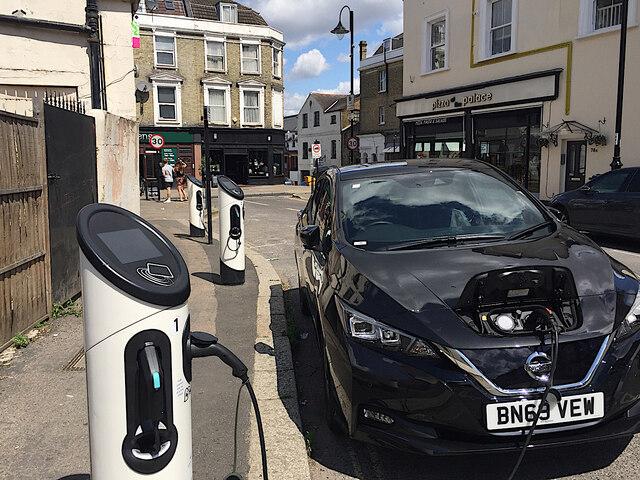
    Newton Abbot’s first electric vehicle (EV) roadshow held on 25th September was well attended, with lots of people stopping to chat to members of the South West EV Owners Group and others who had brought their cars along.

    The event, organised by Action on Climate in Teignbridge (ACT) and ChargeWorks, a local electric vehicle consultancy, lined up 11 EVs by the clocktower.

    Some of the cars were almost new, others already up to six years old. Those on parade included Nissan Leafs, Tesla Models S and 3, a Renault Zoe, Hyundai Ioniq, Kia e-Niro, VW ID.3 and a VW e-Golf – just a small sample of the EVs available today.

    One Tesla owner, John, had come from Bridport in Dorset for the day to share his enthusiasm for the joys of going electric. He bought his first Tesla in 2016 and recently switched to  a newer model. He decided to buy an electric vehicle to be greener, he says. He also has solar panels, runs a wood chip range for his central heating, and is investigating a solar thermal panel for hot water.

    John’s Tesla (the burnt orange one in the picture) has a range of 300 miles, but he confesses on long journeys he has to stop every 150 miles for personal reasons, and the car only takes around 15 minutes to charge on a rapid charger anyway.

    David, another Tesla owner from Plymouth, says his running costs are much lower than on his old diesel car – £250-£300 a year for his 12,000 mileage, down from £1,500. Another advantage is the lack of any scheduled maintenance. Electric vehicles still need servicing regularly, to replace windscreen wipers, change brake fluid, etc, but with no emissions test and fewer parts, repairs are minimal. “You can expect to do 300,000 miles without any problem,” says David.

    His enthusiasm was infectious as he talked about the technicalities of charging and the price of new cars. He says EVs may appear expensive but hold their value better than petrol or diesel cars, and as they have more space inside you can consider a smaller model than you might otherwise have done.

    Emma Fancett of ChargeWorks estimated around 800 people walked past the cars and stopped to chat throughout the day. “Some hadn’t previously talked with others about the electrification or decarbonisation of private transport,” says Emma. “Others had, but were keen to find out more and debunk some of the myths they had been harbouring.

    “Some walked the length of the line up, chatting to each owner to quiz them on their experiences, tips and tales, some went straight for a car they were interested in to scope it out for a future purchase or lease. Others enjoyed more general conversations around carbon emissions, the fuel crises, technology or fast cars.”

    Julian Stringer of ACT says: “The selection of available EV models is expanding all the time, so we are thinking of arranging another event in the future, and would be particularly interested to hear from owners of other types of EVs at the more affordable end of the range who would be interested in sharing their experiences.”

    Cars weren’t the only vehicles on show – some electric bicycle owners were also around to spread the word about the joys of two wheel travel. Richard from Newton Abbot uses his Cube bike, with a powerful 500w motor, to commute to work in Ashburton. It has cut his journey time by 10 minutes compared to his regular bike and allows him to arrive at work cool, calm and collected instead of in a lather from pedalling hard.

    Richard still goes out for leisure rides on his ordinary bike, and has persuaded his partner to accompany him on the electric one. She was so impressed with the ease of cycling on it they ended up in Moretonhampstead when they had planned on just going to Bovey Tracey on the cycle path.

    Electric bikes are often an addition to the household collection of bikes rather than a replacement. Once you have made the switch to an electric car, though, it seems there is no going back. “You will smile every time you get in the car,” says Tesla owner David.

  • Government releases its Hydrogen Strategy

    Government releases its Hydrogen Strategy

    Number 2 of the Government’s 10 Point Plan:

    “Working with industry aiming to generate 5GW of low carbon hydrogen production capacity by 2030 for industry, transport, power and homes, and aiming to develop the first town heated entirely by hydrogen by the end of the decade”

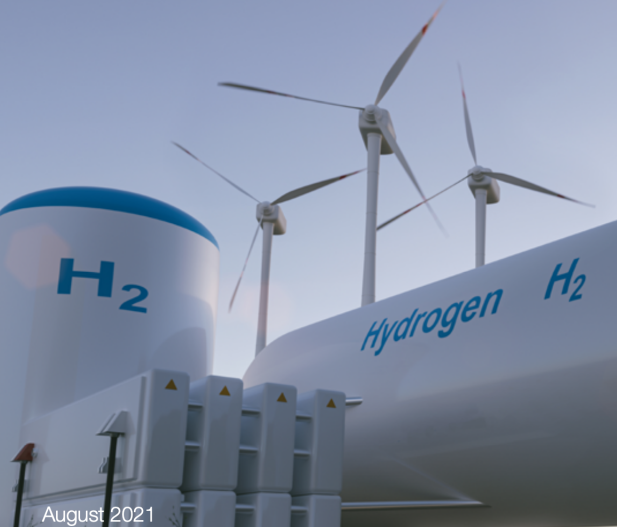
    On 17 August 2021 the department for Business, Energy and Industrial Strategy (BEIS) released its Hydrogen Strategy announcing, in the press release:

    • A ‘twin track’ approach to supporting multiple technologies including ‘green’ electrolytic and ‘blue’ carbon capture-enabled hydrogen production.
    • A UK hydrogen economy could be worth £900 million and create over 9,000 high-quality jobs by 2030, potentially rising to 100,000 jobs and worth up to £13 billion by 2050
    • Hydrogen could play an important role in decarbonising polluting, energy-intensive industries like chemicals, oil refineries, power and heavy transport like shipping, HGV lorries and trains
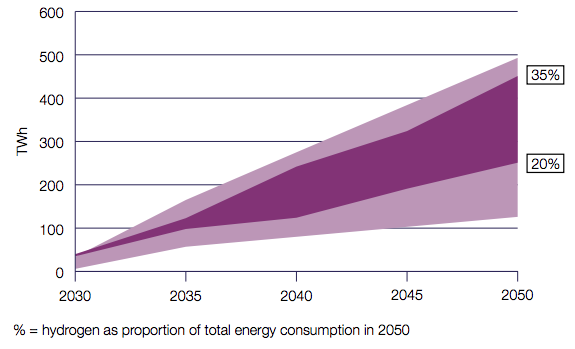
    • By 2050 20-35% of the UK’s energy consumption could be hydrogen-based.
    • A consultation to be launched, based on offshore wind, to look at ways to overcome the cost gap between low carbon hydrogen and fossil fuels, plus a consultation on a £240 million Net Zero Hydrogen Fund, to support the commercial deployment of new low carbon hydrogen production plants.
    • Working with industry to assess the safety, technical feasibility, and cost effectiveness of mixing 20% hydrogen into the existing gas supply.
    • £105 million in UK government funding provided to support polluting industries to significantly slash their emissions

    In the original press release, and elsewhere, it was mentioned that 3 million homes would be powered by hydrogen by 2030 but BEIS have now amended the press release and confirmed that this was an equivalent illustration and that hydrogen will predominantly be used in heavy industry.

    As stated in the strategy, with currently almost no low carbon production of hydrogen in the UK or globally, meeting the 2030 target will require rapid and significant scale up over coming years. It then describes where Hydrogen comes from:

    “There are almost no abundant natural sources of pure hydrogen, which means that it has to be manufactured. The most common production route is steam methane reformation (SMR), where natural gas is reacted with steam to form hydrogen. This is a carbon-intensive process, but one which can be made low carbon through the addition of carbon capture, usage and storage (CCUS) – to produce a gas often called ‘blue hydrogen’. Hydrogen can also be produced through electrolysis, where electricity is used to split water into hydrogen and oxygen – gas from this process is often referred to as ‘green hydrogen’ or zero carbon hydrogen when the electricity comes from renewable sources. Today most hydrogen produced and used in the UK and globally is high carbon, coming from fossil fuels with no carbon capture; less than 1% can be called low carbon. For hydrogen to play a part in our journey to net zero, all current and future production will need to be low carbon.”

    So in following its “twin track” approach the government assumes that blue hydrogen will initially start the strategy going with green hydrogen becoming more abundant (and cheap) in later decades. Without specifying proportions however, it seems that in both mix and, as shown below, use, the government is relying on the market to find the best combination.

    Some key points:

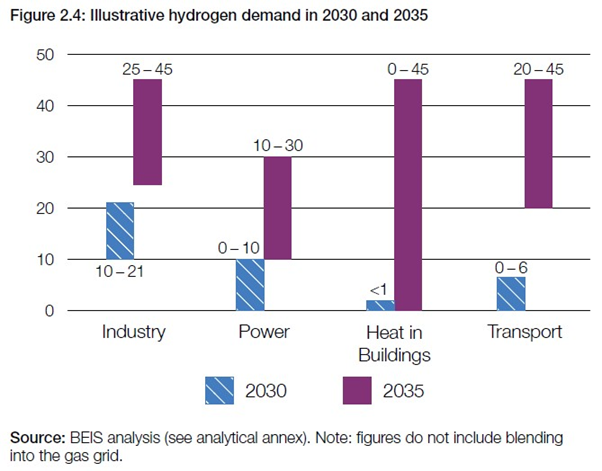
    Here is a graph from the report showing the estimated hydrogen demand in various sectors, in Terawatt Hours (TWh) (one Trillion Kilowatt hours), in 2030 & 2035.

    Note in particular the 0-45 estimate for heating, this reflects the uncertainty about the lesser priority of hydrogen for domestic use and the availability today of alternatives, eg Heat Pumps. To put this into perspective the anticipated <1 TWh in 2030 and up to 45 TWh in 2035 represents about 0.2% and 10% respectively of the UK’s current energy demand for space and water heating.

    It’s likely therefore that, as mentioned in the Climate Change Committee’s (CCC’s) balanced pathway to Net Zero, hydrogen may play a part in heating where the housing is near to the hydrogen production and electrification is not possible or where there is stored hydrogen created from surplus renewable energy.

    Unless using this stored hydrogen however, it makes little sense to use green hydrogen for heating when the renewable energy used to create it would be better used to provide the heating directly and so save the wasted energy from conversion.

    It’s often quoted that “the only waste from using hydrogen is water”.  This is true when hydrogen is used in “fuel cells”, where a chemical reaction takes place, or where hydrogen is burned in pure oxygen but it is not true when, as would be the case with heating, it is burned in air. Air’s main constituent is Nitrogen and burning hydrogen in it produces other pollutants, known as NOx. The strategy considers these and how industry must ensure they are kept within emission limits, opponents however consider that, along with the infrastructure changes needed, it’s unacceptable to plan for any such emissions.

    As explained in an Annex, with an established battery electric vehicle industry now well established, cars and vans do not feature in transport assumptions, leaving the use of hydrogen for haulage, busses, rail, shipping and aviation however, given the rapid development in battery technology, the annex casts doubt over the likelihood of the first three. Consequently, as mentioned above, it seems the government will wait and see what the markets come up with.

    In 2050 the strategy estimates somewhere between 20% to 35% of the UK’s total energy demand being provided by hydrogen.  In the CCC’s 6th Carbon Budget report last year, its balanced pathway relied upon a maximum of about 20%. Until the government releases its own energy pathway it’s not possible to reconcile the two.

    As blue hydrogen relies on a supply of natural gas there’s suspicion outside government over its promotion as an energy source by the fossil fuel industry and studies, including this one in the USA, indicate that current production methods, including carbon capture and storage, result in significant CO2 and Methane (CH4) emissions, both in the extraction of the gas in the first place and then leakage in the capture and storage processes. 

    This view was reinforced by reports that Chris Jackson, the chair of the UK Hydrogen and Fuel Cell Association resigned in advance of the government’s strategy saying he could no longer lead an industry association that included oil companies backing blue hydrogen projects, because the schemes were “not sustainable” and “make no sense at all”.

    As mentioned above, in its twin track approach, the government sees blue hydrogen as useful in creating a path to green hydrogen but, with BEIS talking about up to 15 year contracts, concern has been voiced among climate groups that over-reliance on blue could lock the UK into decades of North Sea gas production, fossil-fuel imports and millions of tonnes of carbon emissions. 

    ACT’s view is that there will be a place for hydrogen in providing energy where electrification is not possible and in some industrial and chemical processes. With the uncertainties over the impacts of its production however and without scaled-up and effective capture and storage, blue hydrogen is wholly inappropriate as a solution and so efforts are better directed towards immediate reductions in the use of fossil fuels with any hydrogen pathway being primarily towards green hydrogen.

    Other relevant links:

    ACT’s Technologies to support Net Zero Section 3 Hydrogen

    The Telegraph Billions to be funnelled into hydrogen subsidies as UK races to hit net zero

    The Guardian Government reveals plans for £4bn hydrogen investment by 2030 

    BBC News Hydrogen power offers jobs boost, says government

    UKERC Pathway to net zero heating in the UK

    The Climate Change Committee Hydrogen in a low-carbon economy

  • Travels With My BEV

    Travels With My BEV

    Who would have thought there could be so much ‘mileage’, in having a BEV. No, not my best friend, my BEV is a Battery Electric Vehicle, writes Helen Chessum.

    Bought last year just before the pandemic took over our lives, BEV turned out to be the perfect lockdown project, providing endless hours of fun looking at stats with my husband, the engineer.

    BEV records your driving stats and shows how energy-efficiently you drive. My husband was keen to make sure I didn’t drive on his stats. When we came to the first review I had a little chuckle when my stats beat his. Of course, this facility isn’t exclusive to electric vehicles. Anyone can make use of these stats on newer cars to reduce their own fuel consumption. It’s not rocket science: the more steadily you drive the less fuel you use!

    As BEV doesn’t have a fuel tank, you have two displays to guide you: battery charge level and range display. Range anxiety is an issue for BEV owners so you need to be more aware of your charge level and range to manage your nerves, especially on a longer outing. Charging points are not on every corner like petrol stations. On a trip back from Exeter I suddenly got a shock when a flashing warning message was triggered: only 12 miles left in the battery!

    The range display is where the magic starts. This is not a specific measure like the charge level indicator, but a prediction based on the conditions, previous driving style and the weather. I can leave home with a range of 140 miles, arrive in the centre of Newton Abbot and still see a range of 140. I’ve driven eight miles but according to the display I haven’t used any energy! It feels like magic but it’s due to energy recovery.

    Both feedback displays really are useful to moderate your driving to save energy. At first there was a downside as I became obsessed with the displays but I have now found a good balance. I have to confess I was never so aware of my driving in my old petrol Polo.

    BEV also has a blue and green zone energy display, next to the normal speedo. All part of the learning curve, I have trained myself to drive in the green zone as much as possible to maximise this energy recovery and make the magic happen. However, this can have some hairshirt consequences when you see how much energy is drawn from the battery by the radio or the heating. Early on I occasionally drove home shivering and with no entertainment just to protect my stats. This is the extreme end of the energy saving sport. But joking aside, it does graphically ‘drive’ home how much energy it takes to power the mod cons in our cars we take for granted.

    What about charging and range anxiety I hear you ask? Well I’m fortunate to have a drive and can park right next to my charger. Much trickier if you live in town. The 13 amp charge lead comes as standard but takes about 10-11 hours to charge fully. Your next investment is a rapid charger. Just plug BEV into her life support overnight and bingo! Or not quite, as my other energy-saving challenge is to charge BEV as much as possible from our solar panels, using truly low-carbon electricity. So overnight is not the ideal time to charge. This all takes some management and engagement with BEV and her charger. So here’s the trick – plan ahead and charge only when you need to travel. At this time of year it’s much easier as there is (usually) more sun. If my journeys are local BEV doesn’t need to be fully charged every time and I can divert some of the solar power to other appliances in my house or to our batteries.

    Of course I do still need to use the grid electricity for part of the year. The grid is using more power from low-carbon sources as we make the changes to combat climate change. But there is no guarantee the energy I’m drawing is from renewables. I have to live with that for the time being. By charging BEV from the grid only when I absolutely need to, I’m making quite an impact on my carbon footprint.

    The next big challenge with BEV is driving to Bristol and back, which is outside BEV’s 145 mile range. This will involve charging away from home – a new adventure. So wish us luck! 

  • Site options for the Teignbridge local plan to be consulted on

    A meeting of the council executive on 1st June passed a motion to run a public consultation on site options for the local plan from 14th June to 9th August.

    Executive Committee meeting

    You can watch the proceedings of the executive committee here , this gives access to a recording of the whole meeting, the local plan is item 6 on the agenda, which you can select from the menu on the right.

    Jackie Hook said “We will have to choose some sites, help us to choose the least damaging. This isn’t however about who can gather the biggest petition against a site, this is about bringing to the council’s attention additional planning related information and knowledge.”

    Local plan consultation on sites

    Part 2 of the local plan has now been published and can be found here.

    Housing Numbers

    As you may know, the Government has told Teignbridge it must build 751 houses a year (they had planned to order 1,532 houses a year!). The council therefore has to identify the sites where the houses can be built. If we do not do this the Government will take over planning at Teignbridge and increase the numbers by 20%.

    This consultation asks that members of the public help by:

    1. Checking through the sites and see what may be proposed in your community and commenting about the sites.
    2. Sharing the consultation with your friends and family living in Teignbridge. It’s really important as many people as possible know about the proposals and say what they think to Teignbridge.

    This could well be the last time local people are given a say in major planning decisions like this.
    The Government is proposing to bring in a new system under which land will be zoned. Anything designated for ‘growth’ will be deemed to have ‘planning permission in principle’.
    Government ministers claim their plan will eliminate ‘red tape’ but many fear that it abolishes any meaningful involvement of residents and local councils in planning matters.
    The consultation on the possible housing sites ends at 12 Noon on Monday 9th August 2021. Do please have your say 

    Low Carbon

    Chapter 11 states Teignbridge’s 2018 carbon footprint and analyses emissions trends over the period 2008-2018, showing that the transport, buildings, agriculture and waste sectors have not reduced over that period.

    Electricity consumption is estimated to grow from 468GWh to 940GWh (101%) as a result of electrification of heat and transport, as well as growth associated with growth mandated by the plan.

    The report doesn’t give any detail of how this electrification will be achieved, but the proposed increase in electricity consumption is close to our own estimates based on widespread EV take-up and retrofitting the existing housing stock to near Passiv Haus standards. Indeed the growth in electricity demand is slightly lower than we estimated, so some other demand reduction must be assumed.

    Possible sites are identified for 217GWh of wind and 726GWh of solar, totalling 953GWh. So on a whole year basis enough to meet demand. The report identifies a number of constraints, which mean that this much renewable generation is unlikely to be buildable.

    Peak demand occurs in the winter, when solar generation is producing least. We see already that in the recent sunny period that grid carbon intensity for the South West can get as low as 30g/kWh when most energy comes from solar and nuclear. Contrast this with winter when on a calm day most of our electricity in the South West comes from gas when grid carbon intensity can exceed 400g/kWh.

    The report identifies an increase of 201GWh of demand from heating, which will mainly be needed in the winter months. It also identifies 49 GWh from additional housing, if we assume that this will also be biased towards winter, the additional winter demand could increase to 230GWh. This is more than could be supplied by the identified wind resource. So Teignbridge will need to import more renewable energy from elsewhere during the winter.

    A large amount of land is identified as suitable for solar development. Here there is also scope for a significant contribution from rooftop PV, however, this is limited in practice by the ability of local substations to deal with local generation.

  • I thought my diesel car would have to go

    I thought my diesel car would have to go

    More than seven in 10 people in the UK are concerned about climate change, surveys show. Nearly half think it is caused mainly or entirely by human activity. This is good news: if enough people are convinced by the scientific evidence that we are the cause of the problem, there is hope that we can be the solution too.

    The question is, can we wait around for the government, or industry, or someone else, to take responsibility and action? Tackling climate change feels like too large a task for individuals but I have come round to the view that what we do both individually and collectively is crucial. 

    Making changes to the way we live is a challenge, of course, and it is easy to make assumptions about what will make the most difference. In my case, I thought driving was my biggest carbon emissions problem. You see I love driving – it’s always been my escape route from life’s troubles. I can just jump into my car and go somewhere – anywhere. 

    When I realised a couple of years ago what a mess we’re making of our environment I became almost embarrassed to drive my old diesel car. I thought it would make my carbon footprint really high. So I tried out both electric and hybrid cars – in fact my husband really wanted one. But however much I tried I really struggled with them. They were automatic, and it felt as if the car was in control rather than me doing the driving. So I decided the car would have to go. 

    Then some friends suggested I use a carbon footprint tracker to find out how I was spending my carbon budget. Imagine my surprise when I discovered my car made a relatively small contribution to my footprint, due to the low mileage I now do. I try to walk most places, usually with my dog – everyone where I live knows me by my dog!

    My highest emissions turned out to come from stuff, which is almost more embarrassing than my car being my biggest problem! The damage my spending on DIY projects, outdoor clothing, gadgets, etc, does to my bank balance is bad enough. The fact that it’s also damaging the planet is double trouble. I now pay much more attention to where my stuff is produced, and  make a conscious effort to buy local, even if it means I don’t receive it the next day. 

    At least I now know how I am spending my carbon budget, and more importantly, what actions I can take to reduce it.

    I was so close to selling my car and making the massive mistake of thinking I was now clean and green. And I could have carried on accumulating more stuff without a thought to the real cost to the environment of each new purchase. 

    So my advice to all my friends is, if you want to make changes, just check they are the ones that will really make a difference to your impact on our planet. 

    Let’s make 2021 the year of climate action!

  • Decarbonising Transport setting the Challenge

    Details of the challenge can be found here: https://assets.publishing.service.gov.uk/government/uploads/system/uploads/attachment_data/file/876251/decarbonising-transport-setting-the-challenge.pdf

    This document reviews current and already proposed future policies towards meeting net zero by 2050. The challenge recognises that these policies alone will not achieve net zero. Public participation in the challenge will take the form of:

    • Stakeholder Events
    • Workshops
    • On going public engagement

    You can share your views on decarbonising transport, register to receive regular updates on the progress of the Transport Decarbonisation Plan and information about the consultation workshops by emailing TDP@dft.gov.uk.

    We will publish our views and hope to take part as an organisation.