Category: Transport

  • Energy group meeting notes (24.10.2024)

    Energy group meeting notes (24.10.2024)

    Here is what we covered:

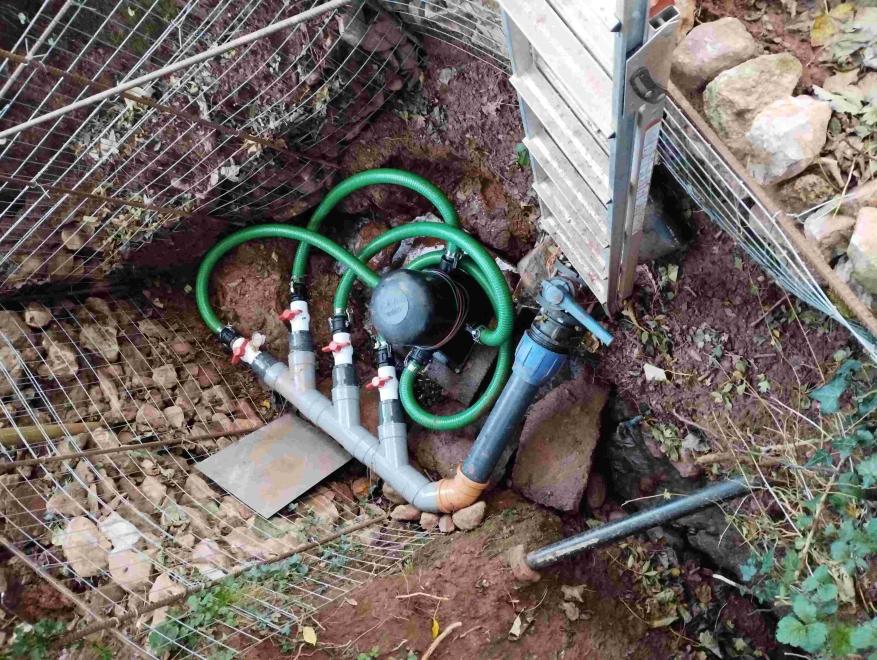
    • We looked at the pros and cons of pico-hydro generation, see picture of the installation. Even with a flow of over 10 L/s it is difficult to extract much power without a significant head. At 3m head, this would theoretically generate ~300 W, but only 150 W once all the losses and inefficiencies are considered. Still a continuous 150 W is 3.6 kWh per day, worth a lot in winter when the sun isn’t shining as much.
      Then there is the cost of purchasing equipment, plumbing, electrics and the groundworks needed. Even when labour and machinery is free, the payback period will almost always be longer than the expected life, especially at this low scale of generation.

    • As everyone awaits the new building regulations, there have been a number of comprehensive industry building standard announced in the past year, we discussed the one on embodied emissions at our last meeting. These attempt to standardise the methodology needed to calculate building performance and associated emissions. The pilot version of the UK Net-Zero building standard has been published, it is backed by key UK institutions.
      In the meantime some pre-fabricated building suppliers are promoting BAU as an alternative to PassivHaus. We thought this was more a marketing ploy than a real alternative. If PassivHaus is too expensive/onerous a standard, then AECB still offers the best alternative for the UK.

    • Data for Devon’s territorial Carbon Budget and Footprint have been published. Unfortunately, this shows that our emissions up to 2022 have been higher than budgeted to mitigate the worst effects of climate change. This means we now need to reduce emissions even faster!

    • We agreed to respond to the Transport consultation for Devon, if you are interested in helping out with this, please contact me.

    • The use of ammonia as a fuel has been discussed a number of times. It is an obvious alternative to using green/white hydrogen as described in our Net Zero Technologies, especially for certain types of transport. Here is a link to data outlining the full lifecycle efficiencies expected for different applications.

    • Is it true that “In the United States, conservative estimates suggest that healthcare pollution is responsible for a health burden similar to that caused by preventable medical errors”?
      An interesting report which highlights the difficulties we face in making our lifestyles more sustainable. Although this report covered the US, the UK is probably not far behind on a per-capita basis.
      While there are many types of pollution, as the report indicates, the one of particular interest to us is ghg emissions. On that basis the report estimates that the ‘health damage’ equates to ~405k Disability Adjusted life years (DALYs) which is comparable to the deaths from medical errors (~71k deaths). One death equates to ~DALYs.
      Obviously tragic and preventable, in a population of 330 million the relative impact is small at 0.02%. The ghg emissions account for 10% of this pollution which represents 0.002% of the US healthcare’s impact on poor health outcomes.
      Overall ghg emissions from healthcare are likely to be much higher as a percentage of total emissions in the US. In the UK the CFT includes all public sector ghg emissions, including our national healthcare. These are allocated per-capita and typically account for ~10% of total emissions. Private healthcare is not included in these figures as this varies significantly, so users have to enter their expenditure to calculate personal emissions for this.

    • There were a couple of submissions in relation to loss of a bus route and identifying unusually high electricity consumption in a public building. Hopefully we’ll pick this up in November’s meeting. Also some good news on secure cycle parking near transport hubs (the subject of a comment on the last meeting notes).

    Written by Fuad

    Energy group coordinatorfuad@actionclimateteignbridge.org

  • Energy group meeting notes (26.09.2024)

    Energy group meeting notes (26.09.2024)

    Here is what we covered:

    • ACT and TDC have piloted a new joint initiative to help householders and businesses better understand their use of energy, starting with electricity. Here is a link to this behavioural change session if you’d like to take advantage of this free offer.
    • We fed back on the successful defence of all the Climate Change policies in the local plan. The examiner understood the importance of these policies and why they needed to exceed the current building regulations in reducing greenhouse gas emissions.
      While ACT would want to see a much more ambitious plan on climate mitigation, we have to accept that the plan needs to remain within legal bounds. Nevertheless, some key policies were retained despite appeals from developers and some were even strengthened.
    • Many will have heard about the ‘smart grid’ and how this is an important component to decarbonise by electrifying heating and transport. The thinking behind this is to ensure that as capacity of the grid grows rapidly, we need to optimise where and when generation/consumption of this electricity happens. This is because many parts of the grid are unable to cope with the increased usage and reinforcing it is very expensive and time consuming.
      As an introduction to this topic, you may want to watch this video about Virtual Power Plants (VPPs).  Dave Borlace’s Just Have A Think is an excellent source of really good information put across in a captivating and accessible way. But even Dave occasionally gets carried away with aspects of what he is presenting.
      We discussed whether, as claimed, VPPs are reducing the grid’s Carbon Intensity (i.e. reducing the overall ghg emissions from electricity). The jury is certainly out here in the UK, at least for the time being. Have a look and have a think yourself, let me know what you think!
      To help you spot the bold claim, here is a hint. It is also a link to yet another website that has recognised the widespread ‘Greenwash’ associated with marketing ‘green’ electricity. Even Money Supermarket has a more nuanced take on this.
    • We briefly touched on the subject of offsetting, especially through tree planting. Here is what this offsetting scheme agent says about their offsetting offer “Yes we do, we love trees. BUT there simply isn’t enough land to plant enough trees. Also, we do not believe that you can successfully plant and nurture a tree for just $5. On average, 18% of planted saplings die within the first year, rising to 44% after five years. Some of the best recorded rates are 80% survival. So, cheap tree-planting is neither practical or effective and is often used to greenwash.”
      Shame they didn’t also mention how long it’ll take before the tree starts to sequester carbon dioxide or how much.
    • We spent some time looking at a question about the energy efficiency difference between wall mounted radiators and wet underfloor heating (UFH), especially when using a Heat Pump (HP). Also, at what point would the investment in retrofitting to a wet UFH system pay back from the difference in energy efficiency?
      The quick answer is that there is no or marginal difference in energy efficiency if all other parameters are the same. This is because the same amount of energy would be delivered into the same space.
      However, because UFH gets the heat to the occupants more direct, they would feel warmer for the same energy input. This may (should?) result in them turning down the thermostat and indirectly reducing the energy demand. How much energy could be saved depends on several things, not least the building’s heat loss and thermal mass characteristics and the characteristics of the heat generator (esp. flow temp.). It is unlikely, in most situations, that retrofitting to wet UFH will itself pay back from potential saving in energy use. Nevertheless, if a deep retrofit is being considered for other reasons and UFH can be installed, it is well worth doing.  
    • Some dubious claims on super savings from reputable sources such as this Guardian article’s claim. See if you can spot this (answer next month).
    • Drawdown is a source of comprehensive advice on mitigating Climate Change. We didn’t have time to discuss who it is aimed at and what does it cover. We’ll try and do this next time, but do send in your views.
      Some concerns include: Global calculations; aimed at corporate and government despite personal advice; data is not kept up to date; does not cover goods and services.

    Written by Fuad

    Energy group coordinator

    fuad@actionclimateteignbridge.org
  • Energy group meeting notes (29.08.24)

    Energy group meeting notes (29.08.24)

    Here is what we covered at this meeting:

    We looked at the offer and claim from two examples Community based or commercial. Both examples use EPC data to recommend changes to a property including having a HP installed. Both allow you to correct the EPC findings. What is interesting is the claimed HP saving in terms of money and ghg emissions. Even installers like HeatGeek, who were recently featured in the national press, appear to oversell their products. Claiming a guaranteed ‘efficiency’ of 380% and zero operational ghg emissions is disappointing, despite the small print clarifications. Why not try the two approaches for your property and compare the advice. Energy Saving Devon is the source ACT recommends for information on all aspects of building retrofit, links to finding installers are also covered.

    We looked at the article in the latest CAT newsletter, see “What’s Holding Back HPs?. In essence it shows the discrepancy between claimed efficiency as specified by installers using government methodology and measure real-world performance of 435 ASHP in 2022 and 1.431 ASHP installed in the previous 5 years. I gave other references to similar UK and European data at our meeting in July when we discussed the dangerous ‘fabric fifth’ messaging being promoted by some.

    Note for example the CAT articles reference to average ASHP efficiency quoted is 360% compared to the average measured efficiency of 270% for those systems.

    With so much misinformation and mis selling it’s useful to be better informed. Please refer to our recently updated guide on HPs, it’s aimed at anyone with little or plenty of heating system experience.

    ACT’s representation at the local plan examination on Climate Change policies.

    ACT will be attending the examination of the section on Climate Change on the 25th September. We have a team of 3 preparing for this with a focus on the submitted representation. Let me know if you would like to comment or find out more. It includes information on what existing plumbing is suitable for conversion to HPs, a question from one of the members attending.

    Transport, what are our options to minimise ghg emissions?

    Not having discussed transport for a while, this was a thought-provoking question on where people would look if they asked the question “what can I do to reduce my greenhouse gas emissions from transport?”.

    One obvious choice is the internet. Googling it gives a reasonable quick list of 8 actions, surprisingly from a US national park authority. Using AI (Chat GPT) is less reasonable, not the best priorities/advice (e.g. hybrids). ACT has made a list of actions available via the CFT, the thinking behind this is to encourage people to consider their circumstances first (i.e. footprint and target reductions) before deciding on the most appropriate/effective action. Arguably a bit more difficult to find, users can still access the same list of actions direct from our Resources menu on the ACT Homepage “Carbon Cutting Action Lookup”.

    Why not try these out and compare, all comments on how to improve our approach is welcome.

    Does every little help?
    In case you’ve missed this, you can still read it here.

    Written by Fuad

    Energy group coordinator

    fuad@actionclimateteignbridge.org

  • Energy group meeting notes (01.08.24)

    Energy group meeting notes (01.08.24)

    The next regular meeting will be on Thursday 29th August 2024 at: 16:30

    Here are notes from our discussion/surgery on Thus.

    Heat Pump Case studies

    Two members have collected extensive data on the performance/behaviour of their respective HPs. It’ll be good to get more case studies about HP performance for both space and hot-water heating. This is an area of particular interest to the Devon Community Energy Network as well as adding to the one ACT case study on HPs. Please contact me if you’d like to share your experience, good or bad.

    Heating water was discussed as this can cause HP performance (SCOP/SPF) to reduce significantly. There is some advice on actions related to this topic from the CFT> Results> help, or search “Hot Water” here.

    TDC’s Climate Hub

    ACT welcomes this recently launched portal, aimed at Teignbridge residents and businesses. It is still sparsely populated, but we are told more ‘actions’ will be added soon. A real shame that TDC did not include the CFT as the tool of choice to calculate residential and business carbon footprints, especially as it was tailored by ACT to meet TDC’s specific requirements.

    There is also no mention of ACT as a source of information and support, a surprising stance of a local authority that claims to want to work with the community and states that “In last year’s annual budget survey, almost three quarters of residents who responded agreed we should work with our partners to support climate change initiatives and reduce our carbon footprint”.

    ACT has fed this and other comments back to TDC, we await a reply.

    Government’s energy transition plans and climate policies
    Unsurprisingly, this ended up being a wide-ranging discussion. Some early announcements/pointers included:

    ACT has submitted suggestion for government to reverse the last government’s ministerial statement which makes it more difficult for Local Development Plans (LDP) to exceed building regulations. This is very topical as the Teignbridge LDP is up for examination in September. Indeed the examiner has raised specific questions around policy CC2, for example Matter Q5.2 “Do the policy’s minimum standards go beyond the relevant current and future Building Regulations and Future Homes Standard? If so, is there a well-reasoned and robustly costed rationale including in respect of development viability and housing supply and affordability?”

    All LDP examination related documents can be found here.

    Meantime various bodies have been suggesting what steps the government should take to mitigate climate change, this example from Regen. Another proposed policy change is on energy tariffs, ACT has proposed this in response to previous consultations, so it’s good to see it covered by a main media outlet.

    A new consultation on the NPPF has been launched. This specifically ask how the NPPF can “tackle climate change”, amongst other topic. ACT intends to respond to some of these (e.g. Question 78, 79 & 81). Please send your comments views to me so that I can collate the response.

    One of the two main comments ACT submitted to the LDP consultation was in relation to including embodied emissions. TDC have responded positively to this. We will be sharing the latest Whole Life Carbon Assessment Standard from RICS with TDC to further strengthen the need for measuring/controlling embodied emissions.

    Grid storage units in Teignbridge
    Some concern was raised about deploying Li-Ion batteries in residential and amenity areas. These units are used to stabilise grid electricity voltage/frequency and deliver energy during peak periods. They are an alternative to the widely used gas-fired peaking units, one of which ACT successfully objected to.

    We support such deployment (see TECs Guide on the topic), provided it is in the appropriate locations and safety considerations. The planning application 24/01127/ful is for a 2m high street cabinet 0.6m wide and 1.2m long in Dawlish. It contains an 800 kWh Li-Iron-Phosphate battery which is larger than an EV battery (typically 40-100kWh). This technology is considered one of the safer options, here is a video that demonstrate this.

    Does every little help?
    We managed to briefly touch on this question in relation to climate change.  Using a typical example, which quotes large numbers, the initial answer was yes or even definitely. However, looking at the same numbers from a different perspective, the answer was no.  More on this later ….

    Written by Fuad

    Energy group coordinator

    fuad@actionclimateteignbridge.org

  • Energy Group notes (04.07.24)

    Energy Group notes (04.07.24)

    Here are notes from our discussion/surgery from last Thursday.

    Cooperation with the Teignmouth U3A

    Three members of the group joined our zoom and shared some of their activities/plans. We agreed to provide support for an upcoming EV event later in the year. There is interest amongst U3A members to find out more about Energy related actions they personally can take and information they can share with others in their community.

    ACT has many free resources on its website including:

    How to interpret messaging

    We discussed the following ‘advice’ from Carbon Coop, a well-respected Community Energy Society:

    Critics claim the technology is best suited to newbuilds – but studies reveal success with retrofits and in poorly insulated homes. This report from the Guardian shares the details.”.

    This type of advice (message) can lead to a fundamental misunderstanding unless the reader looks more closely at the refence material and has the knowledge to correctly interpret what is actually being stated.  So for example, just because it is possible to have a well-functioning Heat Pump (HP) in older properties, it doesn’t follow that a HP will be effective in an older property.

    The Guardian article referenced is quite good in terms of providing ‘caveats’ and reasonably balanced wording. A careful read does make it clear that the “Science” based on monitoring 750 HPs by the ESC has not yet been published. Instead, it references a European study of ~300 HPs over 20 years which gives a slightly different slant in terms of Seasonal Performance Factor (SPF). Frustratingly, there is no mention of ambient internal temperatures, a significant indicator of levels of comfort.

    The quoted 2021 BEIS CODE financial modelling report of UK housing stock for conversion to electric heating is well worth a read. It is very detailed and includes modelling of internal temperatures for ‘good’ comfort levels. Unfortunately, the statement in the executive summary has been picked up without regard to key concepts highlighted in the modelling report: “Decarbonised electricity offers the promise of very low or even zero-carbon heating for homes – without necessarily carrying out extensive deep retrofit work”.

    There has also been a lot of messaging around a so called ‘fabric fifth’ national strategy to decarbonise heating, as opposed to ‘fabric first’, the current approach. While there are some useful points in this approach, it relies on some unrealistic assumptions and confuses the message around what heating systems individuals should opt for. Although ghg emissions are likely to reduce when replacing fossil fuel heating systems, there are still too many instances where overall costs may increase when electrifying mains-gas systems. Until certain market conditions change to a stable trajectory that ensures HPs will be more cost-effective in a majority of cases, ACT will continue to advocate its current approach of ‘fabric first’ as stated in our Energy Hierarchy.

    ACT’s focus is to provide sound, evidence based, advice to those who are considering a HP for their properties. We are in the process of updating our guide on the topic to clarify some of the recent confusion and uncertainty. In essence, it is essential that potential adopters of HPs do not fall for the widespread cherry picking of arguments put for/against HPs. Instead, we strongly advise potential users to undertake at least some simple/practical assessment for their objectives and circumstances before making a decision. Watch this space!   

    Written by Fuad

    Energy group coordinator

    fuad@actionclimateteignbridge.org

  • Energy group meeting notes (06.06.2024)

    Energy group meeting notes (06.06.2024)

    Here are notes from our discussion/surgery on Thus.

    Are the elections energising you? Who’s promising what?

    As a CIC we stayed clear of any party political discussions, but we did look at some of their policies and actions, specifically in relation to the climate and energy policies. ACT covers two constituencies, candidates for Central Devon and Newton Abbot, both with an incumbent MP from the Conservative Party.

    Although not all the manifestos have been published (due soon), we discussed their likely content in terms of policies on the Climate and Ecology.  You can also get a summary of where the main parties stand on these:

    from Friends of the Earth;

    Elmhurst Energy;

    Compare this with the 2019 manifesto promises on Climate action;

    And read where Britons stood on climate policies 6 month ago from the Kings College London piece.

    As an adjunct to this discussion, ACT has submitted question to BBC for inclusion in a radio4 programme on the subject of the 2nd court ruling re inadequacy of government policies

    “Members of the public may however wonder how effective such rulings can be in holding governments to their commitments to achieve climate change targets. Can they go back on their commitments with impunity?”

    What to make of all these industrial innovations?

    We regularly cover promising innovations submitted by energy group members. An ammonia engine was referenced at our last meeting, in response green ammonia was sent in as a counter balance. There are many other technologies we’ve covered, low-carbon road building using low-carbon concrete was another, here is the latest ‘breakthrough’ on this.

    All of these will help to reduce energy demand and hopefully decarbonise.

    Still the most important action which no one wants to talk about is behavioural change to cut out waste.

    I also still regularly come across people who are not aware that simple appliances, like some fridge/freezers, can consume nearly 1.5kWh per day. In this case it represented ~40% of total electricity consumption. It was replaced with a larger, 10 year old, second hand F/F which consumes ~0.4 kWh/day.

    Responsible travel advice.

    In a very good article on this broad subject a group member sent in, I spotted the “be climate smart” advice and a reference comparing ghg emissions from different holidays. The main message was that the length of stay has a significant impact on ghg emissions because of the different emissions from three sources; transport, food and accommodation.  This is typically sound advice, stay longer if your travel emissions are high.

    I thought I’d better check some of the numbers against ACT’s CFT, here is what I found (all emissions are by weight of CO2e emissions):

    e.g. London-North Devon (~450 mi round trip by car @ 50mpg): reference= 37 kg ; CFT= 109 kg

    e.g. London-North Devon (~350 mi round trip by train and ~100 by car @ 50mpg): reference= 20 kg ; CFT= 49 kg

    e.g. Eating out in France (per person-day @ £30 average diet assuming same as UK): reference= 11 kg ; CFT= 15 kg

    e.g. Overnight stay in North Devon (per person-night @ £50): reference= 3.9 kg ; CFT= 27.5 kg

    Some are in the right ballpark, but private transport and accommodation seem quite at odds.  I trust the CFT more! There are of course other factors that’ll come into play for different people travelling at different times of year, so worth a quick check.

    Heating water, what is the best way?

    Although this question was in relation to a public building, the approach is almost the same for a private dwelling. Adhering to legionella regulations is one important difference.

    The answer is of course; it depends!

    The most significant things to find out are how much water is needed at what temperature and when/how often. This gives us the energy requirements and patterns of usage. Then comes the question of what heating system is being used and what are the energy demands/patterns on this. You need to have some idea of the total primary energy demand for the building/occupants before deciding on the most appropriate energy source for heating water or how to adapt an existing heating system to supply this.

    It can be as detailed (complex) as you want it to be, but some simple guidance can help.  The CFT has reference in the help panel to ‘list of actions’. Search or lookup “hot water”, this will give some of these general guidelines.

    Post meeting snippet.

    This link came in just after our meeting.  It’s a 38 second look at where we are with Climate Change from Exeter University. It is a stark but honest reminder.

    Given the catastrophic and irreversible consequences from reaching the tipping point, I’d prefer better odds than 1:2.  This is why we should be aiming for odds of 1:3 as agreed in Paris and reaffirmed since by the IPCC, it would leave us with 5.5 years. In practice this means we need to see a dramatic change in the next 6 months.

     Russian-Roulette odds at 1:6 are better!

    Written by Fuad

    Energy group coordinator

    fuad@actionclimateteignbridge.org

  • Energy group meeting notes (09.05.2024)

    Energy group meeting notes (09.05.2024)

    Our next meeting will be on Thus. 06.06.24 at 19:30, this will be a zoom.

    Here are some notes from the meeting. If you’d like more information on any of the topics, please contact me or comment on the post.

    What an excellent opportunity to sample a recently built PassivHaus, almost as good as the host’s cake!

    The six of us found out first-hand about the construction and operation of Paul’s home, we even managed to have a productive discussion about how/who to message. You can read a summary about the PassivHaus in the case study.

    • Who we should talk to and what we should say.

    Not sure what triggered this, maybe it was the ‘old farts’ sitting round a table with stunning views of the natural world outside. Once we ‘shared’ our frustrations, we had a wide-ranging discussion on what we, that is ACT-Energy and CC, should do and how we should do that. Here is my attempt at summarising this in a few points.

    The message needs to be clear and stark, if the audience can cope with it (great care is needed with young and vulnerable people). The 1.5C tipping point will probably be reached by the end of this year, we may already be past that. This is bad enough, but it can get much worse unless we act immediately and decisively.

    The only realistic solution is to reduce our energy consumption (halve it within a year or two), we provide the support/information on how this can be achieved without prescribing personal actions.  At the same time, we need to replace the energy we generate from fossil fuels with renewables, but this can be challenging and needs a level of technical understanding which ACT can provide.  

    There are 3 groups that we could communicate with: those who set the rules ; those who make, sell or provide goods/services ; the general public. We should focus on the latter two within Teignbridge. It is more effective to engage with those who set the rules by having someone on the inside, general lobbying would not be effective for ACT, other groups already do this like XR, Regen, political parties think-tanks, etc.

    Our Energy & Built Env and Transport webpages guide you to the important information you need. If you are unsure or need specific help, please contact me.

    Here is a US report from earlier this year, but most recently a group of IPCC scientists were surveyed, their message is stark.

    • Electrifying public transport.

    DCC and Torbay have secured grant funding with Stagecoach. We didn’t have much time to discuss, but overall we thought this is a good initiative especially in built up areas.

    • Updates to Carbon Factors.

    We’ve updated the CFT (v5) to reflect latest methodology for calculating consumption emissions for Food, Goods and Services. You may notice some changes to your emissions, we also added a new category of “eating out” as this has a higher carbon intensity than any of the 5 food diets.

    • How is the Devon Carbon Plan progressing?

    The DCP has released its latest information on progress against the plan. It’s really good to see this reporting despite there still being gaps. We very much hope TDC will continue with its annual ghg emissions inventory reporting and expand this top cover Teignbridge as a whole.

    • BBC opportunity get a hustings question on the radio.

    This was sent in as a suggestion from an Energy group member which is worth considering, let me know if you want to be involved in this, suggest changes or even another question (deadline is end of May):

    “The recent High Court ruling that the UK Government acted unlawfully in approving its climate action plan, and the question of how a government can be made to abide by its own laws?”

    • Experience with Time of Day energy pricing.

    This cam up recently in some national media outlets, again we didn’t have much time to discuss, but clearly some of our national newspapers chose to spin the story.  It’s always worth going to the original source or read different media outlets. Here is the original, not so recent reference to the trial in Canada.

    • Ammonia’s use in agriculture and transport.

    This is primarily used in agriculture, but recent headlines have been promoting an ammonia fuelled ICE engine. They tend to say nothing about the climate impact of ammonia production.

    • Another offsetting scheme.

    This is another, probably well-intentioned scheme, but how effective is it in terms of actions to mitigate climate change, its primary selling message. Probably good for the ecology and great if it makes us feel good, but that’s the extent of its impact.  Why the greenwash, why not simply state the two real benefits?

    Written by Fuad

    Energy group coordinator

    fuad@actionclimateteignbridge.org
  • Energy group meeting notes (11.04.2024)

    Energy group meeting notes (11.04.2024)

    The next regular meeting will be in person on Thursday 9th May 2024

    Please contact me for details on how to join.

    Here are some notes from our April meeting. If you’d like more information on any of the topics, please contact me or comment on the post below.

    • Next face-to-face meeting

    Several people offered to host meetings this year. There will probably be the 16:30 start. Our May 9th meeting will be at Paul’s PassivHaus near Ilsington. Numbers are limited, so let me know if you want to book a place and if you would like a car lift or can offer one (let me know where you are traveling from). Places will be allocated on a first come-first-served basis.

    • Transport advice and links

    We discussed whether we should promote links to commercial websites that give verifiable ghg emission information for their service or product. The example we looked at was The Trainline.  On balance, we concluded that this would not be appropriate within the CFT, but we may include such links on ACT’s Transport webpage, your views are welcome.

    Please provide suggestion for sources that allow CFT users to calculate travel distances for public transport (open the help panel to see the links currently provided). Some of the links on the CFT appear not to work! Public transport covers plane, train, boat/ferry, bus/coach and any others you can think of.

    For general advice on transport, see our Resourse Pack to Town/Parish Councils on that topic.

    • Embodied emissions in the built environment

    The UK Green Building Council is calling on the government to regulate embodied carbon. This was one of the comments we’d submitted in our response to the Teignbridge Local Plan (LP) consultation. The LP is due to be examined later this year.

    • Residential Battery Guide updated

    We’ve updated the introductory message in our Home Batteries guide to reflect recent findings and comments. See the link towards the bottom of the ACT Energy & Built Environment webpage.

    • Case studies

    Added a couple of case studies. Both are for PassivHaus, new build and living in one. You can access this from the same place as the Residential Battery. Let me know if you’d like to add any.

    • Parish wide advice and retrofit in Cornwall

    Forgot to mention this initiative in Soke Climsland. This is similar to the Devon wide retrofit scheme, it includes a simple video.  I’d be interested in hearing your views on this approach.

    • AOBs

    It appears that some major planning applications in Teignbridge are being approved without appropriate provision of green corridors.  ACT’s Wildlife Wardens would normally comment on these, so I’ll check why this apparently did not happen in Dawlish.

    As part of remembering Professor Higgs’ work following his passing here is a link to a broad sweep of the Standard Model and those who played a significant part in developing our understanding of the fundamentals of nature itself.  You may need a diagram of the elementary particles to refer to while reading!

    ACT is collating a reading list on climate/ecology for the Newton Abbot library. Two books were mentioned: Lessons in Chemistry and How Bad Are Bananas. If you have any you want to recommend, please send them to Jules.

    Written by Fuad

    Energy group coordinator

    fuad@actionclimateteignbridge.org
  • Energy group meeting notes (14.03.2024)

    Energy group meeting notes (14.03.2024)

    The next regular meeting will be on Thursday 11th April 2024 at:

    Thus. 11.04.24 at 19:30 and every 8 weeks

    Thus. 09.05.24 at 16:30 and every 8 weeks


    Here are some notes from our March meeting. Nice to see people who’ve not been for a while. If you’d like more information on any of the topics, please contact or comment on the post below.

    • Mixed messages from government following some major announcements!

    In Feb 2024, the government announced it will withdraw from the TCP agreement on energy trading.  This is great news as it stops energy companies from suing governments if they passed laws affecting investments in their energy projects.  It was widely hailed as a move to enable Net-Zero policies, in reality it was probably just a reflection of what was becoming a costly liability to EU countries.  In July 2023 the EU had already made that decision leaving the UK little choice.

    Ministerial announcement on not exceeding planning regulation in Local Plans could have an impact on Teignbridge’s pending LP inspection. Although it may be argued that the recent court cases in Oxfordshire and the wider case against the government on the lack of clear plans for achieving Net-Zero could be used to thwart this announcement.

    We also talked about the second consultation on the Review of the Electricity Market Arrangements (REMA). Misleadingly, this was reported as the government building new gas-fired power stations, in reality it has some positive proposals on supporting renewables and “transitioning away from the unabated deployment of gas-based systems…”. See the Regen response so far.

    • Is my gas boiler inefficient?

    This question can be applied to many things, boilers, cars, windows, etc.  We discussed what terms like “efficiency” actually mean and how cost relates to energy and to ghg emissions.  The question we need to be clear about, before deciding on a solution, is “what is the problem?”.  Is it really an inefficient boiler, are gas prices becoming unaffordable or am I consuming more because I’ve changed some setting/behaviour? 

    Many of our routine services (e.g. utilities) do not register in our daily lives, nor should they.  That is until we notice an increase in our bills or hear something about them.  For those who can afford to pay the increased prices, no further though is given to the subject, or we may talk about how utility prices should be kept down so everyone can afford to heat and light their homes.

    We also tend to pick a solution we’ve heard about, one which is affordable, easy to do and appealing. Often this is a random process with the judgement on efficacy based on what we’d like to tell others.  Sometimes this makes us feel good, sometimes not so good.

    So the question is, how much extra effort am I prepared to put in to find an effective solution that I will be happy with in the long term? Do I want to learn enough to spot a ‘sales pitch’ or ‘greenwash’?  I’m sure most of us want to, but struggle to find the time or interest.  Understandably not everyone can, so here are some pointers to where to get someone independent help with household energy use:

    1. Follow some of the advice on actions, ideally after assessing your energy/ghg emissions using the Carbon Footprint Tracker (CFT).  There is a link in the ‘results’ tab under ‘list of actions’ in the ‘help’ panel where you can search specific areas.
    2. a self-help programme (Energy Assessment Pack, E-Pack) available to TECs members with ongoing support.  This is aimed at anyone who wants to learn how to make more informed decision on actions they can take.  It includes measurements and modelling which are becoming more widely available such as the CSE scheme Jules mentioned.
    3. Energy Saving Devon is aimed at those who do not want, or cannot, be involved and would rather be told what to do.  There is an interactive tool to “create home upgrade plan” under Resources.
    4. Hiring a Domestic Energy Assessor and/or architect/heat engineer.  Best to get recommendations from someone whose done what you are looking for.  There are emerging standards/schemes to control quality (e.g. PAS2035), but these are not yet widely used.
    • Does self-build result in lower carbon emissions?

    Here is a report summary from the self-build trade body, some interesting insights.

    • An irresistible opportunity to mitigate climate change and save money?

    How does this offer from Ripple Energy stand up against its claims? Look at the short introduction video, is it an offer you cannot refuse?

    The key to successful advertising is to tell people they’re getting what they want.  Advertising standards are intended to stop mis-selling, but how effective are these?  Advertising codes, published by government even has a relatively new section on ‘environmental claims’ as well as the well established ‘misleading advertising’ codes. It’s not clear whether this is a rigorously implemented as intended or if there is a threshold for number of complaints which isn’t being reached.

    • Standards for emissions from our built environment.

    I mentioned the RICS latest version of their whole life carbon assessment for the built environment. Worth reading some of the introduction sections, ‘1.1.background’ has a useful general perspective.

    • YouTube video on Retrofit.

    There is a lot of material on the internet covering retrofit.  As well as the signposting at the end of our energy webpage, this publicly available AECB video was shared by Paul B.  It does go into some detail and is ~40 mins long, but worth a look if you want to understand the reasons for and key information on Retrofit.

    • What is ACT planning for this year’s national elections.

    This question was raised at the meeting.  Coincidentally the ACT steering group discussed this very topic; whether we should run hustings again this year. After some discussion, it was agreed to draft questions which can be sent to prospective candidates in Teignbridge’s two constituencies.  We would then share the responses.

    So we’ll put some time aside at our next Energy group meeting to discuss and formulate questions. Give this some thought and either come to the next meeting or send me your questions.  Here is an example to get you going:

    “Do you believe the UK should lead the world by example in setting and achieving Carbon Budgets that keep our contribution to within the 1.5C climate tipping point?  If so, what priority topics will you set ahead of this?”

    Written by Fuad

    Energy group coordinator

    fuad@actionclimateteignbridge.org

  • Energy group meeting notes (15.02.2024)

    Energy group meeting notes (15.02.2024)

    The next regular meeting will be on Thursday 14th March 2024 at:

    Thus. 14.03.24 at 16:30 and every 8 weeks:

    Then Thus. 11.04.24 at 19:30 and every 8 weeks: 

    Here are some notes from our February meeting, it was nice to see new faces and several old ones, one unlit!

    Apologies if anyone found the discussion on battery charging too esoteric.

    • How significant are heat domes in new housing developments?

    Also called urban heat islands, these can result in health consequences as well as additional energy demand for cooling.  The general view was that this applied mainly to larger town/cities when overheating is already a major concern.  Appropriate planning rules to improve green spaces/corridors and allow better air circulation are still necessary in smaller urban areas, especially now, given a warming climate.  

    • The numbers are in! We can now make a statement re charging residential batteries from the grid.

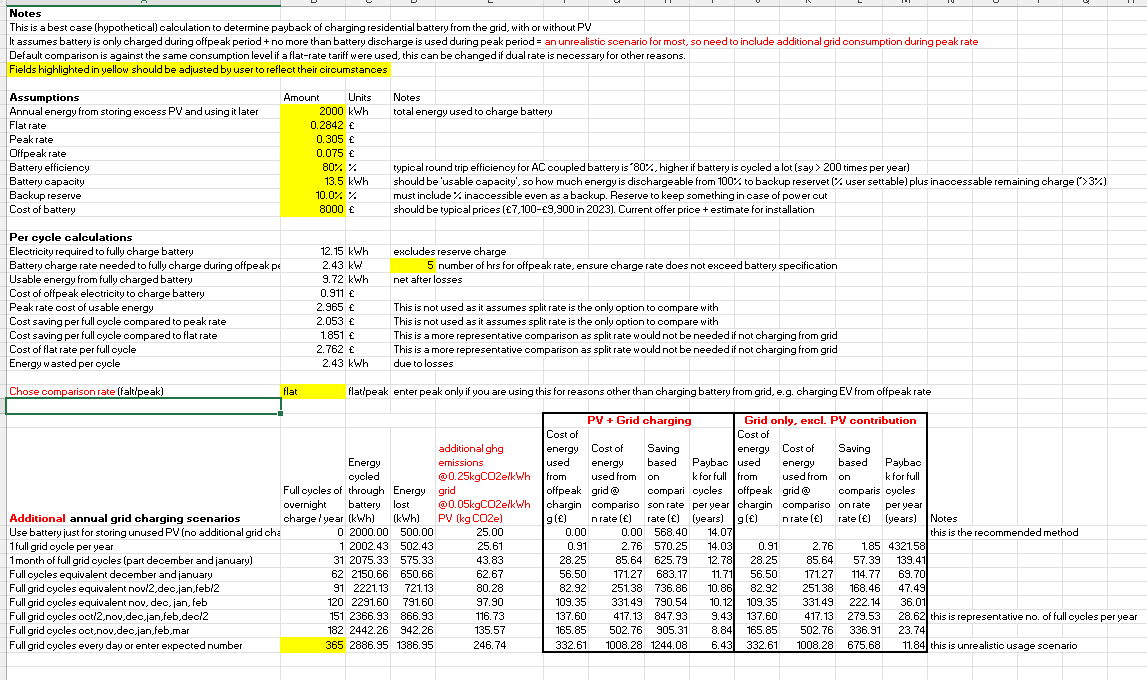
    Jules has developed a spreadsheet to calculate this for individual cases, please take a copy to use.  I’m hoping we can put this discussion to bed with the following statements, but feel free to comment further:

    1. In the absence of any other evidence, we’ve agreed to compromise on ‘typical’ round trip efficiency (RTE) for an AC-coupled battery system of 80%. Individual usage may make this higher (~85%) or lower (~75%).
    2. Charging your battery from surplus PV provides the most effective payback for your battery system. This is what ACT recommends as it also reduces your carbon emissions from the electricity you consume.
    3. Charging your battery from the grid at a significantly lower tariff (e.g. off-peak period rates) can further reduce the payback, by how much will depend on several factors, such as the relative unit price; number of charging cycles; % of grid charging compared to PV charging.
    4. ACT does not encourage excessive charging from the grid as this may increase your grid’s Carbon Intensity and reduce the life of your battery. Instead, we recommend a careful analysis of the various parameters to calculate the financial and carbon impacts, before opting for this.

    There may be other reasons for charging a residential battery from the grid, e.g. helping reduce demand during peak periods or ensuring sufficient backup energy is available in case of a grid outage.  Reducing costs is, however, only possible in a few cases, so it is worth using the calculator above to find out first.

    • How well does the finance sector follow the energy hierarchy?

    It seems more and more. The headlines we hear tend to be either euphoric trumpeting technological solutions or depressing highlighting the lack of effective action.  Often the less dramatic information is not reported.  Industry and commerce is well ahead of most governments and even ahead of most people in taking decisive action. Here is an interview as an example of a business focused on the 2nd step of the energy hierarchy.

    It would be even better if financial/economic system embraced the 1st and most effective step in the hierarchy, namely cutting out waste.  We can do much to reduce (not eliminate) the 67/70 % inefficiency in energy systems (Europe/USA respectively), but we could also eliminate 25-50% unnecessary (wasteful) energy use which is more widespread in homes/businesses than we think.  Unfortunately, there is no money to be made in using less energy and behavioural change is challenging for most people.

    • Scope-3 and carbon factors, sources and how we use them.

    We are updating the carbon factors used in the CFT and associated lookup tools.  Look out for an adjustment to some of these.  If you are interested in joining the discussion to include different ways of calculating ghg emissions caused by our everyday activities, please contact Fuad.

    • Hot water tanks and how best to heat them.

    Hot water accounts for ~20% of total heat energy used in the home.  The question on how to ‘best’ heat this when there are several choices comes up quite often.  Heat Pump (HP) owners often ask this question because of the reduced performance when heating domestic hot water.  Quite a few people have PV diverters that channel surplus electricity to the immersion element.

    It is sometimes tricky to work out the actual hot water energy consumption in a domestic setting.  This becomes more difficult in a public setting because planned consumption can vary a lot.  This is where energy assessment programmes like TECs’ E-Pack can help.

    Advice on this will depend on the objective and circumstances, so these need to be established first.  As a starting point, always use the energy hierarchy shown on our webpage.  That is only heat as much water as you need and only when you need it. This often reduces energy consumption by a significant amount, up to 50% when inadequate heating controls are used.

    We discussed a couple of scenarios to see if it is possible to work out how to heat the required water using different technologies.  You can find a number of calculated actions in relation to heating water from the CFT results help panel, search for “hot water” in the ‘list of actions’ tool (make sure you select the year 2023).

    • Vertically mounted PV panels.

    There are few advantages of vertically mounted PV panels.  In the right orientation and with no obstruction low winter sun, they are likely to perform better in the winter but this is a marginal gain.  Overall, their annual output will be lower than an equivalent roof mounted system.

    Planning rules apply equally to both roof and wall mounted domestic panels. It is, however, worth checking with the respective planning authority (TDC) and of course any immediate neighbours that may be affected. A number of people at the meeting expressed their experience that rules seemed to differ between different planning officers.  A case for asking for a copy of the applicable regulation?

    • New study on domestic wood burners.

    This study focuses on airborne pollutants like PM2.5 and other toxic emissions.  This topic is discussed from time to time at the Energy group meetings.  ACT has also published an article on the topic in early 2021, this generated several comments.

    The general advice is, but each case can be different:

    1. Burn wood as a primary source of heat generation, so basically using a biomass boiler, avoid room burners unless your home is a cabin in the woods.
    2. Know the source of your wood to ensure ecological sustainability and associated ghg emissions.
    3. Ensure your wood is of the correct quality to minimise health impairing VOC, NOx or PM emissions.
    4. Take appropriate precautions to minimise serious health impairing emissions both indoors/outdoors. Urban areas are the most challenging.
    5. Adhere to the latest regulations on sourcing biomass and on devices that burn these.
    • Do e-mails produce more ghg emissions than paper?

    Good question. We try to provide tools to help users make more informed decisions, often by comparing the impact of one or more options for doing/buying something, see the reference to these tools above.  Unfortunately, it’s not possible to populate the tools for all things as it sometimes takes a lot of research to get to a ‘good’ answer.

    Luckily, we can usually find one or more ‘good’ references which we qualify to make sure they give a representative value for ghg emissions.  In this case Jules had “How Bad are Bananas” on hand.

    It turns out e-mails and a sheet of paper, especially scrap paper, produce tiny amounts of ghg emissions (a fraction of a gramme CO2e).  For e-mails, most of this is related to making/using the computer.  When most of us have an annual ghg footprint of 10-20 tonnes, should we not be looking elsewhere for quick and effective reductions?

    Nevertheless, we do send a lot of e-mails (and paper if we used this), so it’s good to follow the energy hierarchy mentioned above.  That is avoid unnecessary e-mail recipients, think about who needs to receive it and can you reduce the size of attached files (e.g. pictures).

    Written by Fuad

    Energy group coordinator

    fuad@actionclimateteignbridge.org