ACT’sStorytelling Event on 24th June, attended by around 40 ACT members, was quite a change from typical ACT events, which focus on the facts and figures of climate science and carbon emissions. Many people can’t or won’t engage with the science so we wanted to find other ways of communicating, and of connecting with each other’s feelings and experiences. We thought storytelling might help people understand the need for carbon cutting.
Three panellists set the scene with their personal stories of why and how the climate and ecological emergency affects them, then everyone present was invited to contribute their own stories and connections.
We heard beautiful memories of the vitality of wildlife, worries about the survival of future generations, and about hope generated by action. There was also uncertainty about how to talk with friends and family who don’t understand climate harm, feelings of betrayal by adults who fail to support young people who want change, and inspiration from role models who lead the way. And these were just some of the topics we touched on.
We concluded by pulling together some of the common threads and weaving them into our knowledge of the psychological science of effective climate communication before the panellists offered their final reflections.
One comment at the end maybe summed up the feelings of many of us, calling for more “passionate leadership” to tackle the challenges we face.
We will use the feedback from those attending to consider how to follow up.
Water Quality Event
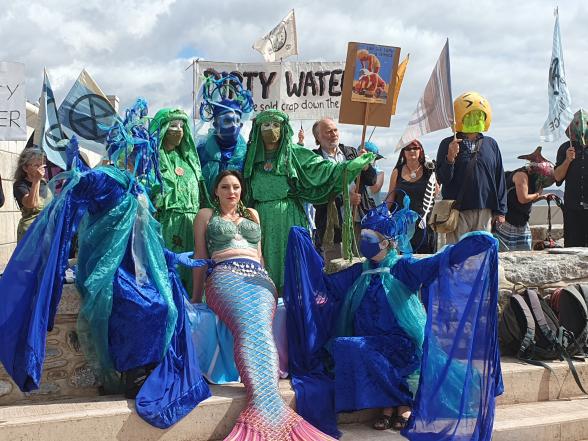
The mermaid takes centre stage at an XR protest in Dawlish
This event featured several presentations followed by a discussion on what can be done to improve the water quality of our rivers and estuaries, how we can work together, and plans for the future, writes Betina Winkler.
Anna Seal from the West Country Rivers Trust talked about how the Trust started, gave an overview of the areas it works in, and explained its citizen science investigation project, which covers rivers all over the South West region. For more information visit: https://wrt.org.uk/westcountry-csi/
David Leach of the Dartmoor Peatland Restoration Project explained how peat is formed, where we find the peatland areas in Dartmoor and the extent of degradation. The South West Peatland Partnership has projects in Exmoor and Dartmoor. Rachel Land talked about upcoming volunteering opportunities. Emma Magee, South Devon Catchment Coordinator for the Environment Agency, is responsible for delivering the EA’s environment programme within South Devon. She provided some links from her presentation:
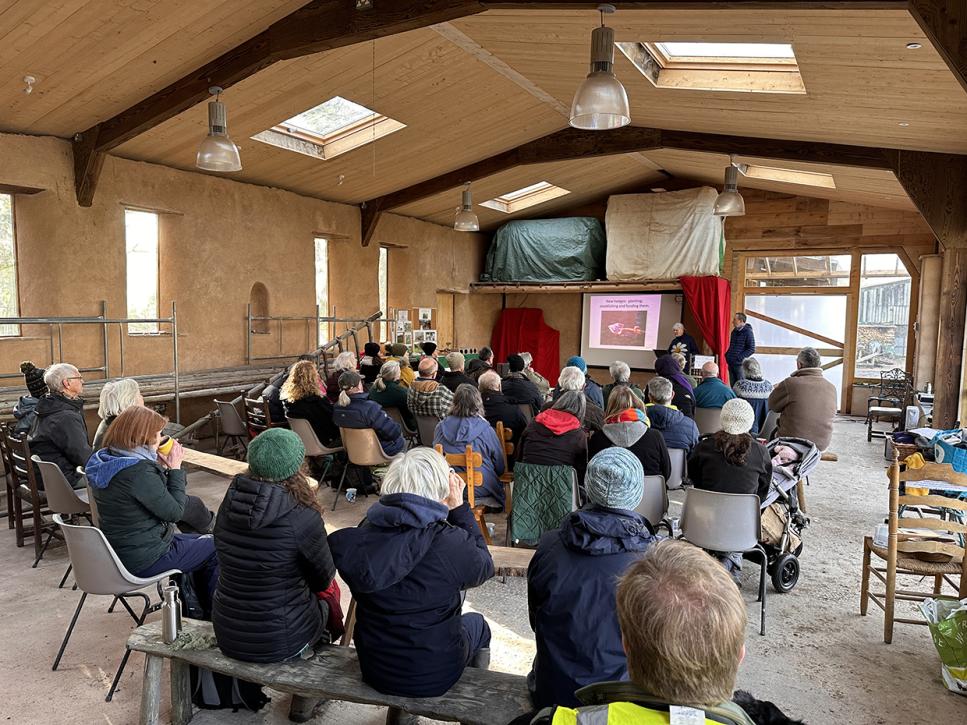
Teignbridge Wildlife Wardens enjoyed their first Big Gathering on January 29th, as 50 of the 100 plus team of wardens came together in the Teign Valley, writes Scott Williams. They convened at Oxen Park Farm, Higher Ashton, on a cold Saturday morning.
The venue is the location for Teign Greens, local food growers, and On the Hill Camp, a great organisation that educates school groups, universities, adults and families to live healthily and in harmony with nature.
This was the first time the Wildlife Wardens had had a chance to come together since the scheme was set up more than two years ago, so it was a happy occasion. However, the gathering’s mood was slightly tempered as it was also an opportunity for the wardens to say farewell to Flavio Winkler Ford, the scheme’s co-ordinator, who is moving on to a job in Scotland.
Flavio said: “We never managed to celebrate the two-year anniversary of the Wildlife Warden Scheme in October, so we organised a big gathering in January. There is a lot to celebrate! We now have over 100 Wildlife Wardens, and we are really proud of everything that you have achieved.
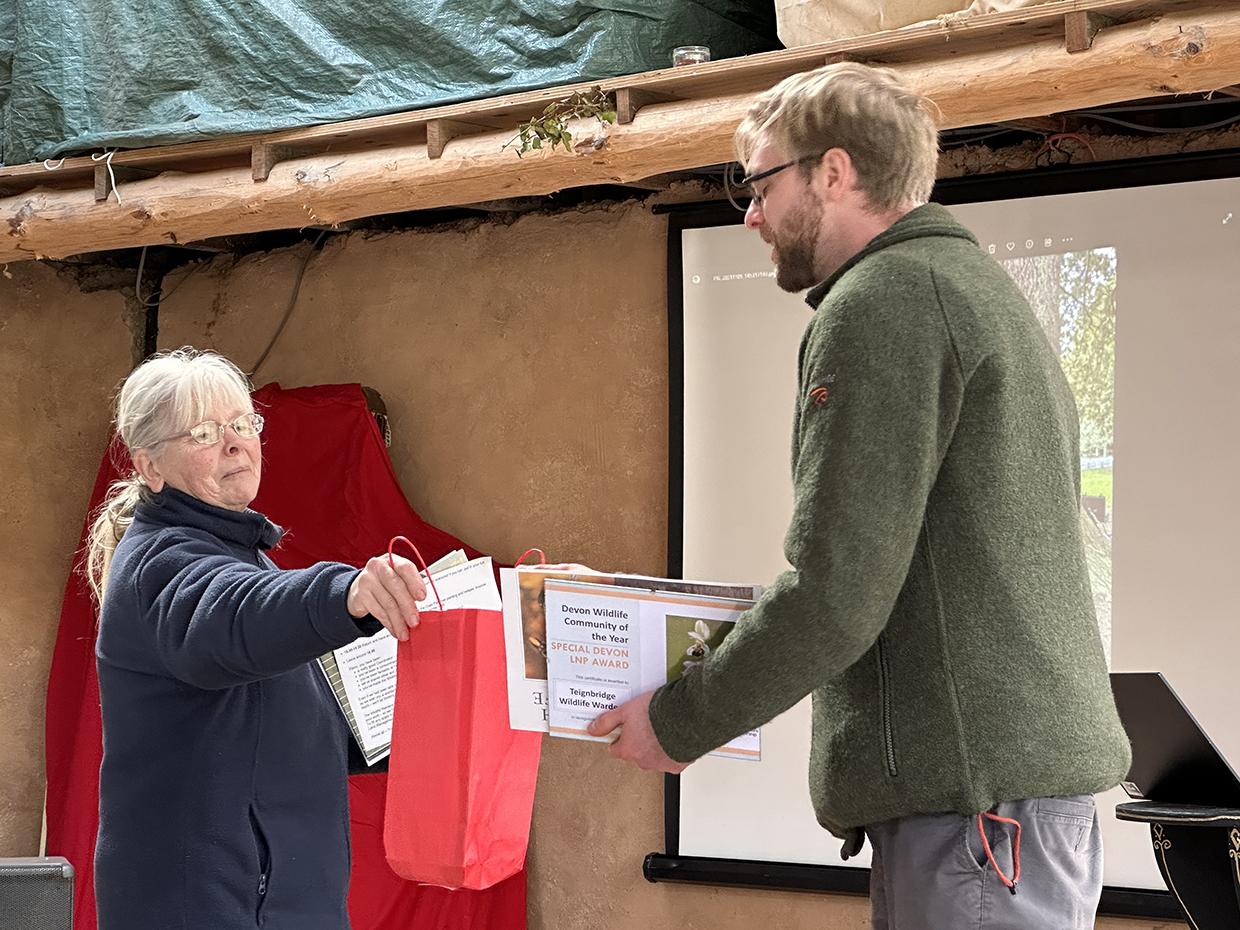
“Audrey was awarded Radio Devon’s Make a Difference Award for her work on the WW Scheme, and the Devon Local Nature Partnership awarded the Teignbridge Wildlife Wardens the ‘Special Award’ at their Community Wildlife Awards evening. Ogwild and Exminster Green Spaces also won awards. Well done everyone! Your hard work is being recognised.”
Host for the day, Jo Clark, made everyone welcome as they gathered in one of Oxen Park’s spacious rooms. ACT’s Audrey Compton spoke briefly about hedges and the new ones that she and John had planted last summer at their Teign Valley farm, and managed to keep alive in the drought.
Audrey had also invited two interesting speakers to further the group’s hedge and tree knowledge. First up was Shira Rub, a Wildlife Warden from Ashton, who spoke about her work surveying hedgerows. Then Dominic Scanlon spoke about trees and hedges. Dom works for Aspect Tree Consultancy and has also worked for Teignbridge District Council. He spoke about the importance of trees and hedges, and planting new ones, as well as legislation such as Tree Preservation Orders.
There was then a moment to thank Flavio for all his great work in the last few years and wish him all the best in his new role.
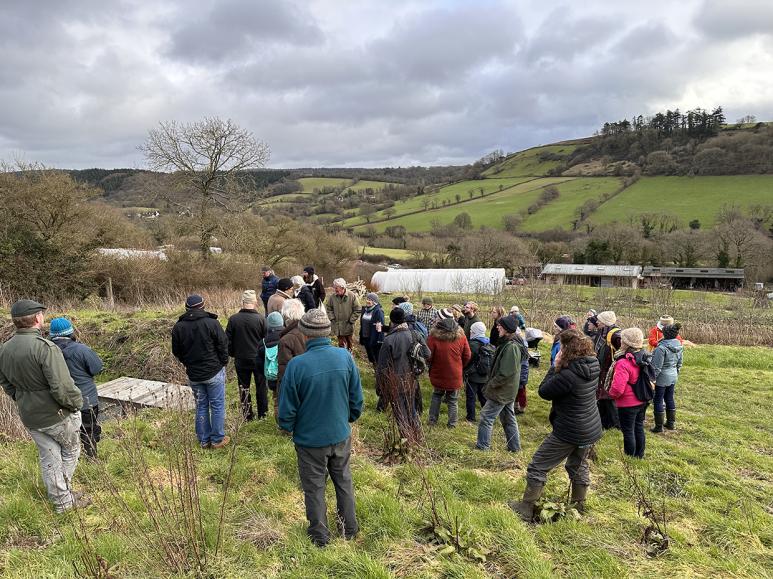
After a delicious homemade hot soup, there was an opportunity to enjoy a tour of Oxen Park Farm with Jo and Dom to see the ponds, a charcoal maker (Jo brought it from nearby Embercombe), new fencing, not to mention some beautiful countryside.
The farm has thousands of new tree plantings, and the group learnt about the problems of local deer who like eating new saplings. They also heard about and inspected old deer park walls, found an ancient oak and saw the new orchard – word is the inaugural Wassail will be next year!
The venue proved to be a perfect location for the gathering, and the range of homemade cakes the Wardens contributed were well received. The first Big Gathering was a great success and it’s hoped it will now (at last) become an annual event.
The Wildlife Warden Scheme is run by Action on Climate in Teignbridge’s (ACT) Ecology Group, supported by Teignbridge District Council, Devon Wildlife Trust, the Woodland Trust and Devon Biodiversity Record Centre. Founded just before the pandemic the volunteer, parish-based, Wildlife Warden Scheme was started to help our wildlife survive and thrive and to mitigate the Ecological and Climate Emergency.
Scott Williams is a Dawlish Wildlife Warden and publisher of Reconnect magazine
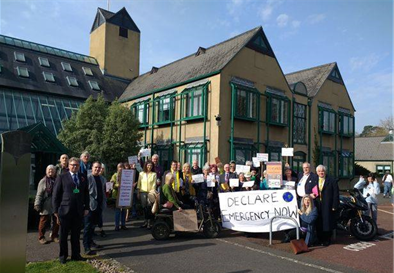
On April 18th 2019, Audrey Compton was standing outside Forde House, the home of Teignbridge District Council (TDC), with a group of people holding banners. They were there to lobby the council to pass the climate emergency declaration proposal put forward by Councillor Jackie Hook.
“We really didn’t think it would pass, but it did, unanimously, and with an amended carbon neutral target date of 2025, which was quite a surprise,” says Audrey, a Teign Valley farmer and environmental campaigner.
That target date was the most ambitious in the country, says Fuad Al-Tawil who was also at Forde House that day. “We thought it would be tough for the council to meet that target so suggested setting up a support group.”
The suggestion was welcomed, and Action on Climate in Teignbridge (ACT) was formed in the summer of 2019 following a public meeting in July at Coombeshead Academy in Newton Abbot attended by about 200 people.
Fuad says: “The idea was to support TDC to deliver on its climate emergency declaration and to work with community organisations in Teignbridge, including parish and town councils, as a bridge between them and TDC.”
New ways of working
A voluntary organisation working with a district council was a novel idea – unique even. Fast forward three years and how has that worked out? Well, the monthly meetings still happen and ACT has given freely of its expertise and opinions, which appear to be valued. It has at times offered a critical voice, and remains completely independent of the council. “We have built a good and pretty unusual relationship with the council,” says Fuad.
Kate Benham, ACT chairperson, says it has been a learning curve for both parties. “The council moves slowly, which can be frustrating, but it’s a case of understanding what it can and can’t do.”
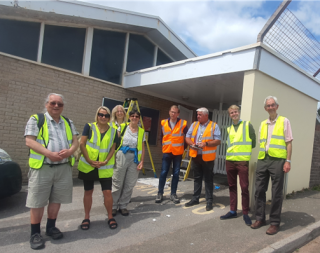
ACT members join Councillor Jackie Hook and council officer Will Easton to view work on renewable energy projects at the Teignmouth Lido in July 2022
Andrew Shadrake, a founding member of ACT, believes ACT has kept the pressure on the council: “Things have happened that wouldn’t have happened without us. We offer a resource, particularly on technical knowledge, that TDC relies on.”
However, the reality remains that carbon emissions have barely budged. Says Fuad: “ACT has succeeded in doing what we set out to do, in terms of supporting the district council and engaging the community. But in delivering on what matters, carbon reduction, we haven’t succeeded.”
Action on nature and carbon
ACT has had success on the ecological front, in particular with its Wildlife Wardens scheme, launched in the autumn of 2020. There are now 100 volunteer wardens spread across Teignbridge who have received training and do what they can to help wildlife in their parish.
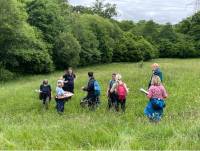
Wildlife Wardens being trained to complete surveys by the Devon Biodiversity Records Centre
“It’s been twice as successful as I ever hoped,” says Audrey, who set up the scheme and runs it with Flavio Winkler-Ford, a part-time paid coordinator.
“The great thing is wardens follow their own interests rather than ACT telling them what to do,” she adds.
Spurred by the success of wildlife wardens, in early 2022 ACT launched the Carbon Cutters initiative in a renewed effort to move the dial on carbon emissions. Trying to achieve this through engaging with local councils has proved tough. ACT will continue to work with councils, but will concentrate on engaging with community groups for the Carbon Cutters scheme.
“We are working with around 13 groups so far,” says Kate. “They are hugely enthusiastic and really want to help.” The scheme is run by part-time paid coordinator Peta Howell, with the help of a group of ACT members.
Still going strong
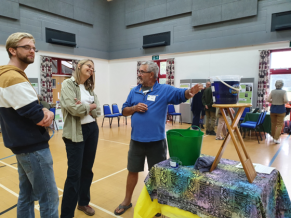
Demonstrating the global carbon budget at the Energy Roadshow in September 2022
Three years since launch, ACT still has a core group of enthusiastic, ambitious and committed people, and a wider membership of close to 450. That’s an achievement in itself, says Andrew.
Moreover, with Wildlife Wardens, and now Carbon Cutters, “we have tested and succeeded in developing a model for people to take action. We have also demonstrated a way of moving a district along, and raised the profile of climate change in the community.”
Flexibility is a key strength. “We are an evolving organisation that is learning all the time,” says Kate. “It’s good that we’re not afraid to change direction if we need to and try new things.” Mandy Cole, a psychologist who volunteers with ACT says it’s also important that “we don’t tell people what to do. We listen and learn more about what would help them to do more about climate change.”
There is also the personal reward for ACT members that comes with taking positive action, working with like-minded people and just having fun. For Audrey, “the last three years with ACT have been the most productive of 20 years of campaigning on climate change”.
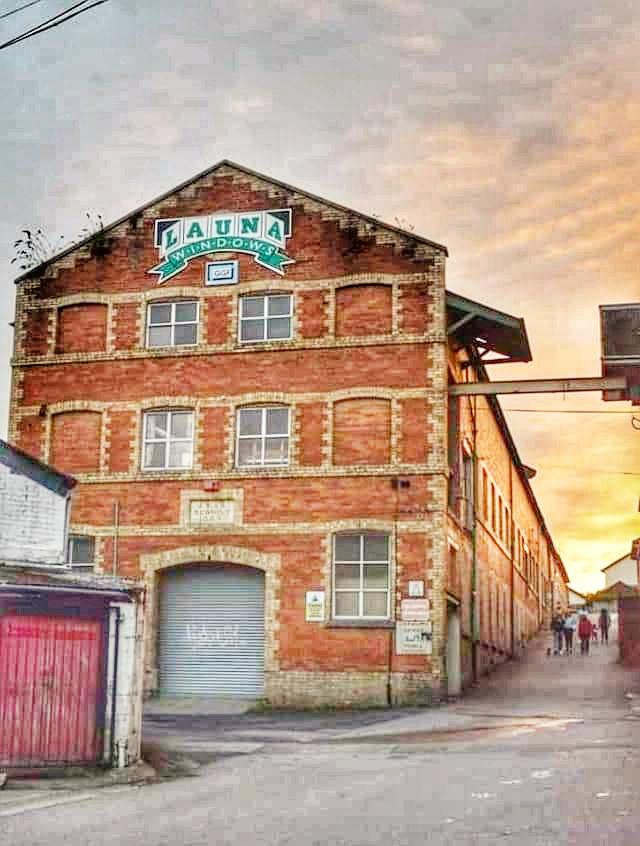
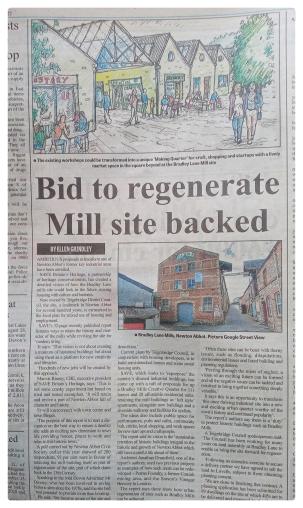
Friday 8th October saw the public release of the planning application for Bradley Lane in Newton Abbot (22/01500/MAJ), writes ACT Wildlife Warden Eloise Rokirilov. Long pending, starting at 171 documents and growing, the expiry date for comments remains at 4th November. The application calls for wholesale demolition of all the buildings, the burial and diversion of the medieval leat, and the construction of 90 new residential properties.
Why is Bradley Lane of interest or importance to anybody?
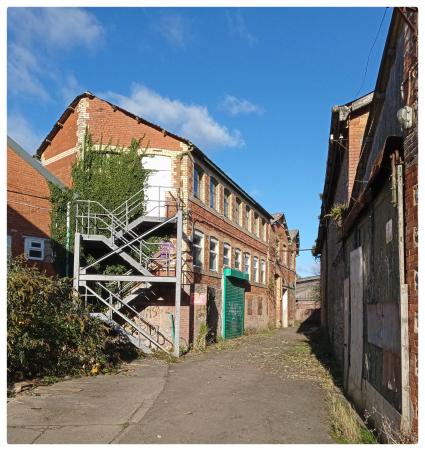
Of environmental as well as historic and archaeological importance, Bradley Lane is a brownfield site containing a set of attractive mill buildings, and a medieval leat that runs through the valley and into the town, joining the River Lemon underground near the Jolly Farmer. Mills have been sited on or around the area since the 13th century. They were originally built to serve Bradley Manor, the nearby Grade I listed National Trust property.
The buildings are a testament to the wealth and contribution of the Vicary family, who were key to the industrial prosperity of Newton Abbot. Employing around 700 people at its peak in the 1800’s, the family’s substantial business interests included wool milling, fellmongery (stripping wool from sheepskins) and tanneries. With the increasing use of synthetic rather than natural materials, among other things, the business finally closed in 1972. Bradley Lane cottages were, of course, workers cottages in their time, and there is a WW2 bunker between the mills and the old Benbows buildings.
Suffering repeat destruction from fire and flood over the centuries, the mills were proudly rebuilt on each occasion. The current buildings display a family plaque, “JV & S Rebuilt 1883”, celebrating its reconstruction in this year before its penultimate catastrophe, there also being a fire in 1921.
The mill buildings are far from the end of their life, being built of red brick, Devon limestone and local clay brick, some of the strongest material around. Historic England and the government themselves have started shouting more loudly about the need to avoid demolition, and instead retrofit and convert buildings as a way of meeting net zero. In a climate and ecological crisis, this makes sense. Demolition releases substantial carbon and other particles into the atmosphere.
Purchased by Teignbridge District Council in 2010, the mills continued to be used for commercial purposes. The council profess a long term intention to develop the site, and is proud of championing social housing on a brownfield site. Councillors state the intention is for the proposed development to include 44% affordable housing. However, the Viability Assessment report indicates a flat refusal by the developer to provide affordable housing as it is not financially viable. Instead, the intention is to sell 18 of the 90 units (20%) to the Guinness Trust, which will provide social rent housing. Homes England have offered funding of £2,063,400.
More crucially for the environment, the Waste Audit Statement shows striking, estimated figures:
14,000 tonnes of concrete, brick and stone to be demolished, and recycled on site.
240 tonnes of asbestos to be removed and transported to landfill.
5 tonnes of greenery to be cut down and recycled off site.
450 tonnes of tarmac to be recycled on site.
The present site has young trees on the west side by the River Lemon, and semi mature trees at the base of Hunterswell Road, where the recent bus survey proposed to put a bus lane, but according to this application, will instead have one self build plot on it.
The Ecological Mitigation report shows thorough work on bat surveys, although it does not mention the leat, which is known to contain European eels, a protected species. However, it has general ‘mitigation’ measures for amphibians and reptiles. There are more details in the 2019 survey report showing that the site is within the South Hams SAC for Greater Horseshoe bats, and located within a Devon Great Crested Newt consultation zone. Also that otters had been recorded within 1km of the survey area. Mitigation will involve staged cutting, in order to allow nature to escape.
Arsenic is recorded at 15 times the acceptable level and “the results of the risk assessment have shown that the concentration of arsenic within the upper made ground and lower natural soils poses a potentially significant risk of causing harm to end users of the environment”. The document nonetheless maintains that there are no concerns of contamination, danger or pollution to people or the water course.
Newton Abbot & District Civic Society applied to Historic England for listing for the buildings, as well as to TDC’s own Community Asset Register, which would also allow a Community Right to Bid should the owner decide to sell. The latter issued a flat rejection stating, “the buildings do not fulfil the requirements of the Localism Act 2011″. They also failed to meet the listing criteria for Historic England. They were noted for their strong local importance, but did not meet enough national criteria and had suffered too many changes over time. TDC did not respond to requests for internal viewings of the buildings, so any internal features could not be noted in the application.
Having evicted their last commercial tenant in March this year, TDC is presumably paying each month for the buildings, which could explain the determination to succeed with the current planning application, in an effort to recoup finance and resolve the future of the site. Of the evicted commercial tenants, at least two returned to Torquay, losing business for Newton Abbot. Benbow Interiors moved to the Brunel estate in 2019 in a deal that saw a new, funded site being built for them.
NADCS had already engaged a national charity, Save Britain’s Heritage, who took the time to visit Newton Abbot with an architect in tow, and were inspired to produce a 32 page report with architectural illustrations showing an entirely different vision for the site. They advised it is possible to accommodate 111 homes by way of conversion and some new build, including 28 affordable homes, which is more than the present application. The architect has worked on some major post-industrial sites including Heartlands in Cornwall and Sarsons Vinegar Factory in London. There are many examples around the country of successful conversions, including Digbeth in Birmingham and Finzels Reach in Bristol to name two more.
We are in a time of mass development, and a common theme of lack of affordability. Cranbrook in Exeter is currently in the news with another 1,000 houses proposed on 220 hectares of former farmland. The question has to be asked, where does it end?
With a deadline of 4th November, we would urge readers to comment on the planning application, and support conversion instead of demolition.(www.teignbridge.gov.uk/planning and search reference 22/01500/MAJ).
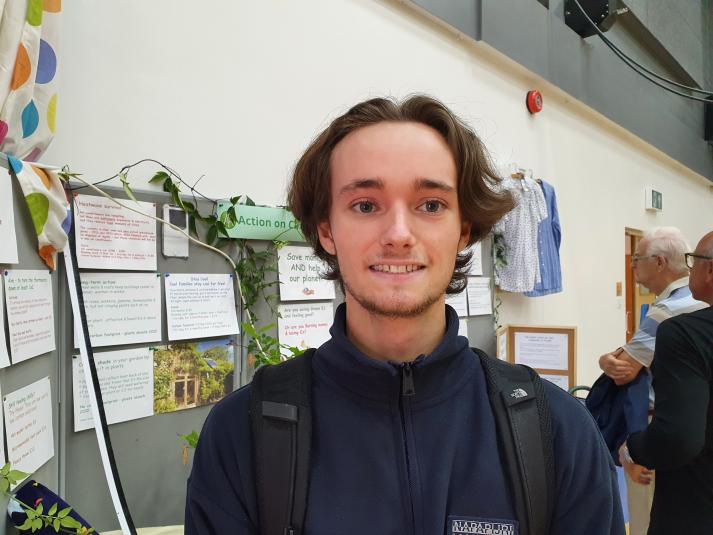
I have just completed a summer placement with ACT and my experience has filled me with hope, writes Finlay Heppell. It was a great learning opportunity for me and I met many knowledgeable and passionate people who all share the same goal of tackling the climate crisis in Teignbridge.
Finlay at ACT’s Energy Roadshow at the end of his placement
I contacted ACT after finding the website while searching for placement opportunities that would be relevant to my studies as a geography student at Bournemouth University. I got involved with both the Carbon Cutters and Wildlife Warden schemes ACT runs, as well as learning about how energy is used in Teignbridge and the psychology behind influencing/attracting people.
I attended several Carbon Cutter training sessions where I realised there is still a lot I do not know about carbon emissions and the climate emergency. One of the new things I learnt was the idea of reducing carbon emissions in an intelligent manner. A great tool that ACT has is a carbon footprint tracker that allows you to accurately work out your carbon footprint and explains how you can reduce it in a smart way. Using numbers is such a great way of helping people understand how to reduce their carbon emissions as numbers are often treated as fact.
Overall, I enjoyed my experience with the Carbon Cutter scheme as I learnt so much new information and it allowed me to get a bigger picture of what people/groups in Teignbridge district are doing to try and reduce carbon. As a young person myself it is really encouraging to know that lots is already happening in my local area
Carbon Cutters was set up to help address the climate emergency. The other scheme I participated in, Wildlife Wardens, focuses on the ecological emergency through helping nature. I learnt many practical skills, such as identifying types of plants and the impact that our carbon emissions are having on the environment in Teignbridge. My first experience of this was at a Wildlife Warden training session on Orley Common with the Devon Biodiversity Record Centre (DBRC). This session consisted of teaching Wildlife Wardens how to fill out a County Wildlife Site survey. This was a great introduction to how site surveying is done as I was around people who were very knowledgeable with regards to identifying plants.
On top of this training session, I attended an actual survey of a meadow in Trusham. This visit allowed me to assess how much of what I learnt had stuck, but more importantly, reinforced what I had learnt. I have learnt so many new things from these two sessions.
Planting wildflowers
The other side of my experience with the Wildlife Warden scheme was focused more on working directly with wardens and helping out with their projects. This included researching information for an article on the health of the river Teign, clearing a flowerbed and planting wildflowers in Newton Abbot, and assisting with a nature trail project in Kingsteignton.
Another aspect of ACT which taught me a lot was learning about the psychology involved in working with the public. The Public Engagement group within ACT particularly considers this. It was an area I was interested in because I don’t have much of a psychology background, so a lot of the information was completely new.
The focus of this subject was to listen, understand, engage, and take action. The complexity of this topic was interesting as many things have to be considered when approaching people. The key takeaway for me was that evoking emotions in people is an essential part of enabling them to make changes, perhaps by overturning their cognitive biases. In this instance it would be changes related to cutting carbon.
The last part of my learning with ACT was the IT aspect, which included the gathering of data and creation of maps for the ACT website. This area was interesting as it tied in with a module that I had just finished at university. The module was about using Geographic Information Software (GIS) to gather data and create maps from it. Being involved with this side of ACT allowed me to see the real-world applications of what I had been learning at university.
As a young person it fills me with hope knowing that the district I live in has such a large and organised group tackling the climate crisis. The schemes cover a wide variety of problems, from ecological issues with the Wildlife Wardens, to how much carbon is being used through the Carbon Cutters scheme. On top of this, each scheme has further projects within it. This allows ACT to try and address multiple and diverse issues surrounding the climate crisis.
ACT is independent of Teignbridge District Council while still working closely with them and providing advice. The independence is important as it allows for much more freedom, and makes it easier to collaborate with many other smaller groups in the area.
In conclusion, my time with ACT was valuable both for what I learned and the people I met. I return to university feeling more hopeful about what we can all do to take action on the climate and ecological emergencies, especially if the ACT model is replicated throughout the country.
The Environmental Audit Committee has written to both the Chancellor and the Office for National Statistics (ONS) to ask for estimates of greenhouse gas emissions to be published alongside GDP figures to indicate whether economic growth and slashing emissions can be achieved together.
This follows the committee’s inquiries in February and March into “Aligning the UK’s economic goals with environmental sustainability” and, in particular, how the reliance on GDP as a sole measure of prosperity can hide the climate and ecological impacts of economic growth.
The letters highlight in general the isolation of climate and ecological data reporting from fiscal reporting and how a true picture of how the country is progressing in all aspects of the economy, the environment and net zero targets is impossible unless integrated reporting is provided.
Much is made of the failure to implement the recommendations of the “Dasgupta” review into our economy’s reliance and impact on the natural world. This was a review commissioned by the Chancellor and had these headline messages.
The two letters are similar in content but the one to the Chancellor provides the main thrust of the committee’s recommendations.
Following Part 1 of the enquiry this part questioned witnesses on how environmental sustainability could be incorporated better into the economic measurements that guide Government policy.
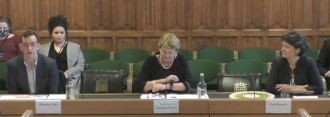
The full inquiry of over an hour can be viewed on parliamentlive.tv however we have separated out the following clips covering the discussions around the use of GDP and how it does, or doesn’t, represent a valid measure of prosperity and how other measures should now be regarded as more fit for purpose in the 21st century. The witnesses in this session were as follows:
Professor Kate Raworth (KR) – Co-founder and Conceptual Lead, and author of Doughnut Economics at Doughnut Economics Action Lab.
Professor Henrietta Moore (HM) – Founder and Director at Institute for Global Prosperity, and Chair in Culture, Philosophy and Design at University College London (UCL).
Matthew Lesh (ML) – Head of Public Policy at Institute of Economic Affairs.
Clip 1 (15 mins) How useful is GDP as the primary methodology and can it cope with the increasing demands of how we view prosperity in our economies?
ML: who, as a traditional economist, accepts that GDP as a measure is flawed but believes it’s still the least worst option as a measure of prosperity. He extols the virtues of GDP and also mentions the UK’s track record in decoupling economic growth from its carbon emissions (see clip 2).
KR: who isn’t a traditional economist, puts the case for a dashboard of measures, in addition to GDP, and also introduces an element of Modern Money Theory surrounding the ability of governments, like the UK, to pay for essentials without worrying about tax revenues.
HM: GDP is not a good proxy for prosperity, it’s a 20th century metric not fit for the 21st century as it tells us nothing about distribution (of income), sustainability, inequality and environmental degradation. She talks about speaking to people in regions over what’s important to them for their prosperity.
Clip 2 (17 mins) Are policy makers trying to have their cake & eat it, when they argue that it’s possible to tackle the climate & nature crisis whilst continuing with economic growth?
KR: Yes they are. She dismisses stories of “Green Growth” and points out that there’s little evidence that we can decouple carbon emissions and our material footprint from economic growth at anything like the speed or scale needed. She goes on to dispute ML’s earlier opinion on the UK’s record on decoupling and how our structural dependency on GDP growth will hamper our ability to deal with the climate & nature crisis.
ML: continues his support for economic growth as a solution to environmental and social problems, (as predicted by the Kuznets Curve*) but that we need to price carbon, and find ways to price other damage to the natural world, in order to bring them into the economic (GDP) equation.
HM: we need to recouple social and economic prosperity and embed it into environmental prosperity and that market solutions alone can not achieve this. We also need to reshape and create new markets dependent on regions.
KR: As a follow on to HM, the Doughnut Economics model is being used in cities, regions and local governments around the world, in the way that HM describes.
Clip 3 (5 mins) A question to KR – how could policy makers reduce the dependencies on growth built into our economic systems?
*The environmental Kuznets curve suggests that economic development initially leads to a deterioration in the environment (and an increase in inequality) but, after a certain level of economic growth, a society begins to improve its relationship with the environment and reduce levels of environmental degradation (and inequality).
A fascinating in depth inquiry into how government policy could move away from GDP as the prime measure of national prosperity to encompass other, more meaningful, measures for social and environmental wellbeing and to consider issues such as a post-growth world, non-monetary capital and inequality.
The remit of the Environmental Audit Committee is to consider the extent to which the policies and programmes of government departments and non-departmental public bodies contribute to environmental protection and sustainable development, and to audit their performance against sustainable development and environmental protection targets.
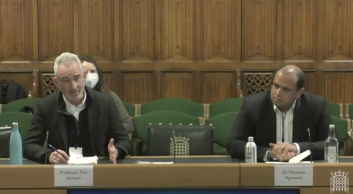
The full inquiry (76 minutes) can be viewed on parliamentlive.tv however we have broken it up into the following clips, each concerned with themed questions to the following two witnesses.
Dr Matthew Agarwala (MA), Project Leader, The Wealth Economy, Bennett Institute for Public Policy, University of Cambridge.
Prof Tim Jackson (TJ), Professor of Sustainable Development and Director, Centre for the Understanding of Sustainable Prosperity (CUSP), University of Surrey.
Clip 1 – (6 Mins) Question to MA, “whether you think that the current measurements of economic success take into account, sufficiently, the role that’s required in order to achieve a decarbonised economy?”
MA explains why GDP was fit for the 20th century but is not for the 21st, it’s a backward looking “flow” measure whereas what we need are forward looking “capital” measures. Using the analogy of assessing a bakery’s pantry of ingredients today in order to determine the quality and quantity of tomorrow’s pies. So, looking at the wealth available, net of any inherent harm, assessing natural assets & ecosystems, healthy & well educated human assets, physical and social infrastructures with strong communities and degrees of trust between people, business and government.
Clip 2 – (3 mins) Question to TJ about whether growing GDP is compatible with the challenge of the government’s sustainability plans.
TJ discusses the history and difficulties of the UK decoupling its GDP growth from its emissions and says how its historic responsibilities for emissions should also be factored in. Also brief reference to how carbon taxes can incentivise decarbonisation.
Clip 3 – (8 mins) Question and discussions over the benefits and pitfalls of GDP and the other measures we should be considering to judge our prosperity.
MA talks more on the history of GDP and expands on the pantry/portfolio approach raised in clip 1 and the excellent statistics, data and accounting available in the UK to measure the various elements.
TJ points out the importance of not just looking at the portfolio of financial, natural and social capital but also at its distribution across society, something GDP ignores, and how an unequal society puts social cohesion at risk. He goes on to explain how GDP takes no account of housework or the true value of care work, most often undertaken by women.
Clip 4(14 mins) Question and discussions on alternative measures to GDP.
TJ explains dashboards of non-monetary indicators, such as climate, health, inequality etc, and how they are already available around the world and how they can be aggregated into single measures.
He describes more subjective measures like wellbeing and how measures can be assigned prices to come up with a single monetary measure, as happens with GDP, and how, being subjective, some measures and how they are used will involve policy decisions.
MA discusses the challenges of defining and measuring social capital, especially as it can’t be assigned a £ value. How it involves measuring trust in, for example, the ability of communities to come together, after say a flood or during the pandemic. It is measured through regular surveys of how people feel in their neighbourhood and about their neighbours, taking into account cultural differences and using scales of 1-10 over trust in people and institutions.
Clip 5(17 minutes) Question over the comparison of monetary values determined by “the market” and those assigned to non-market measures and whether these will always be swayed by political rather than economic decisions, thus bringing in issues over trust.
TJ pushes back by saying that we already have a political element in market prices in that political rules and policies will determine how markets work and discusses existing national satellite accounting by the ONS, for non-market statistics, and how this doesn’t currently make it to policy.
By going back to the origins of GDP, MA explains how its construction and measurement has always involved politics.
TJ discusses carbon targets and the need to put a value on carbon in the economy to encourage or discourage behaviours, but how this must factor in inequality, eg lower income families spending a larger proportion of their income on carbon intensive purchases. He also comments on the importance of some kind of hypothecation in carbon taxes, ie in knowing where the tax comes from and where it is then applied.
MA discusses the UK’s ability to influence international environmental and natural capital accounting including the move away from GDP and how the UN’s system for national accounting for GDP is currently under review to recognise human & natural capital.
Clip 6(12 mins) Question 1 to MA over whether the Treasury is making full use of existing alternative accounting statistics and if not, why not.
MA points out that the recent leveling up approach takes into account various capital approaches but misses out natural capital, a “missed opportunity”. He then goes on to discuss the potential for the UK Treasury to take advantage of its national Green Bonds by underpinning them with the good science and statistics we already have.
Question 2 “As tax revenues are tied to income & spending would it be economically disastrous for government to deprioritise GDP growth?” (Government relies on GDP growth as it believes it needs an ever increasing tax take to help it pay off ever increasing government spending).
TJ starts by explaining the importance of GDP as an accounting measure, and how he is not calling for it to be removed, but expands on his previous comments on where it falls down in recognising the distribution of wealth and the changes in the assets, and environmental impacts, that go to create it.
He says that, in order to move away from GDP as the sole measure, we first have to unravel infrastructures and institutions that are growth dependent and which therefore drive the need for GDP growth, eg privatised social care, and imagine what a post-growth welfare state would look like, pointing out that, with production growth already having fallen, we are, in effect, already there.
Question 3 then explores how the government might square the promotion of green and net-zero policies, eg switching to electric vehicles, with the resulting drop in tax and duty.
Clip 7 – (6 mins) Question about the Treasury’s response to the DasGupta report on The Economics of Biodiversity, in particular, that relying on GDP growth as a measure of our success ignores the reliance we have on nature and its resources.
TJ points out that whilst the report rightly calls for “inclusive” accounting, again it misses social inclusion in terms of the distribution of wealth and environmental/social harms.
MA discusses the lack of government response to the report and how this could be achieved within this parliament, warning that if we keep relying on GDP, the increasing gap between what GDP is telling us about the world and what people are experiencing will diminish public trust in statistics.
“The difference between using wealth versus GDP as a measure of the economy is the difference between getting a backwards, after the fact, diagnosis at an autopsy from a coroner versus getting one ahead of time from the doctor in their surgery that you can then treat”
Other resources:
DasGupta review – report to UK Treasury February 2021 – “The Economics of Biodiversity”
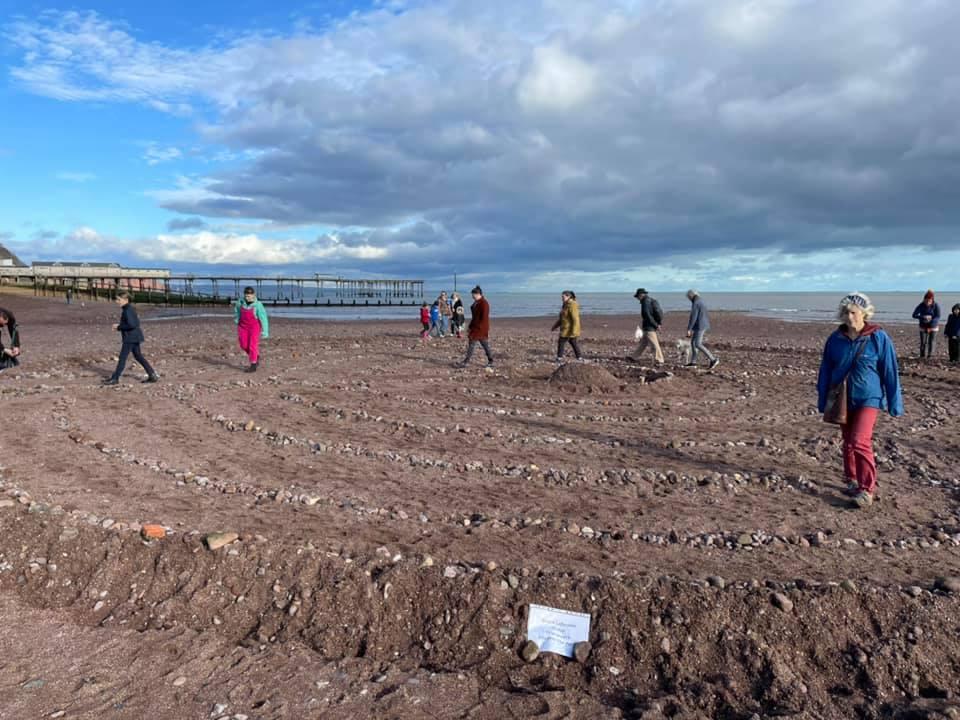
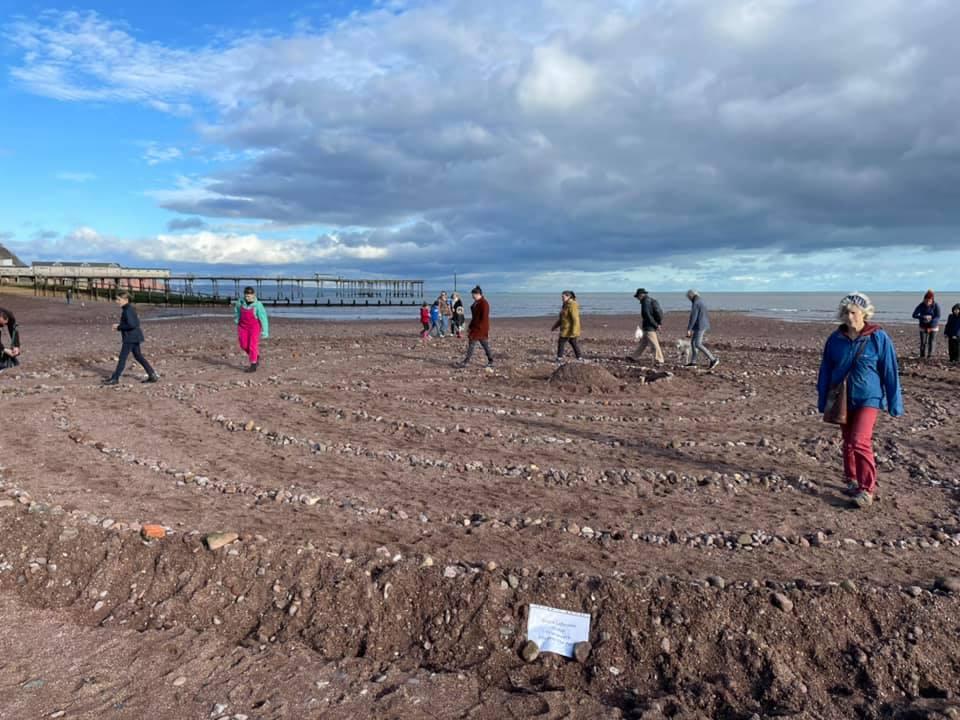
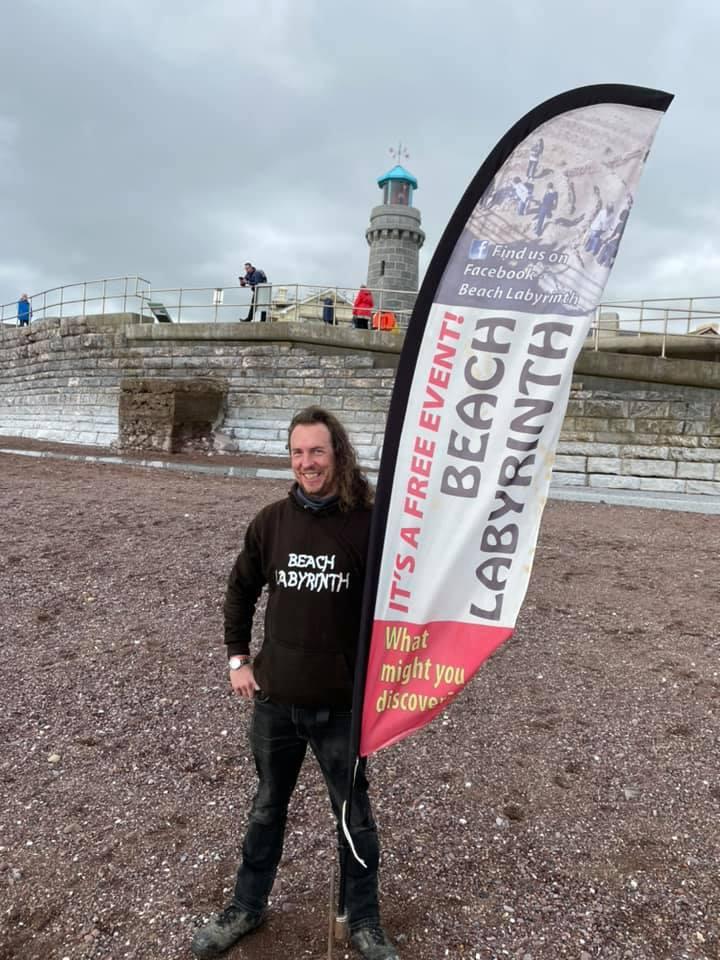
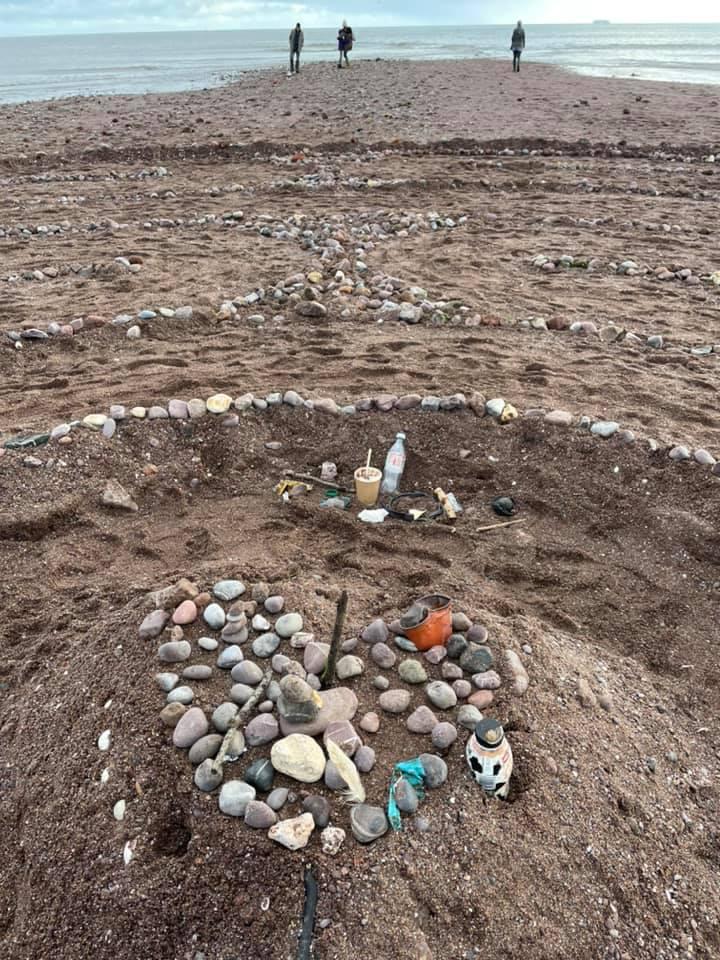
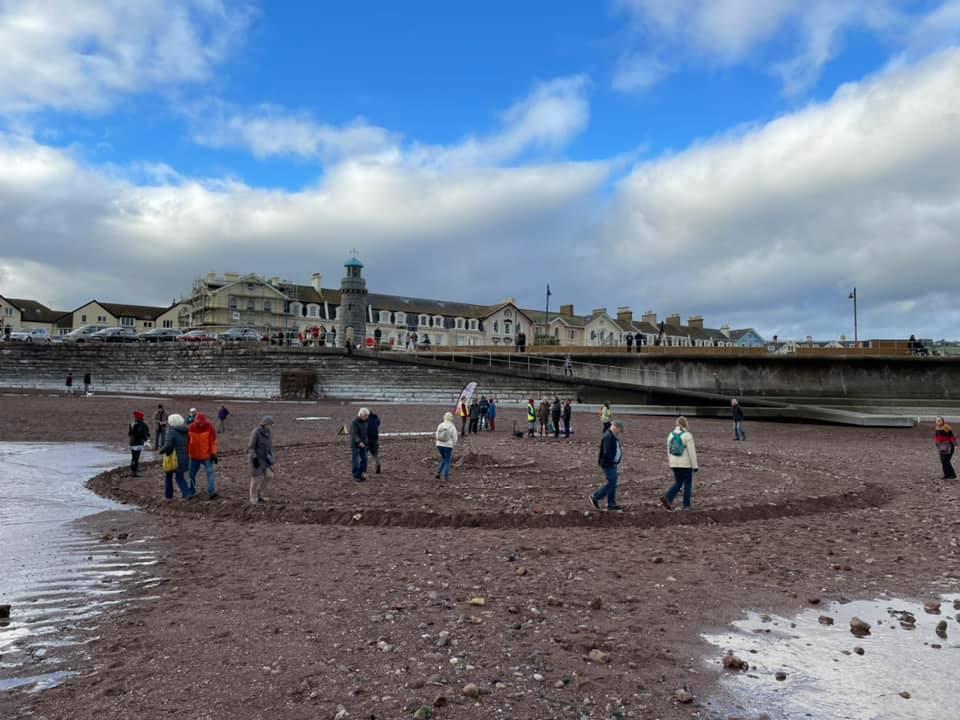
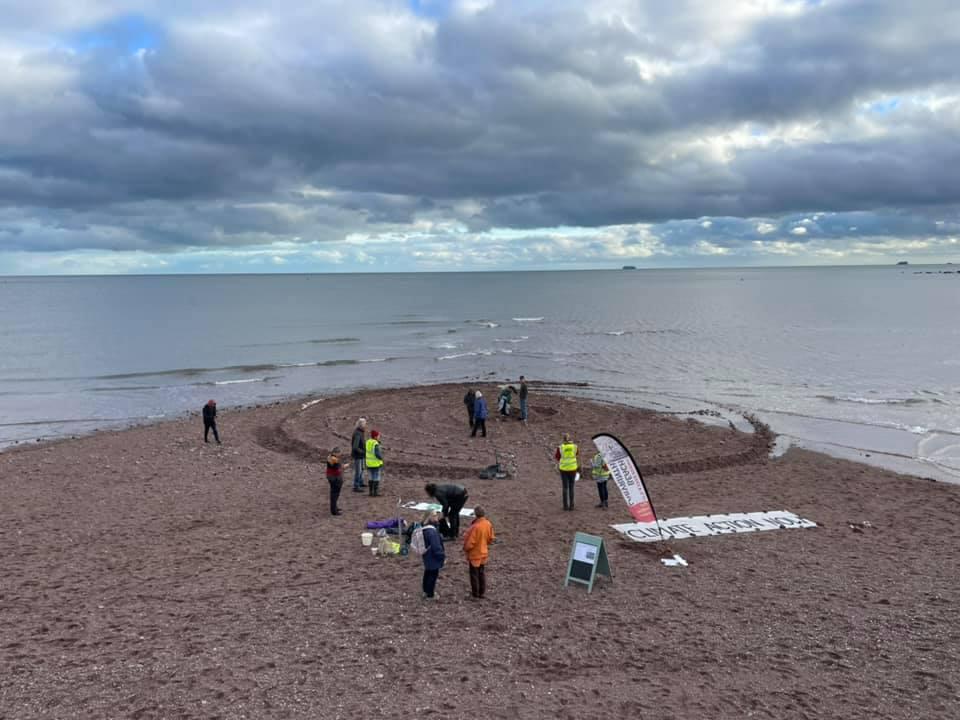
Around 100 people walked the labyrinth created on Teignmouth Beach last weekend for the Global Day of Action for Climate Justice. Plenty more watched the walkers from the promenade.
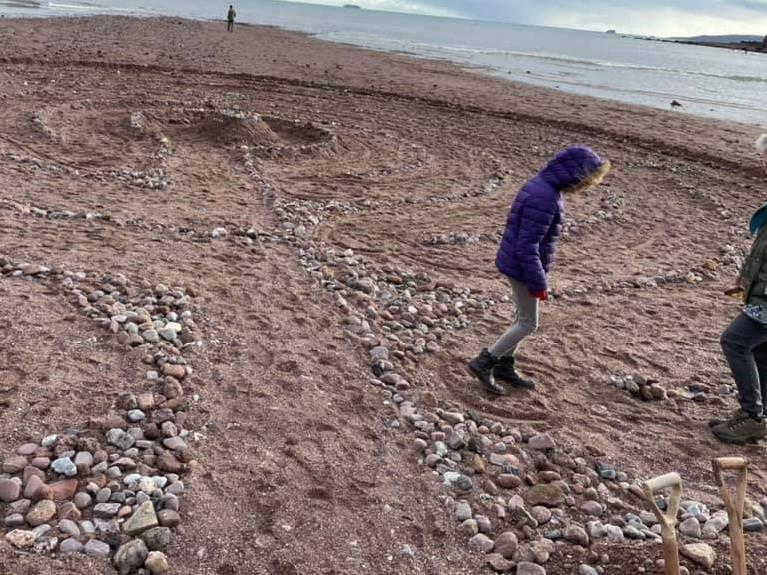
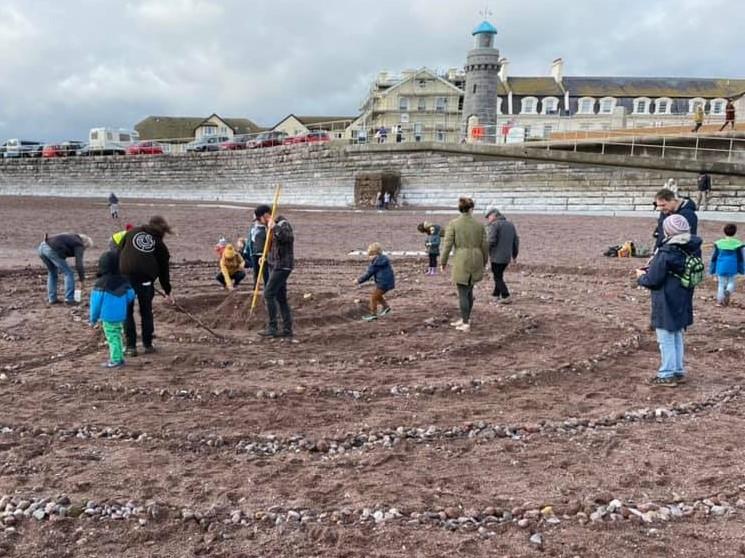
The construction effort, directed by labyrinth artist Andrew Nicholson, was tough work as the chosen location, below the lighthouse, was particularly stony. Still, the stones added to the attraction of the finished artwork as they were used to mark the labyrinth pathways.
Passing families with children joined in enthusiastically to place the stones. “That building effort with the parents and children was my favourite part of the experience,” said John Watson of Action on Climate in Teignbridge, which organised the event. “All in all, it was quite a spiritual event which I think connected with people in a most original way.”
Labyrinths have a long history. People have been creating and walking them since the times of the ancient Greeks. In medieval times, Christian monks would walk them to reflect on the journey of their lives.
The idea of the Teignmouth Beach labyrinth was “to reflect on our concerns for the environment and be thankful for the special places in our lives”, said Andrew Nicholson (pictured above).
Those walking the labyrinth were invited to pick up a piece of rubbish found on the beach at the entrance, reflect on their concerns as they trod the meandering path to the centre, then leave the rubbish and their concerns there. They could then take a stone from the centre and walk back thinking of places precious to them.
Scott Williams, an ACT member, said: “It was amazing and moving to see the flow of people travelling through such an ancient symbol. The solemnity and peace it created within those that walked it will stay with me.”
Of course, the sea claimed the labyrinth as the tide came in later in the day. Watching the water engulf the construction, a vicar from Dawlish remarked how appropriate the image was; a symbol of the threat of climate change to many people around the world.
“There were lots of people watching as the tide came in,” said Audrey Compton of ACT. “People of all ages. People who wanted to talk. It was obvious to me that we have suddenly reached a tipping point of understanding about the environment and desire for change. COP26 may not achieve nearly enough politically, but it has galvanised ‘people power’!”
For more on beach labyrinths visit the facebook page.
In this podcast Emily Marbaix updates us on what wildlife wardens have been up to, reminds us of autumn jobs to do in the garden, especially those that help wildlife, and takes a look at the eco-friendliness (or not) of our pets, including what we feed them and the flea and worm treatments we give them.