Category: Energy & Built Environment

  • Energy group meeting notes (14.03.2024)

    Energy group meeting notes (14.03.2024)

    The next regular meeting will be on Thursday 11th April 2024 at:

    Thus. 11.04.24 at 19:30 and every 8 weeks

    Thus. 09.05.24 at 16:30 and every 8 weeks


    Here are some notes from our March meeting. Nice to see people who’ve not been for a while. If you’d like more information on any of the topics, please contact or comment on the post below.

    • Mixed messages from government following some major announcements!

    In Feb 2024, the government announced it will withdraw from the TCP agreement on energy trading.  This is great news as it stops energy companies from suing governments if they passed laws affecting investments in their energy projects.  It was widely hailed as a move to enable Net-Zero policies, in reality it was probably just a reflection of what was becoming a costly liability to EU countries.  In July 2023 the EU had already made that decision leaving the UK little choice.

    Ministerial announcement on not exceeding planning regulation in Local Plans could have an impact on Teignbridge’s pending LP inspection. Although it may be argued that the recent court cases in Oxfordshire and the wider case against the government on the lack of clear plans for achieving Net-Zero could be used to thwart this announcement.

    We also talked about the second consultation on the Review of the Electricity Market Arrangements (REMA). Misleadingly, this was reported as the government building new gas-fired power stations, in reality it has some positive proposals on supporting renewables and “transitioning away from the unabated deployment of gas-based systems…”. See the Regen response so far.

    • Is my gas boiler inefficient?

    This question can be applied to many things, boilers, cars, windows, etc.  We discussed what terms like “efficiency” actually mean and how cost relates to energy and to ghg emissions.  The question we need to be clear about, before deciding on a solution, is “what is the problem?”.  Is it really an inefficient boiler, are gas prices becoming unaffordable or am I consuming more because I’ve changed some setting/behaviour? 

    Many of our routine services (e.g. utilities) do not register in our daily lives, nor should they.  That is until we notice an increase in our bills or hear something about them.  For those who can afford to pay the increased prices, no further though is given to the subject, or we may talk about how utility prices should be kept down so everyone can afford to heat and light their homes.

    We also tend to pick a solution we’ve heard about, one which is affordable, easy to do and appealing. Often this is a random process with the judgement on efficacy based on what we’d like to tell others.  Sometimes this makes us feel good, sometimes not so good.

    So the question is, how much extra effort am I prepared to put in to find an effective solution that I will be happy with in the long term? Do I want to learn enough to spot a ‘sales pitch’ or ‘greenwash’?  I’m sure most of us want to, but struggle to find the time or interest.  Understandably not everyone can, so here are some pointers to where to get someone independent help with household energy use:

    1. Follow some of the advice on actions, ideally after assessing your energy/ghg emissions using the Carbon Footprint Tracker (CFT).  There is a link in the ‘results’ tab under ‘list of actions’ in the ‘help’ panel where you can search specific areas.
    2. a self-help programme (Energy Assessment Pack, E-Pack) available to TECs members with ongoing support.  This is aimed at anyone who wants to learn how to make more informed decision on actions they can take.  It includes measurements and modelling which are becoming more widely available such as the CSE scheme Jules mentioned.
    3. Energy Saving Devon is aimed at those who do not want, or cannot, be involved and would rather be told what to do.  There is an interactive tool to “create home upgrade plan” under Resources.
    4. Hiring a Domestic Energy Assessor and/or architect/heat engineer.  Best to get recommendations from someone whose done what you are looking for.  There are emerging standards/schemes to control quality (e.g. PAS2035), but these are not yet widely used.
    • Does self-build result in lower carbon emissions?

    Here is a report summary from the self-build trade body, some interesting insights.

    • An irresistible opportunity to mitigate climate change and save money?

    How does this offer from Ripple Energy stand up against its claims? Look at the short introduction video, is it an offer you cannot refuse?

    The key to successful advertising is to tell people they’re getting what they want.  Advertising standards are intended to stop mis-selling, but how effective are these?  Advertising codes, published by government even has a relatively new section on ‘environmental claims’ as well as the well established ‘misleading advertising’ codes. It’s not clear whether this is a rigorously implemented as intended or if there is a threshold for number of complaints which isn’t being reached.

    • Standards for emissions from our built environment.

    I mentioned the RICS latest version of their whole life carbon assessment for the built environment. Worth reading some of the introduction sections, ‘1.1.background’ has a useful general perspective.

    • YouTube video on Retrofit.

    There is a lot of material on the internet covering retrofit.  As well as the signposting at the end of our energy webpage, this publicly available AECB video was shared by Paul B.  It does go into some detail and is ~40 mins long, but worth a look if you want to understand the reasons for and key information on Retrofit.

    • What is ACT planning for this year’s national elections.

    This question was raised at the meeting.  Coincidentally the ACT steering group discussed this very topic; whether we should run hustings again this year. After some discussion, it was agreed to draft questions which can be sent to prospective candidates in Teignbridge’s two constituencies.  We would then share the responses.

    So we’ll put some time aside at our next Energy group meeting to discuss and formulate questions. Give this some thought and either come to the next meeting or send me your questions.  Here is an example to get you going:

    “Do you believe the UK should lead the world by example in setting and achieving Carbon Budgets that keep our contribution to within the 1.5C climate tipping point?  If so, what priority topics will you set ahead of this?”

    Written by Fuad

    Energy group coordinator
    fuad@actionclimateteignbridge.org

  • Energy group meeting notes (15.02.2024)

    Energy group meeting notes (15.02.2024)

    The next regular meeting will be on Thursday 14th March 2024 at:

    Thus. 14.03.24 at 16:30 and every 8 weeks:

    Then Thus. 11.04.24 at 19:30 and every 8 weeks: 

    Here are some notes from our February meeting, it was nice to see new faces and several old ones, one unlit!

    Apologies if anyone found the discussion on battery charging too esoteric.

    • How significant are heat domes in new housing developments?

    Also called urban heat islands, these can result in health consequences as well as additional energy demand for cooling.  The general view was that this applied mainly to larger town/cities when overheating is already a major concern.  Appropriate planning rules to improve green spaces/corridors and allow better air circulation are still necessary in smaller urban areas, especially now, given a warming climate.  

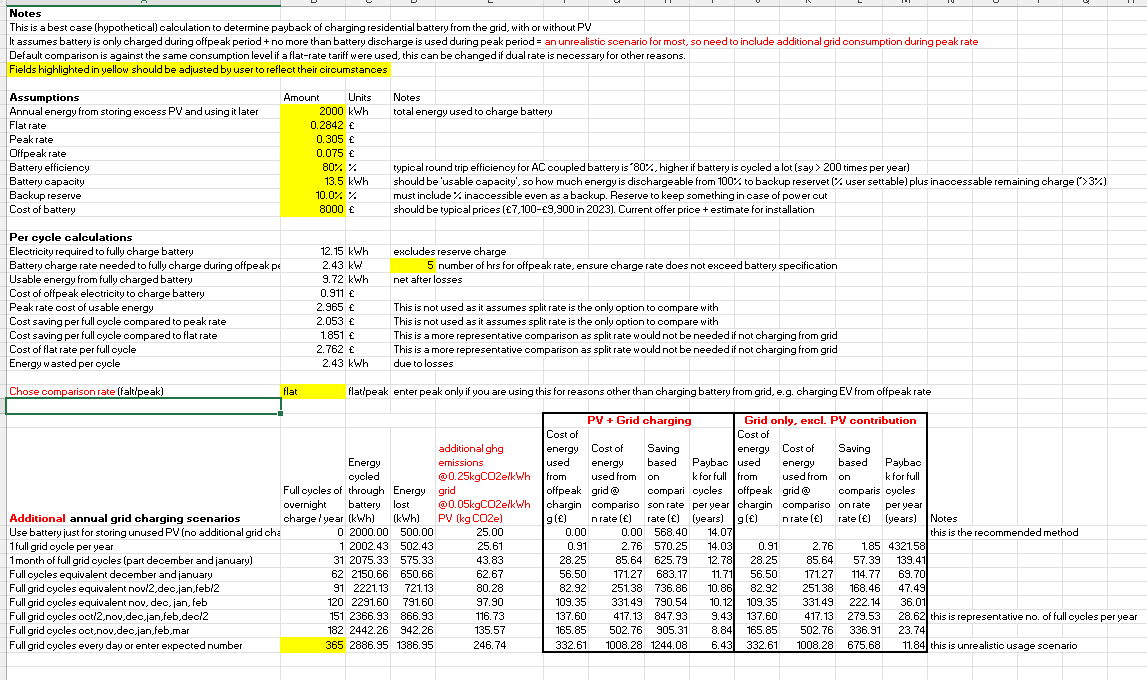
    • The numbers are in! We can now make a statement re charging residential batteries from the grid.

    Jules has developed a spreadsheet to calculate this for individual cases, please take a copy to use.  I’m hoping we can put this discussion to bed with the following statements, but feel free to comment further:

    1. In the absence of any other evidence, we’ve agreed to compromise on ‘typical’ round trip efficiency (RTE) for an AC-coupled battery system of 80%. Individual usage may make this higher (~85%) or lower (~75%).
    2. Charging your battery from surplus PV provides the most effective payback for your battery system. This is what ACT recommends as it also reduces your carbon emissions from the electricity you consume.
    3. Charging your battery from the grid at a significantly lower tariff (e.g. off-peak period rates) can further reduce the payback, by how much will depend on several factors, such as the relative unit price; number of charging cycles; % of grid charging compared to PV charging.
    4. ACT does not encourage excessive charging from the grid as this may increase your grid’s Carbon Intensity and reduce the life of your battery. Instead, we recommend a careful analysis of the various parameters to calculate the financial and carbon impacts, before opting for this.

    There may be other reasons for charging a residential battery from the grid, e.g. helping reduce demand during peak periods or ensuring sufficient backup energy is available in case of a grid outage.  Reducing costs is, however, only possible in a few cases, so it is worth using the calculator above to find out first.

    • How well does the finance sector follow the energy hierarchy?

    It seems more and more. The headlines we hear tend to be either euphoric trumpeting technological solutions or depressing highlighting the lack of effective action.  Often the less dramatic information is not reported.  Industry and commerce is well ahead of most governments and even ahead of most people in taking decisive action. Here is an interview as an example of a business focused on the 2nd step of the energy hierarchy.

    It would be even better if financial/economic system embraced the 1st and most effective step in the hierarchy, namely cutting out waste.  We can do much to reduce (not eliminate) the 67/70 % inefficiency in energy systems (Europe/USA respectively), but we could also eliminate 25-50% unnecessary (wasteful) energy use which is more widespread in homes/businesses than we think.  Unfortunately, there is no money to be made in using less energy and behavioural change is challenging for most people.

    • Scope-3 and carbon factors, sources and how we use them.

    We are updating the carbon factors used in the CFT and associated lookup tools.  Look out for an adjustment to some of these.  If you are interested in joining the discussion to include different ways of calculating ghg emissions caused by our everyday activities, please contact Fuad.

    • Hot water tanks and how best to heat them.

    Hot water accounts for ~20% of total heat energy used in the home.  The question on how to ‘best’ heat this when there are several choices comes up quite often.  Heat Pump (HP) owners often ask this question because of the reduced performance when heating domestic hot water.  Quite a few people have PV diverters that channel surplus electricity to the immersion element.

    It is sometimes tricky to work out the actual hot water energy consumption in a domestic setting.  This becomes more difficult in a public setting because planned consumption can vary a lot.  This is where energy assessment programmes like TECs’ E-Pack can help.

    Advice on this will depend on the objective and circumstances, so these need to be established first.  As a starting point, always use the energy hierarchy shown on our webpage.  That is only heat as much water as you need and only when you need it. This often reduces energy consumption by a significant amount, up to 50% when inadequate heating controls are used.

    We discussed a couple of scenarios to see if it is possible to work out how to heat the required water using different technologies.  You can find a number of calculated actions in relation to heating water from the CFT results help panel, search for “hot water” in the ‘list of actions’ tool (make sure you select the year 2023).

    • Vertically mounted PV panels.

    There are few advantages of vertically mounted PV panels.  In the right orientation and with no obstruction low winter sun, they are likely to perform better in the winter but this is a marginal gain.  Overall, their annual output will be lower than an equivalent roof mounted system.

    Planning rules apply equally to both roof and wall mounted domestic panels. It is, however, worth checking with the respective planning authority (TDC) and of course any immediate neighbours that may be affected. A number of people at the meeting expressed their experience that rules seemed to differ between different planning officers.  A case for asking for a copy of the applicable regulation?

    • New study on domestic wood burners.

    This study focuses on airborne pollutants like PM2.5 and other toxic emissions.  This topic is discussed from time to time at the Energy group meetings.  ACT has also published an article on the topic in early 2021, this generated several comments.

    The general advice is, but each case can be different:

    1. Burn wood as a primary source of heat generation, so basically using a biomass boiler, avoid room burners unless your home is a cabin in the woods.
    2. Know the source of your wood to ensure ecological sustainability and associated ghg emissions.
    3. Ensure your wood is of the correct quality to minimise health impairing VOC, NOx or PM emissions.
    4. Take appropriate precautions to minimise serious health impairing emissions both indoors/outdoors. Urban areas are the most challenging.
    5. Adhere to the latest regulations on sourcing biomass and on devices that burn these.
    • Do e-mails produce more ghg emissions than paper?

    Good question. We try to provide tools to help users make more informed decisions, often by comparing the impact of one or more options for doing/buying something, see the reference to these tools above.  Unfortunately, it’s not possible to populate the tools for all things as it sometimes takes a lot of research to get to a ‘good’ answer.

    Luckily, we can usually find one or more ‘good’ references which we qualify to make sure they give a representative value for ghg emissions.  In this case Jules had “How Bad are Bananas” on hand.

    It turns out e-mails and a sheet of paper, especially scrap paper, produce tiny amounts of ghg emissions (a fraction of a gramme CO2e).  For e-mails, most of this is related to making/using the computer.  When most of us have an annual ghg footprint of 10-20 tonnes, should we not be looking elsewhere for quick and effective reductions?

    Nevertheless, we do send a lot of e-mails (and paper if we used this), so it’s good to follow the energy hierarchy mentioned above.  That is avoid unnecessary e-mail recipients, think about who needs to receive it and can you reduce the size of attached files (e.g. pictures).

    Written by Fuad

    Energy group coordinator

    fuad@actionclimateteignbridge.org

  • Energy group meeting notes (18.01.24)

    Energy group meeting notes (18.01.24)

    The next regular meeting will be a zoom on Thursday 15th February 2024 at 19:30

    Happy Newy Year to you all.

    Here are some notes from our January meeting, some interesting discussions on lots of topics raised by group members.

    Strategic planning of gas and electricity networks.  Is TDC engaged?

    This guide was launched by the Energy Networks Association, aimed at councils. A few years ago, ACT arranged a meeting for this to happen on a regular basis, not sure if this is still happening. We’ll try to find out.

    Is timed low-carbon electricity matching system any closer?

    This topic often raises the question of how to allocate ghg emissions to the electricity we consume from the grid. Unfortunately there are many misunderstandings often exploited by suppliers.  The TECs Greenwash guide has been tweaked to clarify some of the points raised at the meeting.

    There are efforts to create software systems to enable half hourly ghg calculations.  This in leu of a monitoring/tagging standard with greater granularity than the current annual grid electricity Carbon Intensity.  The following is a recent example aimed at business consumers and generators.

    Heat Pump basics (again!) and their deployment at schools, opportunities in Teignbridge.

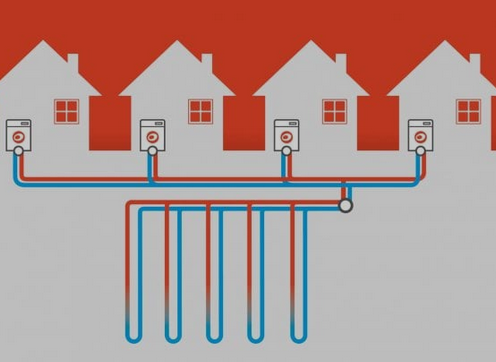
    Regen has a useful guide on shared ground source heat pumps, for use when supplying multiple buildings such as in the case of schools. Also see this example of HP deployment at schools.  Unusually, the Trust has measured things before designing the system, something ACT encourages we all do.

    ‘Insider’ report from COP28

    Here are some takeaways from a webinar organised by the UK’s UN Global Compact Network with three speakers who had attended.

    • Not just technological, we need social/behavioural change;
    • action needs to be local & personal;
    • need responsible business/organisations to develop a plan so as to leave the right legacy.
    • Global stocktake to set targets in article 14 will need to be completed.
    • GHG pricing in article 6 needs work to correctly set markets.
    • Greenwashing is recognised as a serious issue.
    • Easy part is over!
    • Push government to have appropriate policies.

    Behavioural surveys, are they useful?

    This is an international survey with insights from different countries about climate change.  The relationship between level of concern, causes and actions is worth looking at more closely.

    Transport Strategy consultation

    Devon and Cornwall (Peninsula) questionnaire on transport strategy for the region, deadline 5th Feb. Worth responding to as it is an opportunity to support some of the better ideas.

    Observations from media outlets

    BBC Radio 4 Start The Week had some good insights into the positive things that are happening as well as the economics and some science about the consequences.  The positives focused on technology, at no point throughout the 45 mins was reduction of energy consumption through behavioural change mentioned. The most unfortunate statement came from the presenter who suggested that 40% of UK energy came from renewables, this in connection to the UK being ahead of everyone else.  This of course is a mistake often repeated by politicians and media presenters.

    What they should say is that ~40% of electrical energy is now generated by renewables. This represents ~17% of our total territorial energy consumption which is ~1,600 TWh/a compared to electricity which had dropped since the pandemic from 324 TWh/a in 2013 to 275 TWh/a in 2022. These figures do not include the energy we consume for the net import of goods and services.  It also varies year on year with recent reporting showing significant reductions, but mainly because of Covid.  It’s therefore worth looking at the source data (a toe = 11.630 MWh of energy).

    Offsetting, what are valid actions? Tree planting, exported electricity

    We discussed whether tree planting and exporting PV generated electricity to the grid can be used as a legitimate ghg emissions mechanism. This came up at the August meeting, in essence you want to make sure that the scheme:

    • Needs to remove emissions which would not otherwise have been removed.
    • Needs to correctly assign emissions avoided in the year that happens, not historic or future.
    • Needs direct, verifiable evidence reported annually.

    Sizing battery Power to maximise PV generation

    Can one add batteries when on-site PV generation is much greater than on-site consumption, e.g. in the summer.  The direct answer is: technical yes but it would extremely unlikely to pay back financially within it’s expected life, it may even increase ghg emissions.

    Anther topic which we’ve discussed on a number of occasions.  It really pays to do the calculations to size/design the PV and battery systems before opting for an installer’s suggestion, or even one’s own gut feeling.  To help with this please refer to the TECs guides for PV and residential battery systems.

    Impact of new refrigerant (R290 vs R32) on HP efficiencies

    Big claims are being made on the breakthrough R290 refrigerant will make on HP deployment.  R290, or propane, has been used as an effective refrigerant for many years.  It has several pros but also cons, e.g. it is highly flammable. HP manufacturers need to use refrigerant gases which meet the low Global Warming Potential regulations. R290 is ~3 times that of CO2 which compares very favourably to other refrigerants.

    While the heat transfer coefficient of refrigerants used in HPs is important, it is not the only contributor to the overall system’s Seasonal Performance Factor (SPF).  There are several academic studies that analyse different refrigerants, e.g. this one comparing R290 to R32.

    It is important to first establish that a HP is suitable for your home, something you can do relatively easily, start with the TECs guide on HPs.  When choosing a HP, it’s more important to establish the SPF based on the product data as applied to your home and how you heat it, rather than what refrigerant it uses.  It’s also useful to get real world experience of systems in operation if this is available.

    Written by Fuad

    Energy group coordinator
    fuad@actionclimateteignbridge.org

  • Energy group meeting notes (23rd November 2023)

    Energy group meeting notes (23rd November 2023)

    The next regular meeting will be on Thursday 18th January 2024

    Thus. 18.01.24 at 16:30 and every 8 weeks:

    Thus. 15.02.24 at 19:30 and every 8 weeks: 

    Note that the December meeting is not happening. I wish everyone a great Christmas period, whatever you are doing.  Bring or sent me your topics/questions for our next drop-in meeting.  Here are some notes from our November meeting which again had new and returning faces.

    Addendum to Local Plan submission, ACT’s draft response.

    The council has made several changes to the Local Plan, the amended text (in red) can be commented on by 22nd of December.  ACT has a draft response, we encourage everyone to respond to the Climate and Ecological policies if these have been amended.  It is important that as many individuals and organisation comment on these policies.

    Cooperation with developers of UK’s first ‘low carbon’ road development, the A382!

    Three ACT representatives will be attending a meeting with the developer and DDC’ project manager in November.  This is a Live Labs funded project is exploring a number of ways to reduce ghg emissions from both the build and operational phases. Our meeting is to explore how ACT can provide constructive input to the proposed measure and how these are calculated.

    We discussed the need to ensure that any claims are verifiable so that ‘greenwashing’ is avoided.  As an example, we looked at a plug-in hybrid black cab, reported in a reputable outlet, which claims to have avoided 200,000t CO2.  There were enough numbers provided to make a back-of-the-envelope calculation suggesting that this claim was only possible if embodied emissions and emissions from electricity to charge the vehicles were ignored. An initial response appears to confirm that these were not included in the claimed emission savings.  Probably an oversight, but still greenwash!

    ACT launches Carbon Lite training.

    With ~75% of ghg emissions coming from burning fossil fuels for energy, ACT is keen to support organisations and individuals become more effective in tackling climate change.  We have found that many, including those actively working on mitigation, are not sure how to decide on appropriate actions for them.

    ACT’s Carbon Cutter (CC) programme has been running for over a year now with several active trained CCs.  The three 1.5 hr training sessions can be challenging for some who are not yet sure of how active a role they want to play in their community.  The new single 2 hour training is aimed at those who want to be better informed, but not yet ready to becoming a CC.

    All training, resources and follow-on support is provided by ACT for free.  Anyone interested, please contact ACT’s CC programme direct.   

    DCC plan to trial ‘gully solutions’ for on-street EV charging.

    Following on from our discussion last time on this topic, I’ve found out that DCC will soon have a project lead to investigate/evaluate a number of on-street charging solution for running a cable from the home to the vehicle parged outside.

    Are bore holes a realistic option for GSHPs?

    We had a good discussion about heat pumps (HP) and the difference between Air Source HP and Ground Source HP.  Unsurprisingly, this topic has come up on many occasions, but we never put numbers to the costs.

    It is widely accepted that GSHPs have a better Seasonal Performance Factor (SPF) compared to ASHPs given the same building, heating system and usage.  This is because ground temperatures remain nearly constant at 8-12OC in the UK at sea level.  These will be at the upper range in the Southwest and increase by several degrees 15 m or more below the surface.  Thermal properties of different soils will cause some variations as heat retention.

    Other reasons to go for an ASHP, as quoted by an Energy group member, is problems with siting an ASHP.  This may have more to do with perceptions as these fan driven systems can be mounted discretely without causing noise or visual problems.

    Unless otherwise measured, a useful rule-of-thumb is to assume an SPF of 2.7 for ASHPs and 3.5 for GSHPs.  This can vary significantly depending on the heat loss characteristics of the building and how the heating system is set up/used.  We have looked at several examples and calculated one case study comparing gas and ASHP for the same property, it would be good to get other measured examples.

    There are now a number of GSHP installers/manufacturers in the UK, for example Kensa in the Southwest.  Ground loops, just below the surface, remain a popular choice if there is sufficient land area for the required heat demand.  More recently, deep vertical borehole versions have become more widely available as more people with limited space have opted for a HP system, e.g. terraced housing.

    GSHP systems will be more expensive to install, but have several operational advantages.  So how much more expensive are they?  Much will depend on what groundworks are needed and how accessible these are.  The actual HP units and any changes necessary to the building/heating system will be very similar for both GSHP and ASHPs. Here is a useful guide on pricing and the different options with pictures and a video.   

    Mel Stride MP meets “active climate groups”, but refuses to invite ACT.

    Mel Strides invitation e-mail was a great opportunity for ACT, “inviting each of the core active climate change groups across the constituency to send one representative”.  Unfortunately, ACT were refused a representative on spurious arguments which turned out to be false!

    Although ACT’s question was touched on by representatives from other groups, the subsequent report suggested that Mel Stride, despite his understanding and concerns about climate change, was not fully aware of some of the contradictions caused by recent government policy reversals.  Despite the many reports and briefings from the UK’s Committee on Climate Change (CCC), all the indications suggest that those in government making decisions are not fully versed with the critical importance of the legally binding Carbon Budgets.  Opting instead to aim for a distant Net-Zero by 2050.

    ESO Market Survey.

    Dominic reported back from the recent Electricity System Operator event he’d attended. This discussed network access, storage and demand side response.  For more information on these topics and more you can look at Regen’s resources, including Storage & Flexibility.

    Written by Fuad

    Energy group coordinator
    fuad@actionclimateteignbridge.org

  • Energy group meeting notes (26th October 2023)

    Energy group meeting notes (26th October 2023)

    The next regular meeting will be on Thursday 23rd November 2023 at 16:30 contact us for details.

    Here are the topics covered, bring your question, however small/large, next time.

    ACT Energy webpage improvements.

    Jules has implemented a facility to access the guides direct from the pictures at the top of the webpage.  This saves users having to scroll down and click on the highlighted text.  Also, clickable guides now open the latest version of the selected document, rather than having to look this up in a list of documents.

    We’ve only put in two clickable pictures at the moment but will add the rest soon.

    New report on grid-level electricity storage.

    We discussed the Royal Society’s report on large-scale electricity storage sent in by Dominic.  The excellent report has a good executive summary worth a read.

    The wording used to define the problem and constraints is a reflection of the government’s (via Ofgem) priorities, so it is questionable to what extent they are addressing the elephant in the room, namely Climate Change.

    Their target electricity supply of 570 TWh/a by 2050 is interesting, in 2022 it was 275 TWh/a.  This is either acceptance that only a small part of Transport and Heating will be decarbonised through electrification, or it is a complete underestimate of what is needed to avoid a 1.5OC climate tipping point, given that total UK energy consumption in 2022 was 1,558 TWh/a, some two thirds of that is for Transport and Heating.  It could also be that there is a policy to half our energy consumption from Transport and Heating before electrifying its energy source, but somehow government policy suggests the opposite.  You can check out TECs’ calculations for the UK & Teignbridge here.

    A report from Regen suggests we’ll need to deliver the ~570 TWh 15 years earlier , that is by 2035.

    And another Regen analysis showing how the network might function on a challenging day in 2035.

    Just have a think video about pumped storage refers to an Australian study which has produced an atlas of potential closed loop sites https://re100.eng.anu.edu.au/global/ (unfortunately not many of these are in the UK). For the UK RheEnergize is developing high density hydro BEIS is contracting for a 250kW/1MWh demonstrator outside Plymouth in a tungsten mine. These are faster to construct than a water-based system, and potentially suitable in more sites.

    National Infrastructure Commission advice on Hydrogen and Transport infrastructure.

    Parliamentary committees and national commissions are releasing reports challenging government policy on delivering the legally required Carbon Budgets (abbreviated to Net-Zero).  Here are a couple of examples we briefly looked at:

    Hydrogen Heating report.

    Road and Rail Schemes needing clarification against Net-Zero

    Utilities’ claim to low-carbon websites, how significant is it?

    It’s good that businesses want to show how ‘green’ they are.  It has become an essential marketing message as a result of consumer demand, but also greater awareness for the need to act, and quickly.  The danger is that some, deliberately or inadvertently, exaggerate their claims.  Be particularly wary of those who use the colour green to make their claims of being the best.

    Most of the claims are correct, otherwise they could fall foul of the law.  What and how they compare things is pushed to the limit, occasionally beyond, in order to stand out in a competitive market.  It is sometimes difficult to know what to believe, this is where numbers do not lie.  If they don’t provide verifiable numbers, assume it’s greenwash.  If they do provide numbers, give these some consideration to see if they make sense, are relevant and make a significant difference.

    Here is an example from an energy supplier showing off their low-carbon credentials.  While the numbers do check out using the same website carbon calculator, there is no mention of what emissions are generated from using their website. One has to question the importance of this comparison when the typical webpage download emits less than 1g CO2e.

    Electric Boilers, what are they and should they be recommended as a low carbon option.

    This has recently become quite topical, so we spent some time looking at these and discussing alternative technologies for space and water heating.  Some of the interest stems from impressive green claims made for Cylo, claiming an “emission-free” heating system. Note the green background colour!

    The UK manufactured Cylo electric boiler received innovation funding from DCC, so we should expect someone has checked out the claims being made for it.  It may well be a good quality electric boiler, but how innovative are electric boilers in delivering the claimed solution to tackling climate change? 

    Electric boilers have been around for decades.  They work like an electric shower but are much more powerful as they have to heat the water running through the radiators. Coincidentally I bought and installed one in a flat in London in 1981, I transported it from Germany on the back of a motorcycle!

    Looking at some of the numbers quoted on running costs and comparison with HPs or gas boilers, you can see a common thread.  Basically, they compare the worst-case setup with the best-case Cylo system and don’t compare some crucial features. Using the numbers published for Cylo, being a direct electricity heating system, these would also apply to any electric boiler: 

    Assuming a very low heat loss in the system, say 95% efficient, it will consume 70kWh / 0.95 = 73.7 kWh electricity

    An average HP with an SPF of 2.75 (the measured average for recently installed systems) delivering the same 70 kWh of heat energy per day would consume
    70kWh / 2.75 = 25.5 kWh electricity

    A like for like comparison to emissions from a HP, an electric boiler would be a ratio of 2.9:1 (73.7 / 25.5), so almost 3 times greater emissions, certainly not emission-free as claimed for the Cylo.

    Natural gas prices are of course less than 1/3 those of electricity (~8p vs 30p on average in 2023).  At a gas boiler efficiency of 90%, gas would be slightly cheaper to run than an electric boiler.  

    In terms of daily operational emissions (for 70kWh of heat energy); electric boiler 20kg CO2e; gas boiler 17kg CO2e ; HP 7kg CO2e based on 2022 government data.

    Without comparing prices and features it’s not appropriate to recommend one make over another. There are other manufacturers, being more established they don’t need to resort to full on greenwash marketing, companies like Heatrae Sadi or EHC are examples.  The Which? Article gives a good summary of electric heater pros/cons. It is a shame that Cylo felt the need to take advantage of people’s desire to reduce cost and emissions, they know very few consumers check the numbers or read the small print.  This is why we provide a lot of guides, tools and training through ACT.

    No doubt there is a niche application for these systems, where it makes financial and even emission sense.  At best this would break even today, but of course make complete sense if we ever have zero-cost and zero-emission electricity.

    Kerb-side EV charging.

    Glen brought this to the group’s attention.  A nifty solution to charging your EV from your private supply when parked outside your home.  The system appears to be unique in the UK, for the moment.  It has approval from at least one council and is being trialled in others.  It looks a bit on the expensive side at ~£1,000, but does include installation and registration with the council.  In the absence of other practical solutions, it will undoubtedly be the answer for some.

    We’ll check to see if DCC are likely to approve this for Devon Highways.

    Best wishes
    Fuad
    Coordinator for the ACT Energy group
    covering energy, built environment and transport

  • Energy group meeting notes (28th Sept. 2023)

    Energy group meeting notes (28th Sept. 2023)

    The next regular meeting will be on Thursday 26th October 2023 at 19:30 – 21:00  (and every 4 weeks thereafter). Note start time will alternate between 16:30 and 19:30 . See the personal e-mail sent for the zoom link code to use or contact ACT.

    Here are some of the topics raised and discussed.

    Energy group meetings, timing change and venue:

    In order to allow others who may find 16:30 a difficult time to join the regular group meetings, we will be running these alternatively starting at 19:30 and 16:30.  Our next meeting will start at 7.30pm.

    If you would like to offer your place (home or office) as a venue for a face-to-face meeting, please let me know.  You are not expected to prepare any material about your place, just offer it for people to meet.  Please let me know what dates you can offer and what the maximum number of people are invited.

    Recent government announcements on Climate Change mitigation:

    We had a good, wide-ranging discussion about the reasoning and impact of the retrospective policy changes the government has announced in the past few months.  Ignoring the hype and point scoring inevitably associated with such significant changes in policy, it seems clear that mitigating Climate Change has dropped several notches down the government’s priority order.  While some of the arguments put to justify these policy changes could have some merit, there are almost no new policies to rebalance the quite dramatic shift away from reducing our ghg emissions.

    We also discussed the potential economic damage and mistrust created by the messaging alone.  Inevitably this will slow an already snail-pace progress to reduce emissions, but many may simply ignore the government’s stance and continue to decarbonise as they can see the tide has already turned.  Maybe we are witnessing another nail being driven into the coffin of party politics?  Especially when it comes to strategic/long-term policies that affect everyone.  Are we moving ever closer to evidence being determined by those standing on the highest soap box, like the most recent assertion on ecological damage from wind turbines?

    Residential Batteries:

    This topic came up again as group members continue to be approached by enticing offers.  It is difficult for many of us not to be drawn by plausible ‘evidence’ of financial and climate benefits presented by those selling these systems.

    We reviewed the guide provided on the ACT website (Energy group page) to see if this could be made clearer or more accessible. A number of improvements were suggested, including navigating to the various guides at the top of the web-page using pictures/icons.  We’ll review changes made at the next meeting.

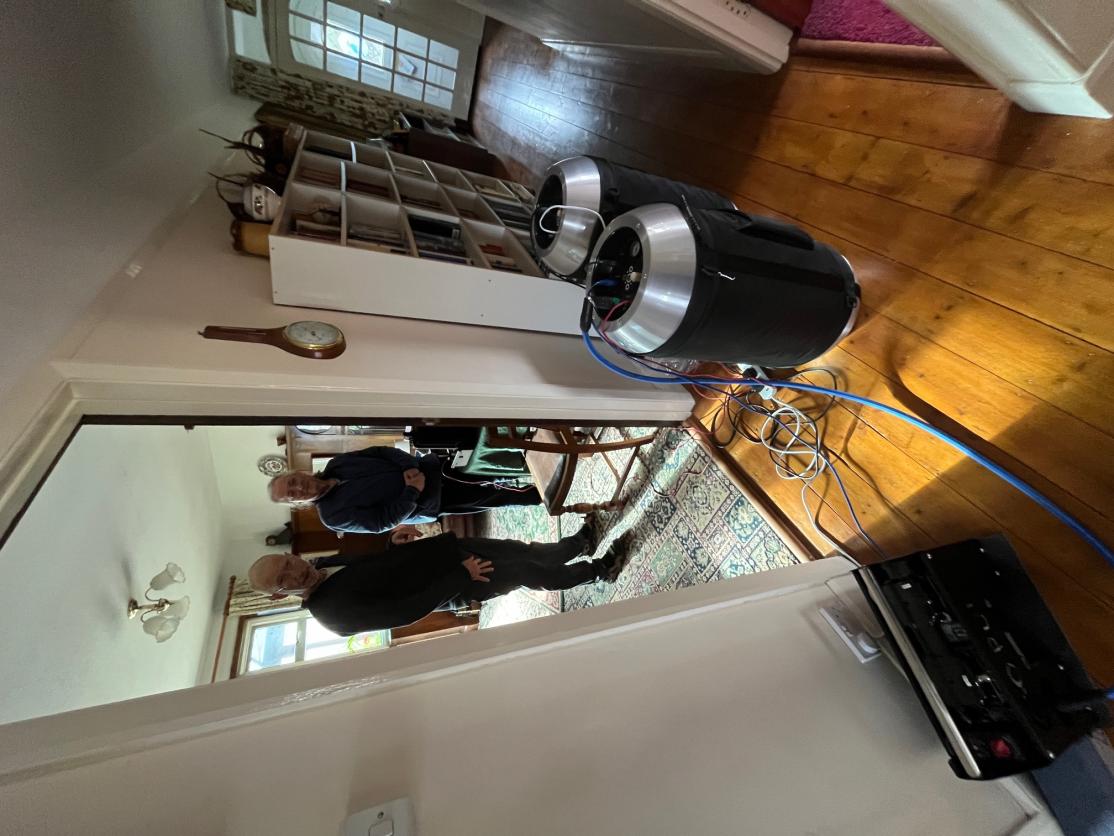
    Maybe we should cover this topic in a few case studies and visit examples of installations.  I had a quick look at a well-designed residential battery system records, installed in 2017.  To date, this showed an avoidance of ~9,500 kWh imported grid electricity, equivalent ~£2,000 of savings and ~2,700 kg CO2e avoided emissions, less the financial and emissions cost of installing the system.  Financially in the red, but already significantly up on emission reduction.  Pretty much confirming the advice and calculations suggested in the guide. 

    Are sea-levels rising?:

    Or should this be “Is sea-level rising” since water levels out?!

    Unsurprisingly, we tend to believe what we experience firsthand.  Unfortunately, this may not always be what is actually happening, magic tricks are a good example.  Then there are all these cognitive biases we need to overcome to make sure that what we are experiencing is reflected in what everyone else sees everywhere else.

    Let’s take the actual and predicted sea level rise caused by a warming world. I don’t think anyone disputes that ice melts when heated. It’s easy to believe that the relatively small areas of ice compared to ocean on the earth’s surface cannot possibly increase sea-levels by very much, certainly not the meters some talk about.  Without knowing the volumes and surface area, it would be unwise to make an assertion either way.

    Most of us are aware of how tides vary, even just around the UK coast.  Not only seasonally, but also with the cycles of the moon, the air pressure, water temperature, water salinity, ocean currents and river flows.  Then there is the coastal topography which affects tides as well as the much slower changes in the relative hight of land masses compared to abutting sea-levels.

    Is it therefore wise to measure local tides in one place over a period and conclude that globally sea level rise caused by Climate Change is not as bad as it is made out to be?  We discussed how sometimes, well founded observations can be misleading if we do not consider all the evidence.  It’s not always easy because we may not be aware of critical information, so discussing this with others to calibrate our conclusions is essential.  We will never know if we’ve stumbled on something no one has spotted, unless we allow everyone to present their case to encourage open dialogue.

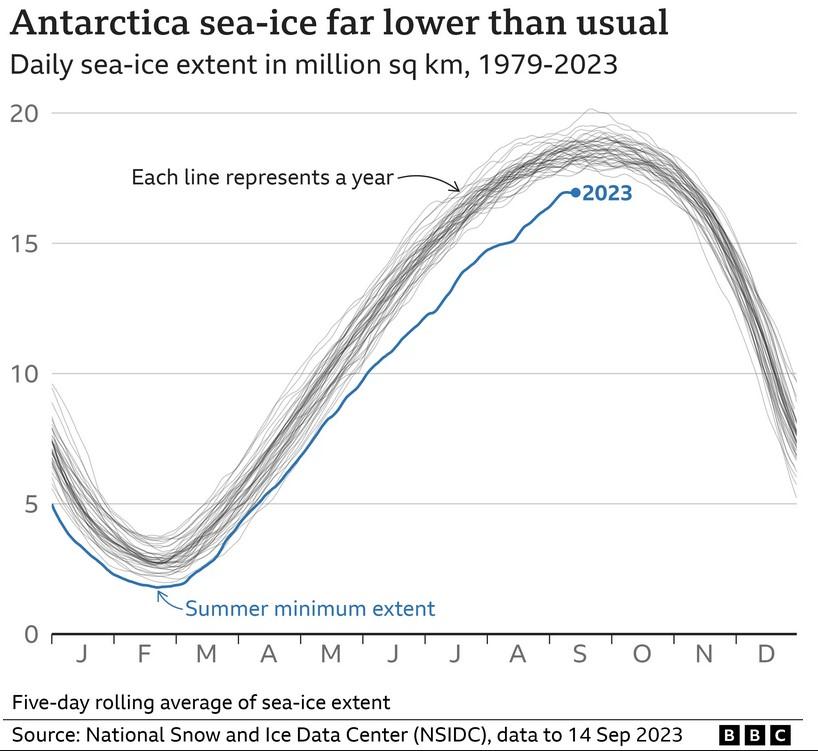
    There was a little-publicised report on the Antarctic ice shelf in 2023, possibly one of a number of tipping points predicted by the IPCC modelling. Here are some references on this topic:

    Loft insulation dilemma and AAHP:

    We tried to reassure Rob that the balance he was striking between more loft insulation vs. loss of long-term storage space, was ‘ok’.  These are personal decisions, ideally made on the available evidence/calculation to come to an ‘informed’ decision.

    We also briefly touched on Air-to-Air Heat Pumps. The use and specification of these is less regulated, but they can be appropriate in specific settings.  As with most technologies, it is important to design the system to fit the requirements.

    Consultation on car parks in Newton Abbot:

    Jules and I represented ACT at the district council’s initial stakeholder event on car park use in Newton Abbot.  I’d sent out this invite to those who registered their location as Newton Abbot and ticked the ACT Transport group.

    Our impression is that the usage/occupancy data collected was useful but did have some significant gaps in reflecting actual usage.  We made a number of recommendations which will hopefully be reflected in the report from this first of several consultation event.  One thing most participants agreed on is that the town centre multi-story is heavily under-utilised (also reflected by the data collected).  Also that the multi-story car park was not inviting to users and generally an eyesore.

    Best wishes
    Fuad
    Coordinator for the ACT Energy group
    covering energy, built environment and transport

  • Energy group meeting notes (31st August 2023)

    Energy group meeting notes (31st August 2023)

    The next regular meeting will be on Thursday 28th September 2023 at 16:30 – 18:00  (and every 4 weeks thereafter).
    This will be the usual zoom, please contact me if you’d like to receive the link.

    Here are some of the topics raised and discussed.

    Energy group meetings, what are they about and who can attend:

    We spent some time discussing how the Energy group meetings have evolved over the past 3.5 years.  The main purpose of these meetings is to give everyone an opportunity to ask questions or discuss topics related to energy, the built environment and transport.

    This is not the first time this topic has been discussed.  Some of the suggestions to get different people involved include:

    • In-person meetings, ideally at someone volunteers their home or place of work.
    • Pre-select a topic to focus on.
    • Vary the meeting times to include a 7pm start, keeping the same 4 week interval.

    It would be good to hear from the 151 ACT members who have asked to receive information on these topics.  Let me know what you think and what would interest you in either coming to one of these meetings or reading the notes that are sent out.

    Devon Retrofit Guide:

    We looked at the Devon Retrofit Guide which I’d mentioned in the last set of notes.  This is well worth a brows if you are thinking of having any work done to your property.  You can also register to get a residential assessment under the Energy Saving Devon scheme.

    Practical list of actions added to the CFT:

    We’ve now released the search/lookup for action you can take after completing your Carbon Footprint Tracker (CFT).  At the meeting we explored some of these actions and how this is not just another general list.  You can access the tool from the CFT ‘Results’ tab by clicking the highlighted “Possible Actions” which will open/highlight the text for this.  There you will see “list of actions” which you can click to take you to the tool.

    Have a go and send me your feedback.

    More on heat pump case study:

    There was more detail provided on the relative cost of this ‘typical’ heat pump installation.  You can find out how financial costs compare to mains gas for this example here, see section 5.3 para starting “My running costs…”.

    How Bad are Bananas!:

    Some call it a ‘bible’, unsurprising given its sub-title “The Carbon Footprint of Everything”.  We take it everywhere, most recently to our stall at the Newton Abbot Fayre.  This second edition has been updated to reflect the latest data available.  It also now has a clear intro to how our behaviour contributes to climate change and, at the end of the book, what we can do about it.

    The CFT uses very similar data sources and methodology.  As an on-line tool, the CFT is updated annually and reflects your emissions rather than average national/international ones.  You can also lookup emissions for specific food/goods/services by using the tool provided in the help panel for these categories.  

    A 3-D printed wind turbine:

    Jules explained his interest in building a small wind turbine using 3D printing.  Please contact Jules if you want to find out more.

    Best wishes
    Fuad
    Coordinator for the ACT Energy group
    covering energy, built environment and transport

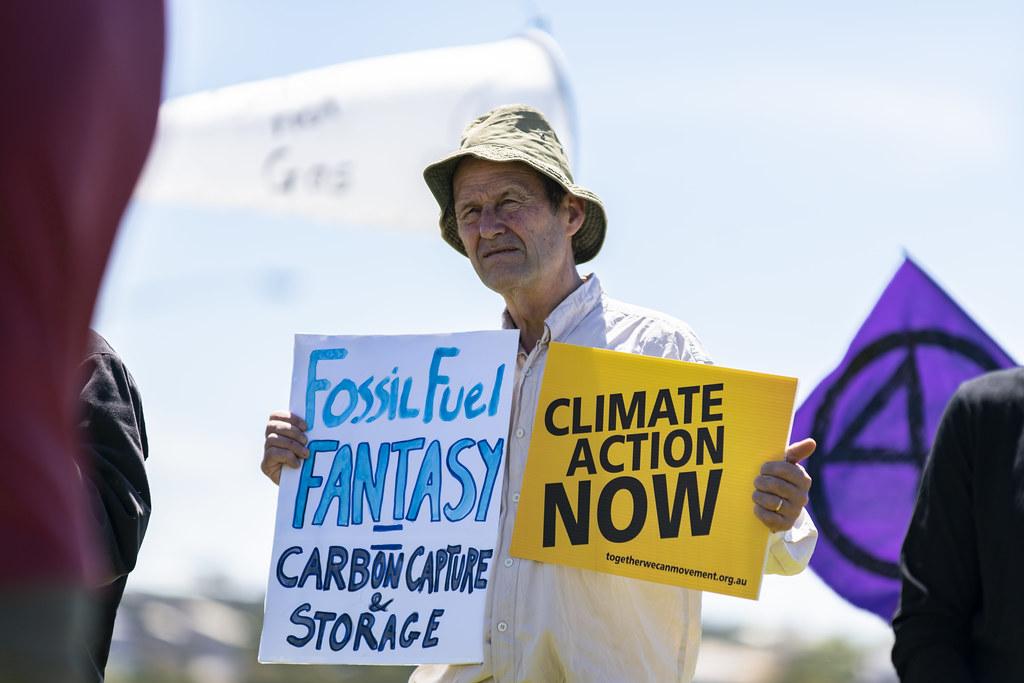
  • Carbon capture and storage: fact or fantasy?

    Carbon capture and storage: fact or fantasy?

    The UK government has committed to a big expansion of carbon capture and storage (CCS), along with plans for more oil and gas drilling in the North Sea. Using CCS is a prerequisite of expanding fossil fuel extraction if the UK is to stick to its target of reaching net zero by 2050. 

    The government will spend £20bn over 20 years to support the establishment of two CCS clusters by 2025, and a further two by 2030. The aim is to capture 20-30 megatons (Mt) of carbon dioxide (CO2) a year and store it under the North Sea.

    Scientists think this is a bad idea. The Guardian newspaper reported that more than 700 scientists wrote to the prime minister before the announcement asking him not to grant any new oil and gas licences and describing CCS as “yet to be proved at scale”.

    CCS involves capturing the CO2 produced by power generation or industrial activity, such as steel or cement making; transporting it; and then storing it deep underground. The technology has been around since the 1970s, but has been used mainly to boost oil production. There is no evidence it can be used at scale to permanently store CO2. There are questions about the expense involved, the storage capacity, the potential for leakage, and the effectiveness of the process.

    A 2021 report by the Centre for International Environment Law found that the 28 CCS facilities currently operating globally have a capacity to capture only 0.1% of fossil fuel emissions, or 37Mt of CO2 annually. Of that capacity, just one-fifth, or 7Mt, is being captured and stored for the long term. This suggests the UK plan to capture 20-30Mt a year is over ambitious, to say the least.

    More recently, New Scientist covered a report by the Institute for Energy Economics and Financial Analysis (IEEFA), an Australian think tank, which found most of 13 flagship CCS schemes worldwide either failed or captured much less CO2 than expected. Two Norwegian projects were more successful, which the report said was due to the country’s business and regulatory environment.

    There is a strong suspicion that investing in CCS is just a means for the fossil fuel industry to carry on “business as usual”, with little attempt being made to reduce carbon emissions. See this video for a satirical take on this.  

    Climate scientist Kevin Anderson said on Twitter: “The promise (though virtually no delivery) of CCS for almost 2 decades has been repeatedly used to undermine the shift away from fossil fuels. It has been a deliberate & effective delay strategy.”

    As if in confirmation, the chief executive of US oil group Occidental Petroleum said earlier this year that DACS (Direct Air Capture & Storage) “is going to be the technology that helps to preserve our industry” and gives it “a licence to continue to operate for 60, 70, 80 years”.

    For more on carbon capture and storage, in its various forms, see these notes.

  • Energy group meeting notes (03.08.23)

    The next regular meeting will be on Thursday 31 August 2023 at 16:30 – 18:00  (and every 4 weeks thereafter).
    This will be the usual zoom https://us06web.zoom.us/j/3684268674

    We carried on with agenda items from last time and a few new ones.

    Retrofit (heat pump case study and more):

    It was worth elaborating further on this case study as it is based on some detailed data collection/analysis.  A draft version is available here, see section 5.3 .

    This further confirms the rule-of-thumb advice ACT has been using when advising people on when to fit a heat pump.  The 50-100 kWh/m2/year heat energy demand, how to work this out and how to use it, will be added to our list of actions on reducing greenhouse gas emissions.  Note also the importance of correct heating system setup and controls mentioned in the case study.

    I forgot to say that DCC’s sponsored Devon Retrofit Guide is now officially released.  This is a detailed, yet accessible resource well worth a read.  It of course includes a section on HPs.

    Urban wind turbines:

    Jules gave some background on new technologies for small scale urban wind turbines, a report is available here.  Although there have been several designs trialled with some commercial versions available, there is still no practical solution for these to be deployed in urban settings.

    Offsetting and greenwashing:

    Offsetting our greenhouse gas emissions seems a reasonable option.  It is something that has been available for some time with schemes becoming more transparent, publicising their ‘Gold Standard’ credentials.  But what is offsetting and how effective is it?

    There are two types of offsetting considered here:

    • We can sequester CO2 from the atmosphere, by removing it using natural means (photosynthesis of plants) or engineered mechanical/chemical means referred to as Carbon Capture Utilisation and Storage (CCUS or just CCS).  There is also Direct Air Capture (DAC) of CO2.
    • We can generate low-carbon energy which is used by us or others to replace energy with higher greenhouse gas emissions.  It is also possible to replace systems with more energy efficient ones (e.g. insulating buildings).

    Both are valid, provided they:

    • account for their full life-cycle emissions and demonstrate the time and
    • accurately state the amount of ‘removed’ or ‘avoided’ emissions. 

    Too often offsetting schemes are presented either without a greenhouse gas impact analysis or one which only considers part of the total lifecycle emissions.  Even more worrying is that technologies such as heat pumps and EVs are often ‘sold’ as low-carbon without stating the full life-cycle emissions to allow an informed decision.  In other words, how much greenhouse gas do I reduce, at what cost and under what circumstances.

    Worst of all is the accounting trick that quite a few offsetting schemes use, even some of the more ‘reputable’ ones.  What they do is calculate a future or even the total ‘offset’ emissions over the life of the measure, but apply it to the year the offset payment was made.  For example, planting a tree may well sequester ~50kg p.a. but this will not happen for several decades from when it was planted.  Similarly, when investing in technologies with high embedded emissions such as PV and EV, the emission pay-back often does not happen for 5-15 years depending on use.

    Then there is the marketing of so called ‘green’ or ‘environmental’ products and services, often referred to as greenwash.  Luckily there are new regulations in place and additional ones being proposed, here is an article that compares some of these policies in the UK, US and EU.

    Home battery:

    We discussed the importance of ensuring that sufficient daily excess PV generation was available throughout the year to ensure financial and carbon pay-back is a realistic outcome when fitting a residential battery system.  The use of batteries to benefit financially from lower tariff periods (e.g. off-peak night rate) needs further analysis and evidence, please contact Jules if you want to find out more about this.

    The more granular the electricity consumption data is, the more accurate the analysis of whether and what size battery would pay back within its warranty period.  If available, Half Hourly consumption data from a smart meter would be ideal.  Monthly meter readings with typical daily consumption patterns can still give a reasonable assessment.  The data required and methodology on how to do this analysis for both financial and carbon pay-back calculation can be found in the TECs Residential Battery guide.

    Can local plans be a catalyst for mitigating climate change?:

    Pauline shared a report from the CSE which includes 23 recommendations for improving the planning system’s ability to promote climate change mitigation and adaptation.  This should be read by planning authorities like TDC who have a strong and clear climate mitigation mandate.

    ACT had previously responded to the new Local Plan consultation, suggesting climate mitigation policies that are currently within planning rules, so don’t need to wait for the CSE recommendations to be reflected in the NPPF.  We do not yet know if these will be adopted or why they wouldn’t given the council’s stated strategic objective.

    Carbon capture, use and Storage (CCUS):

    This is quite topical, so ACT is preparing a news item on this.  Here is and early view on the topic from Jules.

    First carbon -ve road (A382):

    This was discussed a few meetings ago with several eyebrows raised!  ACT has been contacted to explore options for getting involved with Devon County Council in the “early contract stage”.  Several attendees expressed an interest in being involved, let me know if you have not already confirmed your interest and I’ll keep you updated.

    Best wishes
    Fuad
    Coordinator for the ACT Energy group
    covering energy, built environment and transport

  • Energy group meeting notes (06.07.2023)

    The next regular meeting will be on Thursday 03 August 2023 at 16:30 – 18:00  (and every 4 weeks thereafter). This will be by zoom.

    Only a few attended this session, but lots of topics raised/sent in, we managed to discuss a few.

    Heat Pump (HP) Case Study:

    The detailed data sent in by an Energy group regular is revealing many interesting aspects of HPs and heating systems in general.  The daily meter readings for a building with several occupants cover two years, one with mains gas heating and the other with a HP.  This has allowed for a more accurate calculation of this particular HP system’s Seasonal Performance Factor (SPF) was.  The resulting SPF of ~2.4 is slightly less good than the average of 2.7 for the most recent study of a large sample of UK HP systems. The heat energy calculation was adjusted to allow for differences in external temperatures for the two study years using monthly degree-days.

    The analysis identified a number of issues relating to incorrect setup of HP controls as well as particularly low efficiency when used for water heating.  These shortfalls as well as other installation problems, were confirmed by independent heating engineers.  These investigations were a consequence of the homeowner undertaking a self-help ‘simple’ heat assessment programme (E-Pack), they are now starting targeted remedial action.  By continuing to monitor consumption (monthly is ideal) they will be able to quantify the energy, and cost, reduction of these actions.

    CFT & new feature:

    Lookout for the new Carbon Intensity Search facility in the CFT.  This is for anyone who wants to undertake more detailed calculation of their food, good and services.  The source data is the same as that used in the CFT, but we are looking to expand this to include more detail and more accurate Carbon Factors (e.g. kg CO2e/kg of item).  Take a look under the help panel for food/stuff and give us your feedback.  If this search/lookup method proves useful, it may find an application in other areas like finding a safe action to mitigate climate change or how/where to recycle x item.

    Community Energy England (CEE) webinar recordings:

    For those that missed the CE fortnight series of webinars, you can see them here.

    We also talked about the Devon Community Energy Network, a forum for member organisations involved in helping their local community in various aspects of low-carbon energy generation and use.  You can find and contact your local group if you want to find out more.

    Cinema development in Newton Abbot:

    ACT commented on energy/emissions related aspects of the initial (controversial) proposal for this town centre development (22/01129/MAJ).  This latest proposal has an improved statement on emissions and energy use, but falls short on some detail.  In particular the lack of a design target for energy use and emissions as well as the lack of a reassurances that the essential fit-out of Mechanical Ventilation and Heat Recovery (MVHR) systems will not incur addition retrofit costs or compromise the building’s specified air tightness.  Based on the data provided using our calculations, the heat energy loss is expected to be ~62 kWh/m2/a if full MVHR is implemented, ~103 kWh/m2/a if not.  This compares poorly to the AECB recommendation of 30 kWh/m2/a for new buildings (<40 for heating and cooking).

    Bovey Tracy/Newton Abbot rail link:

    This Heathfield line has come up several times over the past 10 years, most recently at one of this group’s meetings last year.  A good analysis of capital costs has been undertaken recently, including the tricky level crossing.  A Bovey based ACT member is advising the group who is preparing the business case for this project.  We discussed some of the more significant short falls, such as market/demand analysis, operating costs and alternative options.

    Urban wind turbines:

    Again, a topic previously discussed, focusing on vertical axis turbines which do not appear to have ‘taken off’!  There is now a new design/concept which uses a large ‘collector’ to focus wind speed/volume onto a smaller turbine.  More on this at the next meeting.

    Offsetting:

    The pros and cons of this are worth discussing as it is being promoted as an alternative to reducing ones own emissions.  Unfortunately, we ran out of time, so we’ll be discussing this at our next meeting.

    Home battery:

    There was a request for advice on adding a 10kWh battery to an existing PV system.  We have discussed this on several occasions, but can cover it again at our next meeting if time allows.  In the meantime, information on residential battery systems and how to correctly size them and calculate their carbon/monetary pay-back can be found here.

    Best wishes
    Fuad
    Coordinator for the ACT Energy group
    covering energy, built environment and transport