In short, it’s not easy for older buildings. There are lots of risks and disruption when doing IWI, not least condensation within the building fabric, referred to as interstitial condensation. In our case External Wall Insulation (EWI) was not an option.
The particular space, 4.5m x 5m and 4m high, was very difficult to heat. Three sides are 700mm external solid limestone and brachia walls constructed some 350 years ago, that’s a lot of thermal mass to heat. The two large radiators would need to work at full blast for 3-4 hrs to make this lounge feel comfortable for someone watching TV.
In around 2010 we decided to replace the radiators with underfloor heating. We considered other heating options, but as we’d converted our heating to a split-log boiler, a wet underfloor system was the obvious choice. This doubled up to insulate the floor.
The roof had already been insulated a U-value of ~0.1 W/m2/OK. I’d also replaced the 3 windows with triple glazing units which made a significant difference, as reported by our guests. It was clear from the temperature and heat meters, that the space was still difficult to heat and not too comfortable to spend an evening in.
Lockdown was a good time to take on the walls. I knew enough about the risks of interstitial condensation to realise that the existing layer of plaster and emulsion paint were not going to allow moisture to ‘breath’ out through the walls. Replacing ~50m2 of non-breathable plaster with a breathable flat surface was going to be expensive. We’d considered the usual stud/batten and foam IWI system until an installer suggested using dehumidifiers to remove excess moisture from within the cavity.
Luckily, I’d been using Mike Wye (the southwest’s mecca for all things to with lime) to source my cork for the wall insulation around the new triple glazed windows. They suggested using lime as a breathable internal wall finish on top of cork or wood-fibre boards, but they also recommended replacing the existing plaster/paint layers. So I did some more measurements and asked a PassivHaus architect what he thought.
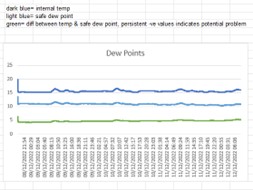
The question we needed to answer is what the worst dewpoint would be if we used IWI. The solid wall’s internal surface would be much colder as it no longer gets heated by the warm air in the room. Any moisture reaching this surface, which would now be trapped between the insulation and the wall would condense, potentially causing damage and mould growth. The thicker/better the insulation, the colder the wall surface and the worse the interstitial condensation. This moisture could only escape back into the room.
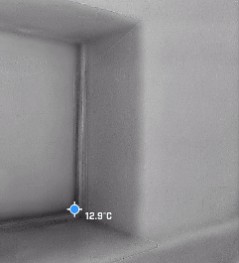
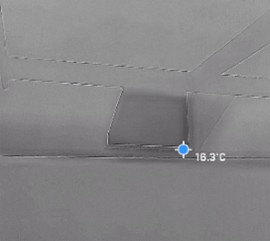
I needed to know the coldest temperature the internal wall surface could reach, so the north facing wall. This was easy to measure using an Infra-Red (IR) thermometer during a very cold spell (<5OC) and not heating the space for several days. Because the walls are thick, this didn’t drop below ~12OC. I also had to know the highest likely internal humidity and temperature to work out how close 12OC is to the dewpoint for the worst case. It was too close for 100mm of natural insulation, in fact I needed to go down to 60mm of insulation. This can be calculated with the help of the TECs E-Pack or there are some on-line tools to do that calculation.
We decided to go for wood-fibre boards rather than cork, mainly because the manufacturer we chose published certified embedded carbon data for their product. Unfortunately, when we eventually managed to find an installer, we were quoted £13,500 for the work. That’s without a finishing lime layer or the two layers of breathable paint. So in March 2022, I did it myself! With help from my wife and friends, it is within the capabilities of a regular DIYer. I tried to get a traditional plasterer and pay for them to train to use lime, but even they are a scarce resource these days.
Early measurements during a cold spell, indicate the results are excellent, the measured wall’s U-value is now ~0.35 W/m2/OK. We’ll continue to measure performance using the E-Pack methodology and tools over a year before confirming results.

Since then BEIS has published excellent advice on IWI retrofit. The Bristol Guide to solid wall insulation includes details for good and poor practice with some excellent details. The Mike Wye natural insulation system we used can be found here. A useful trade body to find practitioners is the AECB. For those in Teignbridge who cannot do their own assessment under the TECs E-Pack, there are two services being launched in Devon, Retrofit Devon for organisations and ECOE’s Retrofit Advice for home owners.