
Our 1980’s Home has had lots of extensions and refurbishments over the years. Our extended family numbers 5 people, we have different jobs and different routines.
The mains gas heating system itself was extended into the various extensions, and consisted of a 30kwatt gas boiler with a separate 24kwatt gas boiler which powered two central heating loops but on a common gas and water supply. There are thermostatic Radiator Valves on 16 of the 20 radiators. There was no hot water tank with hot water direct from the gas boilers feeding 2 of the 4 showers and 2 kitchens. The other 2 showers were direct electric. Each central heating (c/h) circuit was on a master thermostat the temperature being set at about 18C in each case.
The 24kwatt boiler was 14 years old and the 30kwatt boiler was 10 years old.
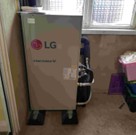
Being aware of our contribution to Climate Change, I’ve been looking at a number of things I could do to reduce my greenhouse gas emissions. Having done the obvious ones like installing a 6.25kW PV system with a 13.5Kilowatt Battery and replacing the petrol and diesel cars with battery electric Vehicles (EV), I decided it was time to get rid of the gas boiler since this was burning fossil fuels and the 14 year old one needed replacement. I opted for a high power LG Therma V split unit rated at 16kwatts so I could use the same radiators and replace both boilers with 1 heat pump. I also had a 290 litre water tank installed which could also be heated by a solar diverter and an internal boost immersion as well as from the heat pump.
I’d been taking regular readings for a full year, our annual water and space heating consumption was 26,558.6 kWh based on bills and meter readings. This was for 2020/21, the period is relevant as I wanted to compare like for like; that is adjusting the heating consumption used to that of the outside temperatures, measured in degree-days. I did this using the TECs E-Pack and comparing the two years, one heating with gas, the other with the HP. Internal temperatures and heating system controls were kept the same in both cases so I knew I had a good set of data to compare.
Isolating the electricity consumption for the HP’s first year of operation was made easier because the data was provided by the LG Therma V unit, it recorded 9,827.1 kWh for 2022, this included 167 kWh for hot water diverted from surplus PV generation. Normalising this for the two years suggests a seasonal performance factor (SPF) of ~2.4 . There are several factors that I’ve not yet checked which would affect this efficiency, e.g. the number of days people were away and how family members may have changed how they adjusted the heating controls. However an SPF of 2.4 is within the range reported for RHI registered system that have been monitored.

My running costs remain very similar in comparison with the previous gas system. This is mainly because of the off-peak electricity tariff between 0030 and 0430 hrs which enables both the battery to be charged as well as the heat pump during those hours. There is a wider differential between gas and electricity unit prices (about 1:3) compared to the heat pump’s seasonal coefficient of efficiency (currently 1:2.4) during the peak rate period. However, this difference is at least partially compensated for during off-peak periods when gas and electricity unit prices are comparable. Some surplus PV contributes further to reducing running costs, but this is minimal.
My ongoing carbon emissions have, however, reduced significantly. From 4,953 kg CO2e using gas to 2,527 kg CO2e using the heat pump, removing almost 2.5 t CO2e from our household’s annual carbon footprint.
After learning more about heating and heat loss from TECs and an getting specific advice from an independent local heating engineer, I’m now planning to make a number of adjustments to how we use the HP. These include reducing the master thermostat by 0.5 OC, to 17.5 adjusting some of the TRVs and fitting better insulated and higher capacity flow pipes 28 mm rather than 22 mm between the HP and water tank and central Heating buffer tank. Also varying the ASHP target temperature depending on the season. The works to the HP piping have just been completed. As it is summer the hot water has been turned down from 55 to 45 C. Heating is down from 55 to 40 OC. I will manually adjust the heat pump temperatures depending on the average outside temperature with a winter setting of 52 C for the heating and 50 C for the hot water.
I’ll continue to take monthly measurements to see what improvements to the ASHP’s efficiency can be achieved without triggering complaints from others in the household!