
We are a second time round couple that moved to Devon in 2005. Our new home was a new build, built to the standards of the day, that included cavity wall insulation and double glazing throughout. At the time we were certainly aware of Climate Change but not really very engaged in tackling it apart from recycling and growing much of our own veg.
My job involved extensive international travel. Probably 5 long haul flights and 10 short haul a year, two of which would have been holidays. Zoom, or similar, were unknown to me then. I had a big 2.5L V6 petrol car, plus we had a smaller run around car and oil-fired central heating, but I was increasing aware that things needed to change.
We installed a significant amount of secondary glazing thus making those windows triple glazed but in truth the driver was noise reduction more than energy saving. The big car was next after a fatal diagnosis and was replaced by a smaller family diesel car, in line with advice at the time. Shortly after we installed a 3.9 kW PV system on the roof, which faced directly south. At the time there were high FIT payment inducements and 12 years later this system has earnt in excess of £25K plus generating on average 3.8MWh of electricity a year.
While we were increasingly aware of Climate Change and our impact on it, we were slow to amend our lifestyle until I retired. We then resolved not to fly, if possible. We added a battery and solar diverter. The latter heating the water instead of exporting excess PV power to the grid. This worked really well when run on a two-tariff system (ie off-peak) and for the 4-5 months with longer day length we were close to being “off grid”.
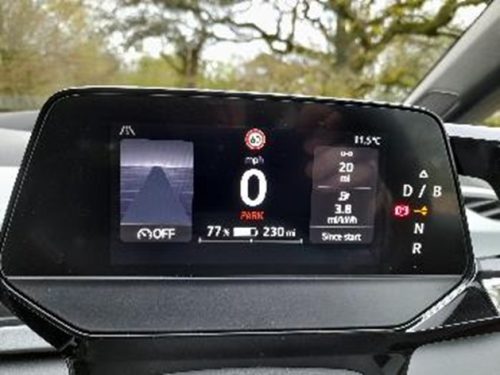
The next change significantly reduced our carbon footprint but also upped our electricity consumption. We sold both cars, even the three-year-old diesel and went down to just one electric car, with a home charger. Driving our two ICE cars some 25,000 emitted an average of 6,767kgCO2e a year.
It took a while to learn how to operate with just one car, but it is now (5 years later) very rarely an issue. While significantly cheaper than public charging, home charging an electric car that does about 10,000 miles a year has a cost and impact on electricity consumption, which is nevertheless cheaper than running an Internal Combustion Engine (ICE) car the same distance. So, the Electric Vehicle (EV) emits 747kgCO2e a year when charged from grid electricity. In addition, EVs currently attract no road tax and generally require less servicing compared to ICE equivalents.
That left us with the biggest question, what to do about our oil central heating. After significant research I opted to go for a high temperature ASHP. While more expensive than a standard heat pump, there is no need to instal under floor heating or increase radiator size because this type of heat pump can, if required to, heat water to the same temperature as an oil or gas boiler. Before installing the pump, we increased loft insulation and replaced three external doors we knew were draughty. So the oil storage tank, boiler and hot water tank were removed and the pump installed with almost no disruption over 2 days. The pump has two heat exchange units, one outside and a second inside (where the old boiler was). The outside unit looks like a large aircon unit and when running makes about the same amount of noise as a gas or oil boiler. A new hot water storage tank is also required but slots in the same place as the old one.
The ASHP has now been in place for two years. It clearly increases electricity consumption, up from 11MWh to 18.5MWh p.a. The old oil heating used about 1,500L and emitted 4,602kgCO2e p.a., while the ASHP, emits 1,765kgCO2e p.a. Although we get about 3.8MWh p.a. from our PV system, this is mainly used to charge the EV, and feed the house electricity needs, avoiding 994 kgCO2e of emissions if we were to import that from the grid.
We no longer directly purchase any fossil fuels for transport or heating; our combined transport, heating and domestic electricity costs in 2022 at 12 p/kWh were £2200 p.a.
To facilitate holidays, and keep us off planes, we do now have a diesel motorhome that does approximately 5,000 miles a year. That is 2,397kgCO2e when averaging 30mpg, while a short haul flight the same distance would create 2,696kgCO2e for the two of us.
All told, we have reduced our annual emissions. But there is more to be achieved especially as the emissions associated with all this new technology will also need to be compensated for.
We need now to look at further reducing energy consumption. One way will be to use more public transport. We have already succeeded in visiting our latest grandchild in Germany, by train. Now we need to use the bus more locally and see if more insulation can be cost effective.
A recent “energy” survey showed we were doing the right things, but further insulation could help. So, our next projects will be increasing the depth of the loft insulation and filling the gap that remains in the cavity with polystyrene beads.
Interestingly over this period the way I grow our vegetables has also changed. I no longer use granulated fertilizer, which is made from fossil fuels. Instead, I use animal manure and homemade compost, produced from vegetable food waste, and composted weeds, grass etc. Crops are protected by nets/mesh now rather than sprayed with pesticides (made using fossil fuels, but at least the nets can be recycled). All rather ironic as I spent my entire career in Agricultural R&D testing and developing new pesticides.