
By 2009 the need for renewable generation had become topical, even the government was planning various subsidies to stimulate the market. I remember being on holiday in Wales and overhearing a conversation in a pub about the Feed in Tariff (FiT) scheme, there was a lot of confusion about it. Although the intention was to make us more aware of our energy use and to shift to low-carbon on-site generation, it inevitably ended up being seen as a financial opportunity. At the time I’d talked to one of the people involved in devising the scheme, who agreed that it could have been better structured, to incentivise a more careful use of electricity.
Like FiT, Renewable Heat Incentive (RHI) and other government incentives to stimulate or nudge market/consumer behaviour, they tend not to last. Rightly so, because they invariably benefit those who have the ability to extract as much of the financial incentive as possible.
As our main motivation is to reduce our greenhouse gas emissions, we evaluated renewables on their ability to do so. As long as the cost of avoiding emissions (£ per tonne/kg of CO2e) was low compared to other options available to us and the payback period was short enough (see 4.1 Is it time for that fridge to go?), we would go for it. This was not always the case, it took us 5 years of mistakes before we fully grasped the importance of this approach.
The world looks very different today, the government incentives have long gone and we have an Energy pricing crisis. We also still have a Climate Emergency!
PV today, especially where the majority of the generation can be used on site, is almost a ‘no-brainer’. You still need to make some basic assessment as set out in TECs’ advice on PV systems.
We installed our first system in 2010, having first tried to install a community owned system. The latter was rejected because one or two residents were sceptical, so we ended up with a ‘buying club’ to reduce what were quite high capital costs at the time, £11,000 for a 3.8 kWp ground-mounted PV. It only made financial sense with the highest level of FiT. It’s a small goldmine now, paying for other initiatives.
The PV system was one of those pivotal moments which made us look much more closely at our use of energy, not just electricity. Exactly what those who devised the FiT scheme had intended, but maybe only because we didn’t do it for the money.
Despite modifying our behaviour in terms of when we would use the PV generated electricity, we struggled to get over 40% on-site consumption. The rest would be exported, not a bad thing because our neighbours would benefit from low carbon electricity, albeit without the financial benefit. Reducing our overall consumption reduced this to 25%, the average for people who are not at home during the day is ~20% on-site PV consumption. The obvious answer was a battery.
After a quick assessment of having a battery along the lines of TECs’ advice on Residential Battery systems, we made a decision. Although the financial payback would be ~20 years, 10 years longer than the battery’s expected life, we still went ahead. The reason was that it reduced our emissions, paying back in 2 years and we needed something to deal with our unstable grid connection.
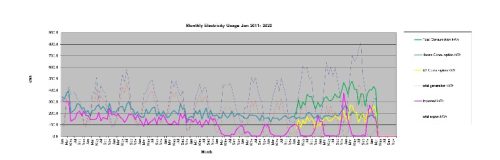
We’ve since installed two additional PV systems, one off-grid to supply the barn and sawmill and the other to extend generation to cover the additional Electric Vehicle (EV) consumption. We worked out that we could put these plug-and-play PV systems together ourselves, we just needed a qualified electrician to ensure system safety and grid connection were all proper and legal. This demonstrated that the market price is a function of ‘conventional’ government subsidy or level of market demand, rather than cost of material and labour.