


Welcome to ACT’s November newsletter keeping you informed of the latest activities our Groups have been working on. Do get in touch if you are tempted to join in with any of our projects!
Featuring:
Spotting Greenwash
ACT Film Night
Carbon Cutters – Championing Carbon Reduction Solutions
Newton Abbot Constituency Climate and Nature Bill Supporters Group Formed to Lobby MP
Food Farming Fisheries and Forestry
New ACT Website
Lower emissions holidays
Wildlife Warden Update
Becoming Pesticide-Free
COP30
Produced by Scott Williams
Spotting Greenwash!
It’s no secret a large majority of people are concerned about our natural environment and what climate change, if unchecked, will do to it. We are motivated to do our bit whenever the opportunity arises.
Sales and marketing are all about understanding what motivates potential customers. It’s great to see so many highlighting the environmental benefits of their product/service, it demonstrates the power we have through our purchasing decisions. Unfortunately, not all are fully transparent with their claims, and not just when it comes to environmental benefits. Luckily, we have consumer protection laws to prevent the least truthful providers, but not all. There will always be loopholes and grey areas to exploit, which is why we need to be a little more questioning of some claims. “There is no such thing as a free lunch” is a good starting thought.
One of the long established and widespread claims is around ‘green’ electricity. Why would we not buy from someone who sells us ‘100% clean’ electricity? Even better when they encourage us to use low tariff electricity overnight because it’s the ‘cleanest’ and cheapest. We run our electricity hungry devices and charge our batteries during these low-cost periods. We feel good that we’ve reduced our emissions, unaware that more likely we have increased our emissions, sometimes by more than double!
Grid electricity can never be Zero emissions, in fact nothing we do or use today can have no greenhouse gas emissions. The better question to ask is how much emission something produces (e.g. a unit of electricity, kWh). It’s called the Carbon Intensity (CI), for electricity it’s measured in weight of emissions per kWh (e.g. the average UK CI of grid electricity in 2024 was ~250 gCO2e / kWh at the plug).
The electricity grid’s CI varies hour by hour, but it’s normally not measured at the sub-station you and I are connected to. It is only measured accurately at major nodes in the network. Electricity Info now provide easy access to regional CI, just enter your postcode. They also reference information on REGO certificates explaining some of the greenwash that still happens. The regional CI is based on NESO’s grid Carbon Intensities data, the ‘official’ source used in the UK.
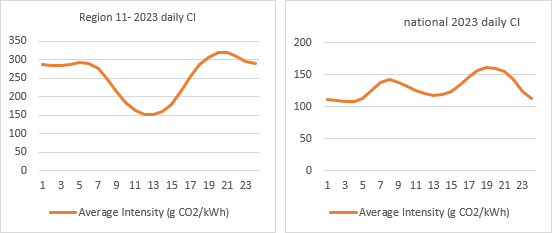
The industry has been using the average CI to make its low emissions claim for overnight electricity. They ignore the data for regional CI, either through ignorance or deliberately. ACT has been highlighting this discrepancy for several years now, but many chose to ignore it.
The charts below highlight the difference between what is used by providers (national) and what is published for the southwest (region-11). The average CI overnight in our region is more than double that of the national average. You should avoid using cheaper electricity overnight, unless you go and check the NESO portal on the day. If you have any questions on any of this, please ask, the energy group loves to be challenged.
Fuad Al-Tawil
Energy group coordinator
ACT Film Night – Climate Scam
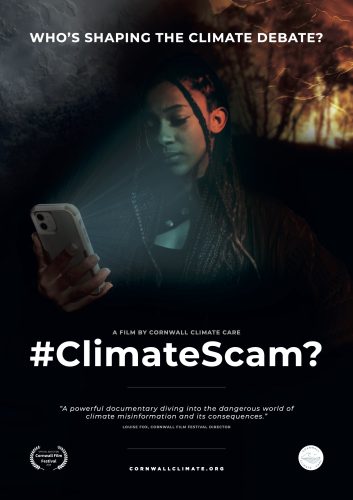
Thank you everyone who came to our showing of the film ‘Climate Scam’ in September. Many of the 55 people who came were subscribers to ACT, but it was also open to anyone who might be interested. The film was made by Cornwall Climate Crisis, and at only 45 minutes long, it managed to pack a lot in, including the effect of climate change on wildlife, the role of the media, the views of ‘disbelievers’, the role of activism, solutions both effective and ineffective, the roles of communities and governments…and more!. Thank you to the Cornwall team, who invited feedback from us all, using a QR code.
The evening began with a social hour, with curries and drinks available. The good attendance made moving around to chat rather difficult, but the food and venue were really great, so thank you to the Alice Cross Centre, Teignmouth, and all the volunteers and staff who helped make the evening a success.
The discussion which followed the film was absolutely what ACT was hoping for; we really wanted to bring people together to share ideas and reaction. We know from scientific studies that communicating about climate change has an impact on our behaviour. As well as helping to manage emotions which can arise with awareness of the crisis, it can also stimulate new ideas about what we can do, as individuals and as a collective, and importantly, show us that we are members of a huge majority of climate concerned people across the world.
A great range of views was shared, and not at all restricted to those about the film’s title. Quite rightly, there was some disagreement but overall a very motivated, constructive and positive atmosphere.
ACT will certainly be reflecting on this event, and hoping to offer other opportunities for us to get together, always focussed on how we can make a difference, with our sights set on a brighter future.
Mandy Cole
ACT Public Engagement Group
Carbon Cutters – Championing Carbon Reduction Solutions
Tackling the climate crisis means acting locally as well as globally. Across the UK, towns and communities are leading the way by trialling new carbon-cutting ideas — from renewable energy projects and community transport schemes to home-grown food networks and tree-planting initiatives.
Here in Teignbridge, we can play our part by supporting innovation, sharing practical solutions, and backing projects that reduce our dependence on fossil fuels. Every step counts — insulating homes, choosing local products, switching to clean energy, or simply cutting waste.
By championing and accelerating carbon-reduction measures, we not only help stabilise our climate but also strengthen our community’s resilience, save money, and improve the places we live in.
The Carbon Cutters Scheme trains folks to turn ambition into action and show that even those from a small village or town can lead in shaping a cleaner, fairer, low-carbon future.
It’s easy to get involved: you decide what level works for you, and we’re happy to provide training tailored to your needs, guide you and give help when you ask for it.
If you’d like to join our Carbon Cutters group email Scott our CC coordinator (scott@actionclimateteignbridge.org)
Scott Williams
ACT CC Coordinator
Newton Abbot Constituency Climate and Nature Bill Supporters Group Formed to Lobby MP
The UK’s legislation on mitigating climate change and protecting nature is out of date. The Climate and Nature (CAN) Bill seeks to update it with the latest science and to compel the UK to meet new legally binding targets. But it needs more support if it is to have a chance of becoming law. So far only 192 of 650 MPs have signed up as supporters.
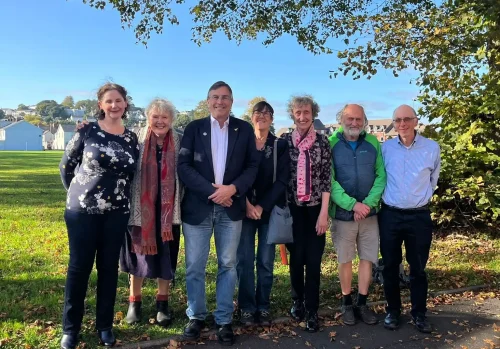
The Zero Hour campaign group that is behind the Bill has encouraged people to lobby their MPs to support it, and convened constituency focused groups to meet with their MPs. One such group has formed in Newton Abbot, with the members representing a number of local organisations, including ACT.
The group met with Newton Abbot MP, Martin Wrigley, in early October. Martin is already a supporter of the CAN Bill so the group asked him to join the Climate and Nature Crisis Caucus of MPs, a cross party group of MPs and peers that launched recently to champion joined-up action on climate and nature. Martin said he would be happy to join.
Following the meeting, the group emailed Martin to request that he also attend the National Emergency Briefing on climate and nature in Parliament on 27th November at which eight of the UK’s leading experts will brief those attending.
The idea behind organising people to press their MPs to support the Bill, join the Caucus and attend the Briefing is to show the government that MPs who do so are representing the wishes of their constituents, and to show MPs that their constituents want action on climate and nature. The Newton Abbot Constituency CAN Bill Supporters Group is keen to raise awareness of the Bill and gain a wider backing for our MP to lobby government ministers about it and ask questions in the House of Commons. The group aims to do this by holding a people’s assembly ahead of the Bill being brought back to Parliament in the spring. A steering group has been formed to organise this.
The CAN Bill has been before Parliament as a Private Members Bill a number of times, the most recent in January 2025 when it was withdrawn following a vote to end the debate on the Bill. These are the key proposals in the Bill:
● Create a joined-up plan—as the crises in climate and nature are deeply intertwined, requiring a plan that considers both together.
● Cut emissions in line with our international 2015 Paris Agreement-aligned Nationally
Determined Contributions (NDCs)—expanded to include international aviation and
shipping.
● Halt and reverse ecosystem decline in nature across the UK by 2030—in line with
the mission of the 2022 Kunming-Montreal Global Biodiversity Framework.
● Take responsibility for Britain’s overseas footprints—both emissions and ecological.
● Prioritise nature in decision-making—and end fossil fuel production and imports as
rapidly as possible.
● Ensure no-one and no community is left behind in the nature-positive just transition
needed—through fairness provisions.
● Involve the public—giving people a say in finding a fair way forward through a
Climate and Nature Assembly.
Update: Martin Wrigley has joined the Climate and Nature Crisis Caucus and accepted the invitation to attend the National Emergency Briefing.
Pauline Wynter
ACT Public Engagement Group PE Co Chair
Food Farming Fisheries and Forestry
The ACT 4F’s Group held an event on the 4th of October on ‘How to support greater local food production.
At the first session Your Health and Your Food
Dr Kim Zhuoxiu Jin from Exeter University spoke about the benefits of a plant-based diet for health. There is a clear trend of lower BMI for people eating plant-based diets. Dietary fibre are broken down by the microorganism in our gut – the gut microbiome, producing short chain fatty acids (SCFA). SCFA play an important role in reducing inflammation, strengthen intestinal barrier, improve insulin sensitivity, thus supporting cardiovascular health. However, many people worry that some essential elements will be missing when eating a mainly plant based diet. Kim highlighted that any diet should be well planned and that some nutrients, such as Vit B12, iron and calcium have to be carefully sourced. The right amino acid profile on a plant based diet is achieved by combining brown rice, soja and beans. There is more production of fava beans and peas in the UK, although production is challenging.
Kim then talked about her research in developing a plant-based protein dense sauce for older adults (ProSauce) in conjunction with Dartmoor Community Kitchen Hub. This is important as older people eat smaller portions and have a greater requirement for protein intake. Kim is still looking for people that are interested in taking part in her research and can be contacted at Z.Jin3@exeter.ac.uk. Kim belongs to the research network on food and diet and they regularly run events and talks Exeter Food | Exeter Food | University of Exeter.
Lori Diggle writer and artist living in Newton talked about her self-devised Red Earth Spirit food equity and art project. She is working with local unique producers of food along the Teign (their origins, community ethos, a recipe, list of local supplier that they use). She makes lino cuts and greetings cards about the venues and revenue goes towards venues and the creation of a new book, a celebration of local food and drink stories along the River Teign. Contact Lori at coolerplanet@me.com for more info.
Why we Need Local Food in our Schools
Fatma Sabet (Devon Food Partnership and University of Exeter) showed a film about school children going to a farm, learning where the food comes form and picking their own ingredients to cook. They then went back to school and devised their own menu, cooking with the ingredients that they sourced at the farm. The children then talked about how this changed their perception and experience around food.
Fatma also runs a social enterprise at Shillingford Organics, creating a cultural shift around peoples learning around food.
Children don’t get to decide choices around the food they eat and a lot of assumptions are made about what they would eat. This is a myth as children love good, fresh, vibrant food! There is a need for a multi-level assessment of school meals, economic value, environmental impact and nutritional value. School caterers work with very small margins and there is a need for more talented chefs in schools.
School food is delivered in different ways –small companies or businesses that have a contract with the school, a model where the school runs its own kitchen with a chef and small team, or its local authorities. We need to have:
1) Local food going into schools
2) Cook from scratch
3) Reduced meat and increase diversity of plant-based food
Fatma gave an example that in some areas in Wales food is procured from local farms and cooked in schools. This is driven by policy. We need ethical leaders willing to deconstruct the status quo. This can start on a microlevel and then it ripples out. Trusts can learn from these models.
Fatma mentioned the Sustainability Conference for Schools coming up in November in Devon. She will be talking there in the afternoon.
How to Support Local Food Production
Andy Johnson talked on behalf of Rebecca Sandover from the Devon Food Partnership
Big supermarkets are responsible for the majority of food retail.
Food is responsible for 25-30% of global GHG emissions and there’s a lot more to it than just the farming aspect. In the UK farms are responsible for 11% of UK emissions. Local food reduces transport and there is less packaging. Organic food standards mean it’s the only food system that delivers on biodiversity.
The Broken Plate Report highlighted that the price of unhealthy food has risen 11% and the price of healthy food 21%. Everyone is paying much less on food, the cost of housing has risen and money being spent on rent/mortgages. How can we reconnect with our food? The Broken Plate 2025 | Food Foundation
The Devon Food Partnership is run by DCC and came out of the Devon Climate Emergency and is composed of DCC, Devon Climate Emergency, food retailers and farmers. It has a “good food strategy”, organise events and launched the ‘Every Bite Counts’ campaign for the public. Please help to promote it.
We need regional approaches to sustainable food change, with shorter supply chains, more of the retail market going directly to farmers and food networks working at a range of scales.
Andy put a tender to take on the running of the indoor market in Newton Abbot. The deadline is November and the market will open in spring. He is hoping that a third of the food will be locally supplied and the money will go back into the local economy.
Martin Braag – Shillingford Organics (Shillingford Organics | Farm Delivery | Exeter)
The soil of the farm is 30% clay and is mainly south facing being ideal to grow vegetables! They would be able to grow more and sell more food to Exeter but its difficult to get more customers.
Farmers got encouraged to produce commodities, therefore the farms got bigger and specialised in producing 1 or 2 crops to the detriment of nature. British farms have to compete with food produced in other countries where the costs are a lot lower (for example the minimum wage is lower in Morocco and Spain). The tenancy of farming has changed, often big companies are growing on an area and then moving, and there is no incentive to look after land/soil for future generations on the farm.
There are some positive changes – the box scheme went up post covid and now dropped back to pre-covid. They go to 5 different markets either weekly or every other week and farmers markets are becoming more popular. If a bigger range of crops is grown it is better to supply farmer markets and its beneficial for the biodiversity of the farm.
Martin highlighted the Local Food Growth Plan that describes what the local, regional authorities can do.
Leonie Flug from Teig Greens (Teign Greens)
Teign Greens is a Community Supported Agriculture (CSA). They try to grow most themselves. They ask people to commit to join for a whole year. This gives security that they are growing for a certain number per year. They encourage people onto the land and have lots of volunteers on a Tuesday and some Saturdays and do open days. Collection points Newton Abbot, Bovey, Chudleigh, Dunsford, Christow, Exeter.
Betina Winkler
ACT Food Farming Fisheries and Forestry
New website
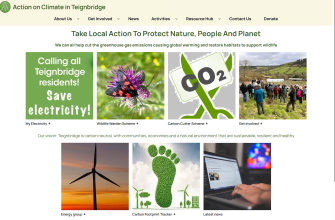
Check out the new look website. It should work much better even on a phone screen.
We’ve had positive feedback on how it looks and navigates, please share yours. Let us know if you spot anything that doesn’t work, we’d really appreciate this.
The News items get a separate menu.
Our working groups can still be found under Activities.
We’ve given Resources and Get Involved a new look including updated Stories and FAQs.
Julian Stringer
ACT Website
Lower emissions holidays
If you prefer to holiday away from Dartmoor and the South Devon coastline, here are some ideas you might like to consider for lower carbon emissions holidays.
Walking is a low carbon intensity mode of transport. We have more than 600 miles of coastal footpath within easy reach by public transport and miles of almost empty moor a short walk from home.
Cycling is also a low carbon intensity form of transport. There are Sustrans routes running right through our village that connect us to the rest of the UK and the Eurovelo network of routes that crisscross Europe. Check out the websites. There is also the option to take the train from Newton Abbot or a ferry from Plymouth (to Roscoff or Santander) to start your ride. I think arriving in Roscoff on a bike and pedalling into town for breakfast is much more fun that arriving by car. Britanny is very electric bike friendly, and the tourist offices provide cycle route maps.
Train is nearly always the lowest carbon intensity mode for moderate to long distance transport. I use “the man in seat 61” web train guide to plan an adventure to anywhere on the European rail network. You can access the network or connect by bus from most ports.
Ferries are a lower carbon intensity form of travel than flying. As well as ferries from Plymouth to Roscoff in France and Santander in Spain, there are ferries from the UK to Ireland, Spain, Holland, other ports in France and from the Scottish Mainland to the islands.
Driving is more efficient for shorter distances than flying, particularly with multiple passengers. Driving gives us access to the UK and all of Europe via the channel tunnel and ferries. You can reach the coast and mountains of Northern Spain, the Pyrenees, much of France, Belgium, Holland and Germany within a one-day drive from a continental port.
If you have an electric car there are good charging systems in each of these countries, often accessible through Chargemap.
Enjoy!
Paul Bloch
ACT Carbon Cutting Team
Wildlife Warden update
The Wildlife Warden’s Gathering at Moor Barton was a great success, with about 50 attendees. We all enjoyed the walk around the 120 acre site – especially going inside the 7 acre (14 ordinary football pitches) beaver enclosure, where the beavers had made amazing, and pretty enormous, dams; these have transformed the valley from having a 1 metre wide stream, into a series of ponds full of wildlife, with more mosses and ferns and an enormous water storage capacity. All of this fights flooding and the effect of droughts, as well as helping our wildlife. The Moor Barton team have also created lots of different woodland habitats which were supporting loads of fungi and wildflowers.
Vicky and I had another enjoyable conversation with the Idverde gang, who look after Teignbridge’s open spaces. We discussed ways that they could create mini-habitats by recognising their potential and then simply NOT cutting them; it was really good to give them ownership of the sites they care for and let them use their intelligence to make them better. Best of all, Mark, the Green Spaces manager, had given his permission for them to do this and came along to the meeting to support it. At the end he asked if we could all discuss the use of pesticides at our next meeting in November!
Vicky and I were on a TEAMS meeting with Green Spaces on the 21st Oct to discussing pesticides and other shared topics.
Vicky, Shira and I had a TEAMS planning meeting, to put on paper some ideas for the Teignbridge Pesticides Campaign. We want to work with Andrew Rotherey on a lot of different aspects and will TEAMS meet with him on Friday.
Natural England’s grassland specialist, Sean Cooch, came to Deer Park Farm on the 7th Nov for an all-day Waxcap Walk (on a rather higher level than my usual ones!). We are doing this in partnership with Moor Meadows.
Vicky is planning a programme of about 5 TEAMS meetings, each of which will cover a different topic. These will keep us all happy during the winter months!
Thank you Vicky!!!!!
Audrey Compton
ACT Wildlife Wardens
Why move to pesticide free?
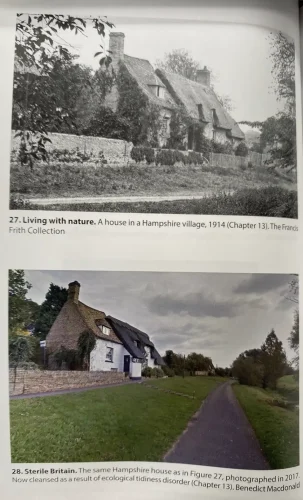
Taken from Rebirding by Bendict Macdonald
Summary of Information for Local Authorities on Becoming Pesticide-Free
- Pesticides (insecticides, herbicides, fungicides) are a key contributor to biodiversity decline. LAs have a responsibility to contribute to the national target to reverse this decline.
- Pesticides damage soil and water health with effects on both humans and wildlife. There is accumulating evidence that glyphosate is carcinogenic. It is the primary chemical used by Local Authorities and they have a duty to reduce the risk of employees and residents being exposed to harmful chemicals. It is understood that children, pregnant women, and older adults are especially vulnerable to environmental toxins. Many areas managed by Local Authorities include parks and play areas frequented by children.
- Whilst the untidiness of nature was accepted by previous generations, in recent decades people’s expectations have been shaped by the ready use of pesticides, with public areas mown and tidy. Public education could help people to see this ‘messiness’ as habitat that supports the creatures that they love, such as birds, butterflies, bees and dragonflies. These photos show the same house and village street a century apart, demonstrating the contrast between the pre and post pesticide environment.
- The urban/suburban landscape can provide a vital network of corridors for invertebrates and other animals, and use of pesticides severely impacts the richness of these habitats. Phasing out the use of chemicals would provide important benefits for nature.
Where to begin:
Audit – Carry out an audit on where pesticide is currently used.
Review – Determine if there are areas/actions that are unnecessary. Stopping these will be a cost saving.
Consider alternative management/planting – Where can spraying be reduced in frequency or moved to spot treatment? Can planting of beds be more naturalised/ use more native plants and perennials rather than bedding plants (this would reduce weed issues as there is less disturbed and exposed soil)?
Involve communities – Make the public aware of how a change to less or no pesticide use benefits biodiversity, water quality and human health (and particularly children). Set up regular weeding parties in parks and public areas. Provide Health and Safety support for residents who wish to take responsibility for their own streets. One estate in Lewes, Sussex, decided to go glyphosate free and to weed pavements themselves.
Review with contractors – Discuss with them the use of non-chemical methods and request that they invest in the appropriate machinery. Alternative methods include: Hot water; Steam; Foamstream; Infra-red flame burner; Thermoelectric weed treatment.
Share resources – If the council is buying its own machinery, the initial outlay for non-chemical methods can make them appear more expensive. However the ongoing costs can be lower than chemicals and safer for the people using them. They can also be shared with neighbouring councils. Renting out to other councils is easier as these methods can be used in any weather, unlike chemicals which cannot be used in the rain or when rain is due.
Invasive species – Increasingly non-chemical control is being explored to eradicate Japanese knotweed (JKW) and Giant hogweed, including heat methods and mesh (which cuts off energy from the tubers as the stems grow). Conventional methods, including chemical treatment, require repeated application and patience. The Wales Wildlife Trust are trialling a new biological control method for JKN called Roots Reset, developed by a company called Soilwise. The method involves removing the above ground parts of the JKW, spreading CleaRoot, a plant based product, mixing it into the soil, covering with a barrier to exclude oxygen, and then allowing the microbes already in the soil and enriched by the CleaRoot to consume the roots of the JKW. This process takes 6-12 months.
Mowing – Is mowing happening more frequently than necessary? Can areas of mown grass become wildflower areas with paths mown through and the whole area cut once or twice a year? This will save money.
Communication – The success of change requires good publicity and communication with the public so that they understand the goal and the benefits to them and their environment.
Councils that have gone pesticide free: Locally Newton Abbot made a formal commitment to be pesticide free in 2023. In 2015 Glastonbury was the first council to be pesticide free. There are about 50 other councils that have also taken this step and many others who have pledged to phase out use of pesticides.
The European experience – The Europeans are far ahead of the UK in moving towards being pesticide free, some areas beginning as far back as the 1980s (Belgium) and the 1990s (Denmark). Effective programmes have been characterised by a combination of public awareness campaigns and a gradual phase-out. Resistance has tended to come from the pesticide manufacturers rather than the general public. Significant progress has been made over the years but there is variance between municipalities in individual countries and derogations continue to be permitted. However since 2023 Germany has prohibited the use of glyphosate in public areas and in private gardens and France implemented a broader pesticide ban on use by public authorities, with exceptions for some specific areas, and in private gardens, across the country in 2022 (including in forests).
Proposed Bill – Sian Berry (MP) has proposed a Private Member’s Bill to prohibit the use by Local Authorities of professional plant protection products on amenity land under their control. The Bill is has cross-party support and is due to receive its second reading in on 12 December 2025.
Online sources: Pesticide Action Network; Wales Wildlife Trust; Lewes Climate Hub;
Books: Vicki Hird Re-bugging the Planet; Benedict Macdonald Re-Birding;
Shira Rüb
Action on Climate Teignbridge, Volunteer Wildlife Warden
COP30

This year’s United Nations climate summit, COP30, is held next week in Belem, at the edge of the Amazon – a fitting yet fragile setting for marking ten years since the Paris Agreement. Unlike previous summits, this one has no single headline theme, but the pressing issues remain all too familiar.
Global emissions are still not falling fast enough to meet the targets agreed in Paris, and despite promises of ambition, many nations missed the February deadline to submit their updated 2035 climate plans. By early November, around sixty-five countries had responded, but few have inspired confidence. China’s plan has disappointed observers, the European Union remains divided, and India is yet to confirm its targets. Brazil, hosting the talks, now faces the difficult task of steering discussions toward a stronger collective effort.
Money will again dominate the debate. Wealthier nations had pledged $300 billion a year by 2035 to help developing countries adapt to a low-carbon future, alongside hopes of raising a further $1.3 trillion from public and private sources. Yet much of this remains vague, and poorer nations are calling for firmer commitments and clearer pathways for adaptation funding—especially to protect vulnerable communities from rising seas and extreme weather.
Finally, forests will take centre stage. Brazil plans to launch the “Tropical Forests Forever Facility,” a fund rewarding countries for keeping trees standing rather than cutting them down. It could become a milestone in forest protection, though campaigners warn that real progress will only come when deforestation truly stops.
Leave a Reply