
Our air-source heat pump (HP) was installed in 2011, when our near PassivHause home was built. Over the years I have evolved a heating schedule to meet our needs and be efficient. The main means of control has been via thermostats, and hot water controlled via a simple timer. I knew that with very little data to monitor, I may not be achieving the best efficiency. i.e. coefficient of performance (COP).
It was becoming obvious that newer installations have a lot more information available to control/tune the system. Towards the end of 2024 we had our system serviced. I discussed fitting a heat meter with our installer, and concluded that for not much more cost the control unit could be completely replaced. This would give much more information about the system and therefore allow for much more control and tuning.
As a software developer, I have over the years developed my own home automation system and wanted to integrate the HP control with that, rather than using a separate cloud based phone app.
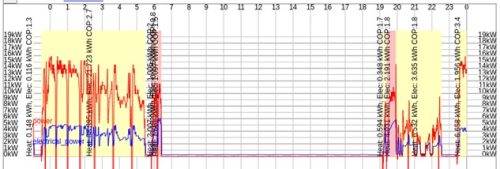
I now have daily graphics to see how the HP is performing, this has included electricity consumption since the early January. The red line shows the metered heat output and the blue the metered electricity input.
What have I discovered so far?
- Controlling the HP using room thermostats leads to cycling, which reduces heat output and still uses a similar amount of electricity (lower efficiency).
- Heating difficult to heat rooms outside the main schedule is pointless, unless there is a need to heat these.
- The most efficient heating periods are long and unbroken.
- As a bonus, the HP also gives enough data to calculate heat loss rate and degree days.

What makes an efficient heating schedule?
- Here the daily heating cycle ran continuously between 23:30 and 05:30 (set to take advantage of the lower electricity tariff).
- At an external ambient temperature between 6 and 8 OC, and flow temperature between 32.5C and 36C, the COP was about 4. Over 41kWh of heat energy was produced from just over 10kWh of electricity.
- Hot water heating follows on directly from other heating so there is no initial temperature drop and a reasonable COP of 2.5 is achieved.
- As the flow temperature gets towards 40C the heat pump heats too aggressively, resulting in cycling, as shown in the next example.
What makes a less efficient heating schedule?
- Here the HP ran continuously overnight and again in the evening to maintain internal temperatures. The later heating cycle was triggered by unused colder areas dropping below their room thermostat settings, these result in much worse HP performance.
- At an external ambient temperature between 0 an ~5 OC. The flow temperature was higher, between 38.5 and 40.5 OC. The COP was about 2.6 based on 58kWh of heat energy generated from 22kWh of electricity.
- It appears that when the flow temperature gets close to the upper set point it causes the HP to shut down for a short period before starting again. Possibly an inappropriate ‘hunting’ or ‘cycling’ occurs due to the ‘hysteresis’ setting, see diagram below.
- The same hunting/cycling of the HP was observed on the 5th December before electricity consumption readings were available. This was at an external ambient temperature of 12 OC and a flow temperature of 29OC, about 27kWh of heat energy was produced. See diagram below.

What’s Next?
I am now in a position to tune the system to perform better. I want to get better electricity readings using an in-line meter rather than CT-clamps. I also want to use weather forecasts with heat loss data from the heat pump to calculate target flow temperature and optimal length of heating period.
For further information Upgrading to FTC6